Most people spend their days reacting to what's urgent. They handle the crisis, respond to the notification, attend the unplanned meeting, and at the end of the day wonder why the work that actually matters never got done. The Eisenhower Matrix doesn't just help you manage time — it exposes the fundamental confusion between urgency and importance that keeps most people perpetually busy and perpetually behind on what actually counts.
Eisenhower's Insight: The Urgent-Important Distinction
Dwight D. Eisenhower served as Supreme Commander of Allied Forces in Europe during World War II, overseeing the most complex military operation in history, and then as the 34th President of the United States for two terms. He was, by any measure, one of the most effective executives of the 20th century — and his approach to decision-making reflected a discipline about time and attention that most people in far less demanding roles never develop.
The principle attributed to Eisenhower is captured in a single sentence, reportedly from a 1954 speech: "I have two kinds of problems: the urgent and the important. The urgent are not important, and the important are never urgent."
Eisenhower's Observation
"What is important is seldom urgent and what is urgent is seldom important."
This observation cuts against the most common intuition about prioritization: that what demands immediate attention is what deserves attention. Eisenhower's experience at the highest levels of military and political leadership taught him the opposite — that the things screaming for attention are often not the things that actually determine outcomes, while the things that genuinely determine outcomes rarely create immediate pressure to act on them.
The 2x2 matrix that systematizes this insight — crossing urgency with importance to create four quadrants — was not developed by Eisenhower himself but by Stephen Covey, who introduced it in The 7 Habits of Highly Effective People (1989) and attributed the underlying principle to Eisenhower. The matrix has since become one of the most widely used productivity frameworks in the world, with good reason: it diagnoses the most common time allocation failure with unusual clarity.
The Four Quadrants Explained
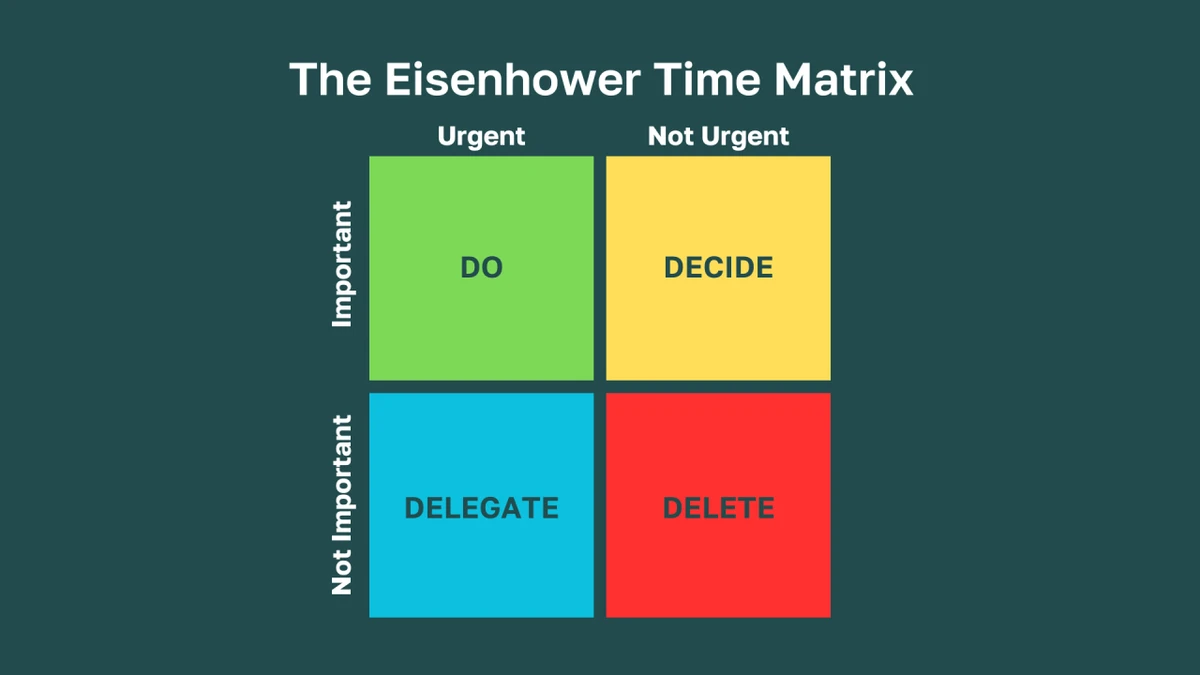
The matrix divides all tasks and activities into four categories based on two dimensions: urgency (does this require immediate attention?) and importance (does this contribute to your most significant goals and values?).
Quadrant 1: Urgent + Important — DO
What belongs here: Genuine crises, critical deadlines, medical emergencies, system failures, urgent client problems that will cause serious damage if unaddressed.
The right response: Do it immediately and personally. These are the fires that actually need fighting.
The goal: Minimize time here. Most Q1 crises are the downstream consequences of neglecting Q2 work. A well-maintained Q2 practice reduces Q1 volume over time.
Quadrant 2: Not Urgent + Important — SCHEDULE
What belongs here: Strategic planning, skill development, relationship building, exercise and health, creative work, proactive process improvement, learning.
The right response: Schedule dedicated, protected time. These are the activities that produce the highest long-term returns but create no immediate pressure.
The goal: Maximize time here. This is where results are built. Neglecting Q2 is the primary cause of both Q1 crises and long-term underperformance.
Quadrant 3: Urgent + Not Important — DELEGATE
What belongs here: Interruptions that feel important but aren't, most meetings, many emails, requests from others for things only marginally related to your core work, urgent tasks that don't actually serve your key goals.
The right response: Delegate to someone else if possible, or decline. These activities hijack your time with urgency while producing minimal value for your actual priorities.
The goal: Minimize time here. The urgency creates the illusion of importance — don't be fooled by it.
Quadrant 4: Not Urgent + Not Important — ELIMINATE
What belongs here: Mindless scrolling, gossip, trivial entertainment, excessive social media consumption, activities you engage in from habit or avoidance rather than genuine value.
The right response: Eliminate or strictly limit. These activities consume time without producing value — they are the most direct competitors for the time that should go to Q2.
The goal: Approach zero. This is the waste category — every hour here is an hour not available for what actually matters.
The matrix's diagnostic power comes from forcing honest categorization. Most people, when asked to categorize their typical work week, discover that far more time goes to Q1 and Q3 than they realized, Q2 is consistently squeezed, and Q4 — while genuinely minimal in most professional contexts — still absorbs meaningful time that could go elsewhere. The act of categorization itself changes behavior by making the allocation visible.
Why Quadrant 2 Is Where Results Are Made
The central insight of the Eisenhower Matrix is not the existence of four quadrants — it is the observation that Q2 is both the most important category and the most systematically neglected one. Understanding why requires understanding the specific dynamics that keep Q2 perpetually underfunded.
Q2 activities share a characteristic that makes them uniquely vulnerable to being crowded out: they produce no immediate pressure and offer no immediate reward. Strategic planning doesn't send you notifications reminding you to do it. Relationship building doesn't create deadlines. Skill development doesn't produce anxiety when neglected today — only regret when the accumulated neglect becomes visible months or years later.
The Q2 Paradox
The activities that produce the highest long-term returns are precisely the ones that produce the lowest short-term pressure. Exercise will transform your health over years; skipping it today produces no immediate consequence. Deep relationships compound over decades; not investing in them today produces no alarm. Strategic thinking shapes your trajectory over years; avoiding it today costs you nothing you can measure.
This is why Q2 is perpetually neglected — not from bad values or poor intentions, but from the structural advantage that urgency has over importance in capturing attention. As explored in the compounding mental model, the activities with the highest long-term returns are almost always the ones with the most delayed and invisible payoffs — which makes them structurally disadvantaged in competition for daily attention against urgent demands.
What Happens When Q2 Is Neglected
The neglect of Q2 has a predictable consequence: Q1 grows. Most genuine crises are the downstream results of Q2 work that wasn't done. The client crisis is the result of relationship maintenance that didn't happen. The system failure is the result of process improvement that was perpetually deferred. The health crisis is the result of exercise and preventive care that was always too low-urgency to prioritize.
People who live primarily in Q1 — perpetually fighting fires — are often not unlucky. They are often people whose neglect of Q2 has created the conditions for chronic Q1 volume. The crisis management that feels like heroic effort is often the consequence of insufficient investment in the prevention work that would have made the crises unnecessary.
Q2 Investment Produces Q1 Reduction
One of the most practically important implications of the matrix: investing in Q2 reduces Q1 volume over time. This creates a virtuous cycle when it works — more Q2 investment leads to fewer crises, which frees more time for Q2, which leads to fewer crises still. The challenge is getting the cycle started when you're currently overwhelmed with Q1, because Q1 crowds out the Q2 investment that would eventually reduce Q1.
This is why the most effective organizations and individuals are often the ones who seem to have the most time — not because they work less, but because their prior Q2 investment has systematically reduced the crisis volume that consumes most people's available time. The appearance of having slack is the dividend of sustained Q2 investment.
The Urgency Trap: Why We Live in Quadrant 1
Understanding why urgency so reliably defeats importance in competition for attention requires engaging with the cognitive mechanisms that make urgent stimuli so compelling.
The Neurological Pull of Urgency
Urgent demands activate the brain's threat-detection systems — the same systems that evolved to respond to predators and physical dangers. Urgency signals "this requires action now or negative consequences will follow," which is precisely the signal that triggers priority attention. Importance, by contrast, signals "this matters to your long-term outcomes" — a much weaker attentional trigger in evolutionary terms.
The result is that urgent stimuli hijack attention even when the important work would produce far greater value. The ringing phone interrupts deep creative work not because it represents higher value but because urgency is biologically compelling in a way that importance is not. As explored in the neuroscience of dopamine and digital distraction, this attentional hijacking is actively exploited by digital platforms — notifications are designed to create the urgency signal that commands attention regardless of actual importance.
Social Urgency and the Responsiveness Norm
Modern professional culture has created a powerful social norm around urgency: being responsive, being available, answering quickly. This norm has made Q3 — urgent but not important — more pervasive than it has ever been, because every message, email, and notification carries implicit social pressure to respond promptly regardless of whether the response requires your specific attention or could be handled differently.
The matrix makes the cost of this norm visible: time spent responding to Q3 urgency is time not available for Q2 importance. Being excellent at Q3 — maximally responsive, always available, never dropping a ball — is perfectly compatible with being poor at Q2 and therefore poor at the activities that actually determine long-term outcomes.
The Urgency Audit
For one week, before responding to any interruption, categorize it: Is this actually urgent? Is it actually important? What quadrant does this belong in? The audit typically reveals that the overwhelming majority of interruptions that feel urgent are Q3 — urgent but not genuinely important to your core goals. The categorization doesn't eliminate the social pressure to respond, but it creates cognitive distance from the urgency signal and allows deliberate rather than automatic response.
How to Apply the Matrix Daily
The matrix is most valuable not as an occasional review tool but as a daily operating framework that shapes how you allocate attention before urgency has a chance to commandeer it.
Action Steps
- Capture everything first. Before categorizing, do a full brain dump of everything on your plate — tasks, projects, commitments, ideas. The categorization is only as good as the completeness of the list. Uncaptured items default to urgency-driven attention, which means they'll be handled when they become crises rather than when they're most efficiently addressed.
- Categorize by honest importance assessment. For each item, ask: does this contribute meaningfully to my most significant goals? Not "does this feel important?" but "does this actually move the needle on what I care most about?" The distinction matters — many things feel important because they're urgent or because they represent social pressure, not because they genuinely contribute to your priorities.
- Schedule Q2 first, before anything else. Protect specific time blocks for your most important non-urgent work before allocating time to urgent demands. If Q2 doesn't get scheduled time before the day fills up with urgency, it will not get done. Calendar blocking — putting Q2 work in the calendar as a non-negotiable appointment — is the most reliable mechanism for ensuring Q2 actually happens.
- Batch Q3 and Q1 responses. Rather than responding to Q3 interruptions as they arrive, batch them into designated response windows. Most email, messages, and requests that feel urgent can wait 2-4 hours without genuine consequence. Batching creates protected time for Q2 while still addressing Q3 responsibly.
- Review and eliminate Q4 ruthlessly. Periodically audit your time for Q4 activities. These typically accumulate gradually — a few minutes here, a few there — until they represent a meaningful fraction of available time. Q4 is the easiest category to reduce without sacrifice, since by definition it produces neither urgency-driven results nor important-outcome-driven results.
The Weekly Q2 Planning Session
The most powerful application of the matrix is a weekly planning session dedicated to identifying the Q2 work that most needs to happen in the coming week and blocking protected time for it. This session — 30 to 60 minutes, ideally on Friday afternoon or Sunday evening — converts the matrix from a reactive categorization tool into a proactive planning framework.
The session asks: what are the two or three most important non-urgent things I could do this week that would have the greatest long-term impact? Then it books those activities as protected calendar time before the week fills with reactive demands. This practice is the operationalization of Covey's "first things first" — putting Q2 in the calendar before Q1 and Q3 can crowd it out.
The Art of Effective Delegation (Quadrant 3)
Q3 — urgent but not important — is the category most people handle worst. The urgency creates the compulsion to respond personally and immediately, while the lack of genuine importance means the response rarely requires your specific skills, judgment, or attention. This mismatch is where delegation becomes critical.
Effective delegation of Q3 requires clarity about what actually requires your specific involvement and what merely feels like it requires your involvement because the urgency is directed at you. Many Q3 items that feel personal — requests that come to you specifically — can be handled by someone else without meaningful loss of quality. The question is whether you have the systems and relationships in place to redirect them efficiently.
What Can Be Delegated
Anything that doesn't require your specific judgment, your specific relationships, or your specific expertise is a candidate for delegation. The fact that something is addressed to you personally doesn't mean it requires your personal response. The fact that you could handle it better than someone else doesn't mean you should — the opportunity cost of your time spent on Q3 is the Q2 work you're not doing.
Building Delegation Infrastructure
Effective Q3 delegation requires upfront investment in building the systems and relationships that make redirection possible: clear documentation of recurring Q3 tasks, trained team members who can handle standard requests, communication channels that allow appropriate redirection without dropping items, and explicit agreements about what types of requests can be handled independently versus escalated.
The investment required to build this infrastructure is itself Q2 work — important but not urgent. This is why many people remain trapped in Q3: they know they should delegate more, but building the delegation infrastructure requires Q2 investment that never happens because Q3 keeps crowding it out.
Elimination Without Guilt (Quadrant 4)
Q4 — not urgent and not important — seems like the easiest category to address: just stop doing those things. In practice, Q4 elimination is often surprisingly difficult because Q4 activities are typically serving emotional or psychological functions, even when they produce no practical value.
Social media scrolling is Q4 for most people's professional goals — but it provides dopamine hits, social connection proxies, and escape from the difficulty of Q2 work. Gossip is Q4 — but it provides social bonding and the pleasures of narrative. Trivial entertainment is Q4 — but it provides recovery from cognitive depletion.
Eliminating Q4 without addressing the underlying functions it serves typically fails. The person who swears off social media cold turkey usually relapses, because the social connection need doesn't disappear with the app. The effective approach is to replace Q4 activities with activities that serve the same underlying functions more efficiently or more healthily.
The Q4 Replacement Strategy
For each Q4 activity you want to eliminate, identify what psychological or social function it's serving, then find a replacement that serves the same function with less time cost or greater intrinsic value.
Social media → genuine social connection (phone calls, in-person time) that serves the connection need more directly. Gossip → meaningful conversation about ideas and experiences. Trivial entertainment → quality entertainment that you'd actually recommend to others, consumed intentionally rather than reflexively.
The goal is not asceticism — it's replacing Q4's low-value versions of genuine needs with higher-value versions of the same needs. This works where pure willpower-based elimination typically doesn't.
Stephen Covey and the Time Management Matrix
Stephen Covey's treatment of the matrix in The 7 Habits of Highly Effective People added several dimensions to Eisenhower's original insight. Covey situated the matrix within a broader framework of personal effectiveness and identified specific patterns of time allocation associated with different effectiveness levels.
Covey's analysis of where different people spend their time showed a consistent pattern: effective people spend most of their time in Q2, with minimal time in Q1 (because Q2 work has reduced crises) and almost none in Q3 or Q4. Ineffective people spend most of their time in Q1 and Q3, with little time in Q2 and varying amounts in Q4.
Covey's Time Allocation Profiles
Effective leaders: ~65% Q2, ~25% Q1, ~10% Q3/Q4. High Q2 investment has reduced Q1 volume and created the space for sustained strategic work.
Crisis managers: ~50% Q1, ~30% Q3, ~15% Q2, ~5% Q4. Perpetually reactive, minimal strategic work, chronic stress, always behind on important priorities.
People pleasers: ~10% Q1, ~60% Q3, ~15% Q2, ~15% Q4. Highly responsive but not strategically focused — very busy, minimal impact on core goals.
Disengaged: ~10% Q1, ~15% Q3, ~5% Q2, ~70% Q4. Withdrawn from demands, significant escapism, neither productive nor strategically invested.
Covey's central prescription — "first things first," the title of his companion book — is the instruction to allocate time to Q2 before allocating it to anything else. This requires proactive scheduling of Q2 work, and it requires the discipline to protect that schedule from Q3 urgency. The matrix provides the categorization; first things first provides the allocation rule.
Common Mistakes and How to Avoid Them
Mistake 1: Mislabeling Q3 as Q1
The most common categorization error: treating urgent requests from others as personally important simply because they're directed at you and feel time-sensitive. Most urgency is socially constructed — the sender thinks it's urgent, which creates pressure, but the urgency doesn't reflect genuine importance to your goals.
Fix: For every urgent demand, ask independently: "If I don't respond to this today, what are the actual consequences?" In most cases, the consequences are minor social friction — not genuine harm.
Mistake 2: Treating All Q1 as Avoidable
Some people, after learning about the matrix, conclude that all Q1 work reflects poor planning and try to eliminate it entirely. But some Q1 situations are genuinely unpredictable — a team member's sudden illness, an unexpected client emergency, an external event requiring immediate response.
Fix: Distinguish recurring Q1 (which often reflects neglected Q2 prevention) from genuinely unpredictable Q1 (which requires responsive capacity). Build slack into schedules to handle unpredictable Q1 without letting it crowd out Q2.
Mistake 3: Categorizing by Feeling Rather Than Analysis
Many people categorize tasks by how they feel rather than by honest analysis of importance and urgency. Important-sounding tasks get labeled Q1 or Q2 based on their emotional weight rather than their actual contribution to goals. Uncomfortable tasks get mislabeled as Q4 (trivial, avoid) when they're actually Q2 (important, do).
Fix: For every item, test importance against your actual goals explicitly: "Does completing this contribute meaningfully to my top three priorities?" If yes, it's important. If no, it isn't — regardless of how it feels.
Mistake 4: Using the Matrix as a One-Time Exercise
The matrix is most commonly introduced as a one-time categorization exercise — sort your task list once, feel organized, and then revert to reactive habits. The exercise produces minimal lasting benefit without ongoing practice.
Fix: Build the matrix into regular routines — daily task categorization and weekly planning sessions. The matrix's value is cumulative: it builds the habit of distinguishing urgency from importance until the distinction becomes automatic.
The Matrix and Delegation Culture
For managers and leaders, the matrix has a cultural dimension beyond personal time management: it shapes how you direct your team's attention and how you structure organizational responses to demands. A team whose leader consistently demonstrates the urgent-important distinction — who visibly protects Q2 work and doesn't reward Q3 heroics — develops a different collective relationship with urgency than one whose leader rewards responsiveness above all else.
The Eisenhower Matrix applied organizationally: periodically review where your team's aggregate time is going and whether that allocation reflects genuine priorities or accumulated urgency-driven habits. The team that is perpetually busy but rarely makes progress on strategic objectives is almost certainly spending too much collective time in Q1 and Q3 and too little in Q2. The diagnosis is the matrix; the fix is cultural permission and structural support to invest in Q2 collectively, not just individually.
The Integration
The Eisenhower Matrix works best as part of an integrated productivity system rather than as a standalone tool. Combined with the 80/20 principle — which identifies which Q2 activities have the highest leverage — it becomes a tool for not just protecting time for important work but for ensuring that important time goes to the most impactful subset of important work. Combined with habit formation science — which provides the mechanisms for making Q2 investment automatic rather than effortful — it becomes the foundation for a sustainable high-performance practice rather than a temporary fix. And combined with opportunity cost awareness — which makes the true cost of Q3 and Q4 time visible — it converts the abstract value of Q2 into the concrete terms that motivate sustained prioritization.