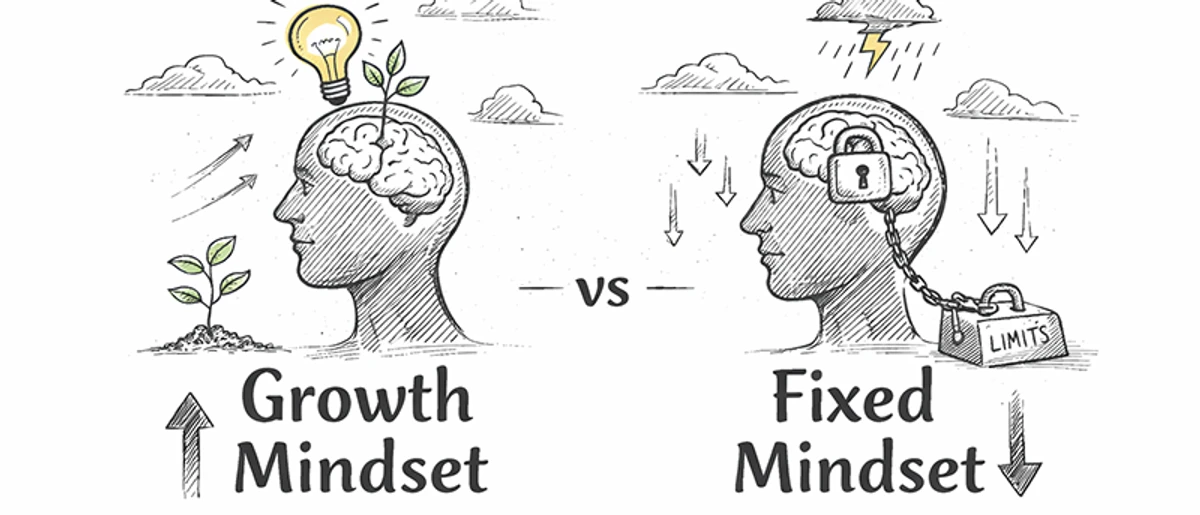
In 1988, Stanford psychologist Carol Dweck identified something that would reshape how we understand achievement: it's not talent, intelligence, or even effort that most reliably predicts success — it's what people believe about talent and intelligence. Those beliefs, which she called mindsets, determine whether challenges are approached or avoided, whether setbacks produce learning or retreat, and whether effort feels meaningful or pointless. Understanding the difference between a growth mindset and a fixed mindset is, for many people, the entry point to a fundamentally different relationship with their own potential.
What Is Mindset? Dweck's Core Finding
Carol Dweck's research began with a simple observation: children responded to failure differently. Some became energized by challenges and used failure as information. Others became defensive, avoided difficulty, and interpreted failure as evidence of permanent inadequacy. Dweck traced these different responses back to a single variable — what children believed about the nature of their own abilities.
She identified two implicit theories that people hold about intelligence and ability. A fixed mindset is the belief that qualities like intelligence, talent, and personality are fixed traits — you either have them or you don't, and effort can't change that. A growth mindset is the belief that these qualities can be developed through dedication, effort, and learning. These aren't just philosophical positions; they produce measurably different behaviors, responses to challenge, and long-term outcomes.
The Original Experiment
Dweck gave students a series of puzzles, starting easy and progressively getting harder. After a point, all students began to fail. The fixed mindset students became distressed, lost confidence, and started performing worse even on problems they had solved correctly before. The growth mindset students stayed engaged, tried new strategies, and some actually improved their performance as the problems got harder. Same difficulty level — completely different responses, driven entirely by their beliefs about what failure meant.
The Fixed Mindset: Characteristics and Costs
A fixed mindset does not mean being pessimistic or having low self-esteem. Many fixed mindset individuals have very high self-esteem — they simply believe their capabilities are fixed quantities that need to be proven rather than developed. This creates a specific and predictable set of behaviors that feel rational from the inside but produce poor outcomes over time.
The Core Behaviors of a Fixed Mindset
Fixed mindset individuals tend to avoid challenges where failure is possible, because failure would constitute evidence of low ability. They give up more quickly when obstacles arise, because effort feels pointless if ability is fixed. They ignore or dismiss negative feedback, because it feels like an attack on their identity rather than useful information. They feel threatened by the success of others, interpreting it as evidence that they are comparatively inadequate. And they tend to plateau early — reaching a level of competence and then stopping, because further challenge risks exposing limitations.
Fixed Mindset Thought Patterns
"I'm either good at this or I'm not."
"If I have to work hard at it, I must not have natural talent."
"Failing means I'm a failure."
"I shouldn't try if I might not succeed."
"Their success means I'm falling behind."
Fixed Mindset Behaviors
Sticking to tasks where success is guaranteed.
Giving up quickly when things get difficult.
Hiding mistakes instead of learning from them.
Feeling defensive when receiving criticism.
Comparing to others to assess self-worth.
The Hidden Cost: Stagnation
The most significant cost of a fixed mindset is not immediate failure — it's long-term stagnation. Fixed mindset individuals often perform well in familiar, low-challenge environments where their existing abilities are sufficient. The cost emerges when conditions change, when higher performance is required, or when genuine mastery requires sustained effort through difficulty. In those moments, the fixed mindset produces avoidance, underperformance, and a widening gap between potential and achievement that compounds over years.
The Growth Mindset: Characteristics and Benefits
A growth mindset is not the belief that anyone can become anything with enough effort, or that all people are equally capable. It is the more specific belief that abilities can be developed — that the brain is plastic, that skills are built through practice, and that current performance does not determine future potential. This belief changes the entire relationship with challenge, effort, and failure.
The Core Behaviors of a Growth Mindset
Growth mindset individuals embrace challenges, because difficulty is the condition under which development occurs. They persist through obstacles, because effort is the mechanism of improvement rather than evidence of inadequacy. They learn from criticism, because feedback is information about how to improve rather than a verdict on their worth. They find lessons in the success of others, treating high achievers as models to learn from rather than threats to their status. And they tend to continue improving over time — because sustained engagement with challenge is the engine of skill development.
Growth Mindset Thought Patterns
"I can't do this yet — but I can learn."
"Effort is what builds ability."
"Failure is information, not identity."
"Challenges are where growth happens."
"Their success shows me what's possible."
Growth Mindset Behaviors
Seeking out challenges at the edge of current ability.
Persisting through difficulty with strategy changes.
Analyzing mistakes to extract lessons.
Welcoming feedback as useful data.
Measuring progress against past self, not others.
The Science Behind the Theory
Dweck's original research has been replicated hundreds of times across cultures, age groups, and domains. The core finding — that mindset beliefs influence challenge-seeking, persistence, and performance — is robust. Brain imaging studies have added a neurological dimension: individuals with growth mindsets show greater neural activity when processing errors, and this error-processing engagement predicts subsequent performance improvements. The brain, it turns out, literally responds differently to failure depending on what the person believes failure means.
The neuroscience of neuroplasticity provides the biological basis for growth mindset. The brain physically changes in response to learning and experience — forming new synaptic connections, strengthening frequently used pathways, and pruning unused ones. This is not metaphor; it is measurable structural change. A growth mindset is, in a precise sense, neurologically accurate: abilities genuinely can be developed, because the brain that underlies them is genuinely capable of change. For a deeper look at the neuroscience, our article on how extreme focus rewires the brain explores the mechanisms in detail.
Replication and Nuance
Large-scale replications of mindset interventions — particularly in educational settings — have produced more mixed results than Dweck's original studies. Effect sizes vary significantly by context, baseline mindset level, and quality of implementation. The takeaway from the replication literature is not that mindset doesn't matter, but that mindset interventions are not magic bullets: they work best when the environment also supports growth (teachers believe in development, failure is tolerated, effort is genuinely rewarded), and when they address actual fixed-mindset thinking rather than just teaching people to say growth-mindset phrases.
Mindset in Education and Learning
The educational context is where mindset research began and where its effects are most extensively documented. Students with growth mindsets consistently outperform students with fixed mindsets when controlling for initial ability — and the gap widens over time, because growth mindset students engage more deeply with difficult material, seek help when stuck rather than hiding confusion, and recover faster from poor performance.
Praise and Its Effects
One of Dweck's most counterintuitive and practically significant findings concerns praise. In a series of experiments, students who were praised for intelligence ("You must be smart") showed fixed mindset responses in subsequent tasks: they chose easier problems to protect their reputation, gave up more quickly on difficult tasks, and performed worse after setbacks. Students praised for effort and strategy ("You must have worked hard") showed growth mindset responses: they chose harder problems, persisted longer, and improved their performance after setbacks.
The practical implication extends beyond parenting and teaching. How you praise yourself matters. Internal praise for results ("I'm smart for getting this right") reinforces fixed mindset thinking. Internal acknowledgment of process ("I figured that out because I worked through it systematically") reinforces growth mindset thinking. The habits and discipline that produce achievement deserve more credit than the achievement itself.
Mindset at Work and in Business
Dweck's research on organizational mindset found that companies with cultures reflecting fixed mindset thinking — where talent is seen as innate, where stars are celebrated and non-stars dismissed, where failure is punished — produced predictable outcomes: employees hid mistakes, collaboration suffered, innovation declined, and ethical problems were more common as people prioritized looking good over doing right.
Companies with growth mindset cultures — where development is emphasized, where failure in service of learning is tolerated, where effort and improvement are recognized — showed greater collaboration, higher innovation rates, stronger ethical behavior, and more sustainable performance. The mindset wasn't just a soft cultural variable; it predicted hard business outcomes.
Mindset in High-Stakes Situations
Fixed mindset thinking tends to intensify under pressure. When stakes are high — an important presentation, a performance review, a high-visibility project — the fixed mindset response is to protect existing reputation rather than risk failure. This produces conservative, defensive behavior at precisely the moments when bold, creative risk-taking would be most valuable. Recognizing this pattern is the first step to counteracting it: when you notice yourself avoiding a challenge because of what failure would mean about you, that's the fixed mindset operating, and it's a signal to deliberately engage rather than retreat.
Mindset in Relationships
Mindset applies to how people think about relationships as well as abilities. A fixed mindset about relationships produces beliefs like "compatibility is either there or it isn't," "you shouldn't have to work at a good relationship," and "people don't really change." These beliefs predict lower relationship satisfaction, less effort invested in conflict resolution, and higher rates of giving up when relationships become difficult.
A growth mindset about relationships produces the belief that relationship quality can be developed — that communication skills can be learned, that understanding can deepen with effort, and that both partners can grow and change. This predicts more constructive conflict resolution, greater relationship satisfaction over time, and more resilience through difficult periods.
Common Misconceptions About Growth Mindset
Myth 1: Growth Mindset Means Always Being Positive
Growth mindset is not toxic positivity. It doesn't mean pretending failure isn't painful or that all outcomes are equally good. It means holding failure as information and setbacks as temporary while continuing to engage. Acknowledging that something is hard, frustrating, or discouraging is entirely consistent with a growth mindset — the difference is what you do next.
Myth 2: You Either Have It or You Don't
Ironically, treating growth mindset as a fixed trait is itself a fixed mindset response. Mindset is situational and domain-specific. Most people hold growth mindsets in some areas and fixed mindsets in others, and the same person can shift between them based on context, stress, and social cues. The goal is not to achieve some permanent growth mindset state but to notice fixed mindset triggers and shift the internal framing deliberately.
Myth 3: Effort Alone Is Enough
Growth mindset emphasizes effort, but Dweck has been careful to clarify: effort is necessary but not sufficient. Effort without strategy, feedback, and appropriate challenge produces limited improvement. The growth mindset perspective is that effort plus smart practice plus learning from feedback is the path to development — not effort as an end in itself.
The False Growth Mindset
Dweck has written about "false growth mindset" — the performance of growth mindset language without the underlying beliefs. Organizations that praise effort while still ultimately rewarding only results, or individuals who say "I embrace failure" but never actually risk failing, are performing growth mindset rather than holding it. The test is behavioral: does challenge-seeking and failure-learning actually occur, or just get talked about?
How to Shift from Fixed to Growth Mindset
Mindset can be changed — but not by simply deciding to have a growth mindset. The shift requires consistent practice at the level of specific thoughts in specific situations, not broad declarations of intent. Here is what the research supports.
Step 1: Learn the Neuroscience of Growth
Understanding that the brain physically changes in response to learning — that neurons form new connections with practice, that this process is ongoing throughout life, and that difficulty is the condition that drives neural development — provides a rational basis for growth mindset beliefs. This knowledge makes "I can develop this" feel factually grounded rather than merely optimistic.
Step 2: Recognize Your Fixed Mindset Triggers
Fixed mindset thinking activates in predictable situations: when facing a new challenge, when receiving critical feedback, when comparing yourself to someone performing better, when failing at something that matters. Identifying your specific triggers allows you to notice when the fixed mindset voice is operating — "I can't do this," "I'm not cut out for this," "They're so much better than me" — before it determines your behavior.
Step 3: Engage the Fixed Mindset Voice in Dialogue
Dweck's approach is not to suppress fixed mindset thinking but to respond to it. When the fixed mindset voice says "You're going to fail," the growth mindset response is not "No I won't" but "Maybe — and I can learn from what happens either way." This creates a genuine internal dialogue that acknowledges the fear without surrendering to it. For a related framework on managing internal resistance, see our article on overcoming resistance.
Step 4: Take Growth Mindset Actions
Beliefs follow behavior as much as behavior follows beliefs. Deliberately choosing challenge, engaging with difficult feedback, persisting through failure — these behaviors produce the mastery experiences that build genuine growth mindset beliefs. Starting with small challenges where the risk is manageable and building progressively is more reliable than waiting to feel confident before attempting difficult things.
Daily Practices for a Growth Mindset
Growth mindset is cultivated through consistent small practices rather than periodic large commitments. These are the habits that build and maintain the underlying beliefs over time.
Action Steps
The Long Game
Growth mindset is not a quick fix. Its effects compound over years: each challenge engaged produces skill, each failure processed produces learning, each piece of feedback integrated produces improvement. The person who has operated with a genuine growth mindset for five years will have accumulated dramatically more skill, resilience, and adaptability than an equivalently talented person operating with a fixed mindset — not because of one dramatic moment but because of thousands of small decisions to engage rather than avoid. Combined with the broader psychology of success and the mental models that support it, growth mindset becomes the foundation for achievement that genuinely compounds.


