
Warren Buffett keeps his calendar nearly empty by design. Steve Jobs returned from his second tenure at Apple by eliminating 70 percent of the company's product line. Greg McKeown, whose research on high performers underpins his book Essentialism, found that the most accomplished people in any field share a single counterintuitive trait: they say no far more often than their peers. The capacity to decline — clearly, kindly, and without excessive guilt — is not a social skill. It is a strategic one. And it may be the most undervalued productivity lever available to any knowledge worker today.
The Yes Problem: Why Overcommitment Is a Default, Not a Choice
Most professionals do not consciously choose to be overcommitted. Overcommitment is the predictable outcome of a default behavioral pattern: saying yes to requests, opportunities, and invitations without a systematic framework for evaluating whether they align with current priorities. Each individual yes seems reasonable in isolation — the favor for a colleague, the interesting project, the meeting that might be useful, the networking event worth attending. The problem is not any single yes. It is the accumulated weight of dozens of individually reasonable yeses that collectively crowd out the time, attention, and energy required for the work that most matters.
Research by Christopher Barnes and colleagues at the University of Washington found that managers who were more responsive to requests — who said yes more readily and responded to communications more promptly — were rated as lower performers on strategic, high-value tasks compared to those who were more selective in their responsiveness. The managers perceived as most helpful by colleagues were systematically the least effective at their own highest-priority work. Helpfulness and high performance, in this study, were in structural tension — and the tension was resolved, inevitably, at the expense of the work that required sustained focus.
The structural driver of the yes default is what behavioral economists call the "identifiability effect" applied to time. When a specific person asks for a specific favor at a specific moment, the cost of declining is vivid and immediate — the person in front of you experiences disappointment, the relationship feels momentarily strained, and the social discomfort of the refusal is tangible. The cost of saying yes — the hours lost from deep work, the deadline pressure on the high-priority project, the mental fragmentation of an additional commitment — is abstract, deferred, and distributed across future days that do not yet exist. The human motivational system is far more responsive to vivid, immediate costs than to abstract, deferred ones. This asymmetry makes yes the psychologically easier default in virtually every individual interaction, even when no is the strategically correct answer.
The Paradox of the Open Door
Many organizations celebrate the "open door policy" as evidence of accessible, collaborative leadership. Research by Ethan Bernstein at Harvard Business School on workplace transparency and interruption found a counterintuitive result: the most accessible leaders — those with genuinely open doors — were often the least strategically effective, because their accessibility created a continuous stream of interruptions that prevented the sustained attention required for high-quality strategic thinking. The leaders whose doors were effectively open 100 percent of the time were, in practice, spending zero percent of their time on the deep, uninterrupted work that their roles most required. Accessibility is a genuine organizational virtue; unlimited accessibility is a productivity catastrophe disguised as a leadership virtue.
The Psychology of Saying No: Why It Feels So Difficult
The difficulty of saying no is not simply social anxiety or conflict avoidance. It is rooted in several deeply embedded psychological mechanisms that make refusal genuinely costly at the emotional level, independent of the actual relationship or reputational consequences.
The most fundamental mechanism is loss aversion — the well-documented finding by Kahneman and Tversky that losses are experienced approximately twice as painfully as equivalent gains are experienced pleasurably. When you say no to a request, you experience the immediate loss of the requester's approval and the relationship warmth that the yes would have generated. When you say yes to a request, you gain that approval, but the gain is felt less intensely than the loss of declining it would have been. This asymmetry means that even when the rational calculation clearly favors declining, the emotional experience of declining feels disproportionately costly — not because the cost is actually larger, but because the psychology of loss makes it feel that way.
A second mechanism is what social psychologists call "anticipated regret" — the forward-looking fear of feeling guilty or embarrassed if the declined opportunity turns out to have been valuable. Research by Marcel Zeelenberg and colleagues on regret-driven decision making found that people systematically overestimate the regret they will feel if they decline an opportunity that subsequently turns out to have been good. This anticipated regret drives a precautionary yes — saying yes to hedge against the possibility of missed opportunity — even when the objective probability of significant value from the commitment is low. The result is a portfolio of commitments motivated primarily by hedging against a psychological discomfort that, research suggests, would have been significantly smaller than anticipated if the no had been delivered.
A third mechanism is identity. Many high-achievers and capable professionals have built a significant portion of their professional identity around being the person who gets things done, who can be relied upon, who delivers when asked. Saying no threatens this identity directly — it requires the person to act in a way that is inconsistent with the self-conception of being capable and helpful. This identity-based resistance to no is particularly strong in people whose social standing and professional reputation are most clearly associated with their responsiveness and reliability, and it is one of the reasons that high performers who are most capable of taking on additional work are often the most overcommitted — their capability makes the yes more credible and their identity makes the no more difficult.
Every Yes Is a No: The Opportunity Cost of Commitments
The most clarifying reframe for the saying-no decision is the opportunity cost lens. Every yes is simultaneously a no to something else — not metaphorically, but literally. Time is fixed at 24 hours per day and attention is finite. A commitment that occupies three hours of a workday is not "adding to" the schedule — it is replacing three hours of whatever else would have occupied that time. The question is never "should I say yes to this?" in isolation. It is always "should I say yes to this instead of what I would otherwise do with this time and attention?"
The opportunity cost framing is supported by the economics literature on time allocation, but its most direct application comes from Greg McKeown's essentialism research. McKeown documents the careers of high performers across multiple fields and finds a consistent pattern: the periods of greatest output and greatest achievement are almost always preceded by a deliberate reduction in commitments — a thinning of the portfolio that creates the focused, uninterrupted time in which exceptional work becomes possible. The inverse pattern — periods of maximum busyness, maximum responsiveness, and maximum helpfulness to others — is consistently associated with periods of minimum personal output on high-value work. The correlation is not coincidental. It is the opportunity cost of the yes default, expressed in career terms across time.
Warren Buffett's investment philosophy provides perhaps the clearest illustration of this principle applied outside a conventional productivity context. Buffett has described his approach as: "The difference between successful people and very successful people is that very successful people say no to almost everything." His investment record is built not on the breadth of his commitments but on the extreme selectivity with which he deploys his most finite resource — his focused analytical attention — on the small number of investments that meet his most rigorous criteria. The quality of his portfolio is a direct product of the discipline with which he has declined the hundreds of plausible-seeming opportunities that did not meet the bar. This is the opportunity cost principle applied with unusual consistency over an unusually long time horizon, and its results compound in exactly the way the 1% better research predicts.
Essentialism: The Disciplined Pursuit of Less
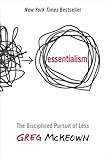
Greg McKeown's framework of essentialism is the most systematic treatment of the saying-no skill in the productivity literature. McKeown distinguishes between two orientations: the non-essentialist, who assumes "I have to do all of this and I can," and the essentialist, who assumes "I choose to do this, only the most important things, and do them well." The distinction is not about doing less — it is about doing less but better, with the deliberate elimination of the good in service of the great.
The essentialist framework identifies three practices that operationalize the saying-no skill. The first is exploration — before committing, investing time in understanding what is actually essential, using questions like "Is this the most important use of my time and energy right now?" rather than "Is this reasonable and useful?" The second is elimination — systematically cutting non-essential commitments through graceful refusal, selective invisibility, and the deliberate underscheduling that creates space for unexpected opportunities and deep work. The third is execution — creating the routines, boundaries, and systems that make the essential commitments effortless enough to protect against encroachment by non-essential demands.
McKeown's research produced a finding that directly challenges the assumption underlying most professional culture: the people perceived as most valuable in their organizations are not those with the broadest portfolios of commitments but those with the deepest expertise and most reliable output on the specific areas most critical to organizational success. The specialist who delivers exceptional work on three priorities is more valuable than the generalist who delivers adequate work on twelve — not despite their narrower scope, but because of it. This finding connects directly to the deep work research: the conditions for exceptional output require the sustained, uninterrupted attention that a portfolio of twelve commitments cannot support.
The Four Types of No — and When to Use Each
Not all refusals are equivalent. The appropriate form of no depends on the nature of the request, the relationship with the requester, and the specific reason for declining. Understanding the four primary forms of refusal — and their appropriate application — allows the no to be delivered in a way that is honest, kind, and relationally intelligent rather than blunt or evasive.
The Honest Direct No
The direct no is the simplest form: a clear, unequivocal statement of inability or unwillingness to take on the commitment, without excessive explanation or apology. "I won't be able to take that on" or "That is not something I can commit to right now" are complete statements that require no further justification. Research on refusal effectiveness by Christopher Carey and colleagues found that direct, confident refusals are more effective at preventing repeated requests and less damaging to relationships than hedging, over-explaining refusals — because hedging signals ambiguity about the decision rather than clarity, which invites negotiation. The direct no is most appropriate when the relationship is relatively stable, the request is genuinely not a fit, and further discussion would not change the outcome.
The Redirecting No
The redirecting no declines the specific request while offering an alternative path forward for the requester. "I cannot take that on, but [person X] would be excellent for this and may have capacity" or "I cannot commit to that timeline, but if you need it by [later date] I could help." This form of no is appropriate when you genuinely cannot fulfill the request as specified but can add value to the requester's situation in a different way. The redirection honors the relationship and the requester's underlying need without accepting a commitment that would compromise your capacity for higher-priority work. It is particularly useful in professional contexts where the requester is a senior colleague or client whose relationship warrants more than a simple decline.
The Conditional No
The conditional no declines the current version of the request while specifying conditions under which it could be reconsidered. "I cannot commit to that right now, but if your timeline extends to [date], I could potentially help" or "I am fully committed through [date] but would be interested after that." This form is appropriate when the request is genuinely interesting but the timing or scope is incompatible with current priorities. It maintains the relationship and the potential future opportunity without accepting an immediate commitment that competes with existing work. The condition must be genuine — using the conditional no as a soft way to avoid a direct decline, when you have no real intention of accepting under the stated conditions, is a form of dishonesty that damages relationships more than a direct no would.
The Delayed No
The delayed no uses a time buffer to separate the request from the response, reducing the influence of in-the-moment social pressure on the decision. "Let me check my commitments and get back to you by [specific date]" creates space for the evaluation process described in the commitment filter protocol below. This is particularly valuable for requests that feel urgent and important in the social moment of being asked but whose actual priority is unclear without reflection. The delay does not guarantee a no — it creates the conditions for an honest evaluation of whether yes or no is the right answer, rather than defaulting to yes under social pressure.
How to Say No Without Damaging Relationships
The fear that saying no will damage important relationships is the most common reason people avoid it. The research on relationship maintenance and perceived reliability suggests that this fear is systematically overstated — and that in many cases, the relationship consequences of a well-delivered no are smaller than anticipated while the relationship consequences of a poorly-executed yes are larger.
A poorly-executed yes — one that results in late delivery, diminished quality, or the need to withdraw after initial commitment — is more damaging to professional relationships than a clear, early no. Research on expectation management in professional contexts consistently shows that unmet commitments create stronger negative impressions than declined requests, because unmet commitments represent both a failure to deliver and a failure of judgment in accepting the commitment in the first place. The person who says no clearly and early is protecting the requester from the worse outcome of a yes that cannot be fulfilled.
Four elements characterize a no that preserves and sometimes strengthens relationships. First, timeliness — the sooner the no is delivered after the request, the less the requester has invested in the expectation of your participation and the more easily they can make alternative arrangements. Second, acknowledgment — briefly recognizing the value of the request and the requester's purpose before declining, which signals that the refusal is about capacity, not disinterest or disrespect. Third, clarity — a clear statement of the refusal without excessive hedging, qualification, or false hope. Fourth, warmth — a tone that is friendly and genuinely regretful where appropriate, distinguishing the no from rejection of the person. These four elements can be delivered in two to three sentences, making the fear of lengthy, difficult decline conversations largely unfounded.
How to Apply This: Building a Personal Commitment Filter
The commitment filter is a pre-defined decision framework that removes the in-the-moment social pressure from the yes-or-no decision by establishing evaluation criteria in advance. The following protocol builds and applies this filter systematically.
Action Steps
Common Misconceptions About Saying No
Misconception 1: "Saying no will make people think less of me professionally"
The research on professional reputation and selectivity suggests the opposite is often true. A person who says yes to everything is perceived as having unlimited capacity — which implies either that their existing work is not very demanding or that they are spreading themselves too thin to do any of it well. A person who declines requests selectively, with clear reasons rooted in existing priorities, signals that their time is genuinely valuable and their existing commitments are genuine. Research on perceived expertise and competence by Simine Vazire at UC Davis found that people who express confident, selective opinions are rated as more competent and trustworthy than those who agree readily — a finding that extends to commitment behavior. Selective yeses, accompanied by clear and confident nos, typically increase rather than decrease professional standing among people who pay attention to what others actually accomplish rather than just how responsive they are.
Misconception 2: "I can always find time for one more thing"
This belief, which is the psychological foundation of the yes default, is empirically false in a very specific sense. Time is genuinely fixed — there are exactly 168 hours in a week regardless of how many commitments you have accepted. Adding one more commitment does not create one more set of hours; it compresses the existing commitments into less time, reduces the quality of attention available to each, or displaces something that was already committed. The phrase "find time" is itself a linguistic obscurement of the reality: time is not found, it is reallocated from something else. The honest version of "I can always find time for one more thing" is "I can always reallocate time from my existing commitments to one more thing" — which immediately makes visible the trade-off that the original framing obscures.
Misconception 3: "Saying no is only for senior people who have leverage"
Saying no is a skill that operates at every career level, though its specific application varies. Junior professionals have genuine constraints on which requests they can decline — requests from managers and clients often carry real consequences for non-compliance. But even in high-constraint environments, the saying-no skill applies to discretionary commitments: the optional meeting, the informal favor, the social obligation that feels mandatory but is not, the additional project taken on voluntarily. The habit of applying the commitment filter to discretionary commitments — even small ones — builds the judgment and the relational capital that eventually makes it possible to decline even higher-stakes requests from a position of trust and established value. The skill is built in low-stakes situations and deployed in high-stakes ones. Waiting until you have "enough leverage" to practice saying no is waiting until the skill is most needed before beginning to develop it.
Conclusion
The art of saying no is, at its core, the art of saying yes to the right things with enough force and focus to actually achieve them. Every commitment accepted is a portion of finite time and attention allocated. Every unnecessary commitment accepted is a portion of finite time and attention subtracted from the work that most matters. The yes default does not feel costly in any individual instance — each individual yes seems reasonable, each individual sacrifice of focus time seems minor. The accumulated product, over weeks and months and years, is the professional life lived primarily in service of others' priorities rather than one's own.
The research on overcommitment, opportunity cost, and the psychology of refusal converges on a conclusion that is uncomfortable but clear: the ability to say no — to requests, to opportunities, to invitations, to the comfortable identity of being the person who always says yes — is one of the most significant determinants of whether exceptional work gets produced. Not because the requests are unimportant or the requesters unworthy, but because exceptional work requires the one resource that saying yes continuously depletes: sustained, focused, uninterrupted attention directed at the right things.
The next time a request arrives that does not score 90 out of 100 on your priority criteria, the most generous thing you can do for the requester — and the most strategic thing you can do for yourself — is to decline clearly, warmly, and without excessive guilt. The no you give them frees them to find better help and frees you to give your best attention to the work that already has it.
Your Next Step
This week, identify one commitment currently on your plate that, if offered to you today, you would decline. It might be a recurring meeting, an ongoing informal obligation, or a project taken on for the wrong reasons. Draft the message required to exit it gracefully — and send it before the week ends. Then protect the time it frees with something from your highest-priority list. For the complete framework on essentialism and selective commitment, Greg McKeown's Essentialism is the most thorough treatment of the topic. James Clear's Atomic Habits (available here) provides the habit design framework that makes the no-by-default pattern permanent rather than effortful.
External Resources
- Greg McKeown — Essentialism: The Disciplined Pursuit of Less — The foundational book on the philosophy and practice of selective commitment, including the 90 percent rule and the trade-off framework for evaluating opportunities.
- Zeelenberg et al. — Anticipated Regret and Behavioral Decision Making (Journal of Behavioral Decision Making) — Research on how anticipated regret drives precautionary yes responses — the psychological mechanism behind the overcommitment default.
- Peter Bergman — To-Do Lists Don't Work (Harvard Business Review) — Analysis of how unlimited task accumulation without commitment filtering produces the overloaded schedule that makes saying no essential rather than optional.
📚 Recommended Reading


Affiliate links — we may earn a small commission at no extra cost to you.