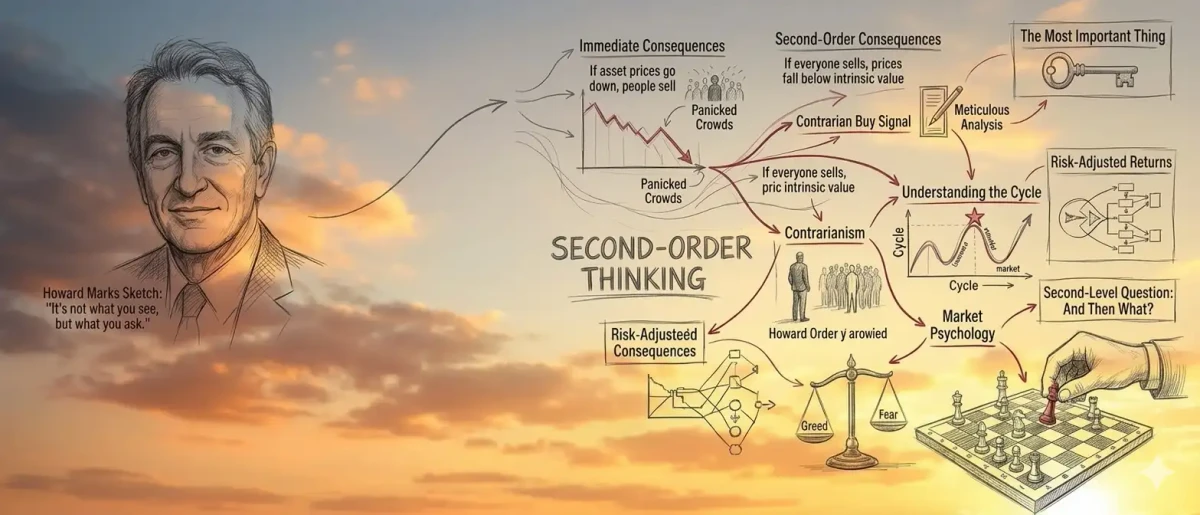
First-order thinking asks: "What happens next?" Second-order thinking asks: "And then what?" The gap between those two questions is where most of the important consequences live — the ones that surprise first-order thinkers, that produce unintended outcomes, and that separate decisions that look smart from decisions that are smart.
What Is Second-Order Thinking?
Every action produces a consequence. That consequence is the first-order effect — the most immediate, most visible, most predictable result of the action. But that first-order effect doesn't stop there. It becomes a cause in its own right, producing its own set of consequences. Those are the second-order effects. And those second-order effects produce third-order effects, and so on through a chain of causation that can extend indefinitely.
Most people stop at the first-order effect. They ask "what will this action produce?" and when they have a satisfactory answer to that question, they proceed. Second-order thinking refuses to stop there. It insists on asking "and then what?" — following the consequences through at least one additional step, and usually several, to find where the chain actually leads.
The Classic Example: Cane Toads in Australia
In 1935, Australian farmers introduced cane toads from South America to control the cane beetle destroying sugar crops. First-order effect: cane toads eat beetles. Second-order effect: cane toads are highly poisonous and have no natural predators in Australia. Third-order effect: native species that eat the toads die. Fourth-order effect: with their predators eliminated, other prey species explode in population. Fifth-order effect: ecosystem-wide disruption that continues nearly 90 years later, with 200+ million cane toads now considered one of the worst environmental disasters in Australian history.
Every step was predictable in hindsight. None was examined before the introduction.
The cane toad example is extreme, but the pattern it illustrates is universal. In complex systems — economies, organizations, ecosystems, relationships — actions propagate through networks of causation in ways that are genuinely difficult to predict from first-order analysis alone. The consequences that matter most are often not the immediate ones.
Howard Marks and Second-Level Thinking
Howard Marks, the co-founder of Oaktree Capital Management and one of the most successful investors of the past 40 years, built his entire investment philosophy around what he calls "second-level thinking." His 2011 book The Most Important Thing opens with this framework and returns to it throughout.
Marks on First vs. Second Level Thinking
"First-level thinking says, 'It's a good company; let's buy the stock.' Second-level thinking says, 'It's a good company, but everyone thinks it's a great company, and it's not. So the stock's overrated and overpriced; let's sell.'"
The first-level thinker asks whether the company is good. The second-level thinker asks whether the consensus view of the company is right — and whether that consensus is already reflected in the price. These are completely different questions, and the second one is what determines investment returns.
Marks's insight is that financial markets are a second-order environment by definition. The price of a security reflects the consensus first-order view. To outperform, you need to be right about something the consensus is wrong about — which requires thinking at least one level deeper than the average participant. A company can be genuinely excellent and still be a poor investment if everyone already knows it's excellent and the price reflects that knowledge.
This is why second-order thinking is especially critical in competitive environments. In a game where all participants are applying first-order analysis, the first-order analysis becomes worthless as a differentiator — everyone reaches the same conclusions and the advantage disappears. The edge lies in the question that most participants aren't asking.
Marks also makes the point that second-level thinking is genuinely difficult and genuinely rare. It requires not just asking "and then what?" but asking it with enough depth and accuracy to reach conclusions that differ from the consensus in ways that are right rather than merely different. Being contrarian for its own sake is not second-order thinking — it's just first-order thinking inverted. The goal is accuracy at a level of analysis the crowd isn't operating at.
Why First-Order Thinking Dominates
If second-order thinking produces better decisions, why do most people default to first-order analysis? The reasons are structural and cognitive, not merely a matter of effort or intelligence.
Cognitive Load and Temporal Discounting
Following a chain of consequences through multiple steps is cognitively expensive. Each additional step requires holding the previous steps in working memory while generating new inferences. The human brain's working memory is limited, and the effort required to trace consequences two or three steps forward is genuinely higher than stopping at the first step.
Compounding this is temporal discounting — the well-documented tendency to value immediate outcomes more heavily than future ones. First-order effects are immediate; second and third-order effects are delayed. Even when people recognize that the downstream effects are larger, the psychological pull of the immediate outcome is powerful and often decisive. This connects directly to what we explored in dopamine and the digital age — the same neurological mechanism that makes immediate social media rewards override long-term productivity goals also makes first-order consequences override second-order ones.
The Curse of Clarity
First-order effects are typically visible and clear. Second-order effects are typically invisible and uncertain. The human mind is strongly biased toward clear, vivid information over uncertain, abstract information. An immediate benefit that you can see and describe specifically feels more real and more motivating than a diffuse future consequence that you can only sketch probabilistically.
This asymmetry is exploited systematically in politics, marketing, and management. Almost every bad policy that gets enacted, every product feature that backfires, every management decision that creates unintended consequences was the result of a decision-maker who saw the first-order benefit clearly and was blind to the second-order costs.
The Politician's Fallacy
The classic political version: a government imposes rent controls to make housing more affordable for low-income renters. First-order effect: rents are lower, renters benefit. Second-order effect: landlords reduce maintenance and eventually convert or sell properties, reducing the supply of rental housing. Third-order effect: housing scarcity increases, making it harder for new renters to find any housing at any price. Fourth-order effect: the people rent control was designed to help are now worse off than before its introduction, while those who secured apartments before the control benefit at their expense.
This pattern has repeated in every major city that has implemented strict rent control. It was predictable from the second-order analysis. It was invisible from the first-order view.
Accountability Structures Reward First-Order Success
In most organizational contexts, people are evaluated on near-term outcomes. A manager who implements a cost-cutting measure that improves this quarter's earnings but damages culture and increases turnover over the following year will likely be rewarded for the first-order result and face few consequences for the second-order damage. This creates systematic incentives to optimize for first-order effects at the expense of second-order ones — and it means that most organizations are structurally biased toward first-order thinking regardless of what their values statements say.
The Science of Unintended Consequences
Sociologist Robert Merton formalized the concept of unintended consequences in a landmark 1936 paper, identifying five sources: ignorance (not knowing enough to anticipate all effects), error (knowing but making the wrong prediction), immediate interest overriding long-term consequences, the self-defeating prophecy (where anticipating a consequence changes behavior in ways that prevent it), and the self-fulfilling prophecy (where believing a consequence will occur causes it to occur).
The first two — ignorance and error — are the most common sources of second-order surprises, and both are amenable to the same remedy: more systematic thinking about downstream consequences before acting. The point is not that second-order effects are always knowable in advance. It's that they are often knowable in advance with modest additional analysis, and the failure to do that analysis is a choice, not an inevitability.
The Cobra Effect
During British colonial rule in India, the government offered a bounty for every dead cobra, intending to reduce the cobra population. First-order effect: people killed cobras and collected the bounty. Second-order effect: entrepreneurial Indians began breeding cobras specifically to kill them for the bounty. Third-order effect: when the government discovered the scheme and cancelled the program, the breeders released their now-worthless cobras into the wild. The cobra population ended up larger than before the program began.
The "Cobra Effect" — a well-meaning intervention that produces the opposite of its intended outcome — is a direct consequence of stopping analysis at the first-order level. It recurs constantly in policy, management, and personal decisions.
Systems thinker Donella Meadows identified a related phenomenon she called "fixes that fail" — interventions that produce the desired first-order result but generate second-order side effects that eventually undermine the fix, requiring further intervention, creating a reinforcing cycle. Most chronic organizational problems are sustained by exactly this dynamic: a symptom is addressed with a fix, the fix creates new symptoms, those symptoms are addressed with new fixes, and the underlying structure that generates the problems is never examined.
How to Apply Second-Order Thinking
Second-order thinking is not a complex procedure. It is a habit of asking an additional question — "and then what?" — and following that question with enough discipline to reach the level of analysis where the important consequences live. The challenge is not the method itself but the commitment to applying it consistently, especially when the first-order picture is compelling and the pressure to act is high.
The "And Then What?" Protocol
Action Steps
- State the action and its intended first-order effect. Be specific: "We are doing X because we expect Y to result." This forces clarity about what the first-order reasoning actually is, which is a necessary precondition for questioning it.
- Ask: who else is affected by Y, and how will they respond? Second-order effects almost always involve the reactions of other agents — people, organizations, markets — to the first-order outcome. The second-order question is not just "what else happens?" but "who responds to what happens, and what do they do?"
- Ask: what does that response produce? The response identified in step 2 is itself an action, with its own first-order effects. Follow those effects one more step to reach the third-order consequences.
- Ask: are any of these downstream consequences larger or more important than the first-order benefit? If the second or third-order effects dwarf the first-order benefit — or undermine it entirely — the action needs to be reconsidered or restructured.
- Ask: what is the time horizon? Second-order effects often operate on a longer time scale than first-order effects. Specifying when each consequence is expected to materialize helps evaluate the true trade-off — a large second-order cost that arrives in 5 years is real, but different in decision terms from one that arrives in 5 months.
The 10/10/10 Shortcut
For decisions under time pressure, Suzy Welch's 10/10/10 framework provides a rapid second-order approximation: ask how you'll feel about this decision in 10 minutes, 10 months, and 10 years. The 10-minute answer captures the first-order emotional response. The 10-month answer captures the medium-term second-order consequences. The 10-year answer captures the long-term third-order effects. When these three answers diverge significantly, the divergence is exactly where second-order thinking is most needed.
The Key Question for Competitive Environments
In any competitive situation — investing, business strategy, negotiations, career decisions — the single most useful second-order question is: "If this is obviously the right move, why hasn't everyone already made it?"
This question forces you to consider what the consensus is already doing (first-order) and what the gap between your analysis and the consensus might mean (second-order). Either you have information or insight others lack (possible), the consensus is irrationally ignoring an obvious opportunity (rare), or your first-order analysis is missing something the consensus already knows (most common). The question doesn't answer itself — but it prevents the most common error in competitive environments, which is acting on first-order analysis in a world where everyone else is doing the same analysis.
Second-Order Effects Across Domains
Technology: Social Media and Polarization
Facebook's early product decisions optimized for engagement — specifically, for time spent on platform. First-order effect: users spend more time on Facebook, revenue increases. Second-order effect: the content that drives most engagement turns out to be outrage-inducing, emotionally charged, and tribal. Third-order effect: algorithmic amplification of this content reshapes the information diet of billions of people, increasing political polarization, reducing trust in institutions, and creating information environments where shared factual reality becomes harder to maintain.
None of the Facebook engineers designing the engagement algorithm in 2009 intended to polarize democratic societies. They were optimizing for a clear first-order metric. The second and third-order consequences were knowable — social science research on media and polarization existed — but were not part of the decision framework.
Personal Finance: The Raise That Costs You
A 30-year-old receives a significant salary increase. First-order effect: more monthly income. Most common response: increase lifestyle spending proportionally — better apartment, nicer car, more restaurants. Second-order effect: higher fixed costs that are difficult to reduce later. Third-order effect: when the next economic disruption arrives and income drops, the person's financial position is worse than if they'd maintained the lower lifestyle and invested the difference. The raise that felt like financial progress produced financial fragility through second-order effects that were entirely predictable and entirely unexamined.
Management: The Star Employee Dilemma
A team's highest performer is struggling with workload. First-order solution: promote them to manager, where they'll have more resources and status. Second-order effect: the best individual contributor is now managing people — a completely different skill set — and is no longer doing the work they were excellent at. Third-order effect: both the management work (done poorly) and the individual contribution work (now done by someone less skilled) suffer. The team is worse off and the promoted individual is unhappy. This pattern is so common it has a name: the Peter Principle — people are promoted to their level of incompetence, because the skills that produce success at one level are often unrelated to the skills required at the next.
Personal Development: The Knowledge Trap
A person committed to growth reads extensively — books on productivity, psychology, business, and self-improvement. First-order effect: accumulation of knowledge and frameworks. Second-order effect: the reading itself becomes a substitute for the difficult, uncomfortable work of actually changing behavior. Reading about habits is easier than building them; reading about courage is more comfortable than acting courageously. Third-order effect: the person develops an increasingly sophisticated self-improvement framework and an increasingly large gap between their knowledge and their actual behavior — which produces guilt and demotivation that makes genuine change harder. As we explored in the science of habits and momentum, knowledge without implementation compounds into a specific kind of stagnation.
Positive Second-Order Effects
Exercise: First order: physical fitness. Second order: improved sleep quality, better mood, increased cognitive performance, higher energy for other activities. Third order: compounding improvements in work quality, relationship quality, and decision-making that amplify the first-order benefit enormously.
Learning a skill deeply: First order: competence in the skill. Second order: accelerated learning of adjacent skills (learning how to learn transfers). Third order: compounding career optionality as skill trees connect in unexpected ways.
Negative Second-Order Effects to Watch
Optimizing for metrics: First order: metric improves. Second order: behavior changes to optimize the metric rather than the underlying goal (Goodhart's Law). Third order: the metric becomes a poor proxy for what it was designed to measure.
Eliminating slack: First order: efficiency increases. Second order: the system has no buffer for unexpected demands. Third order: any disruption cascades into crisis, because all capacity is already committed.
When to Go to Third Order and Beyond
If second-order thinking is valuable, is third-order thinking even more valuable? Sometimes. But the relationship is not linear — more steps of analysis don't automatically produce better decisions, and there are significant costs to pushing the analysis too far.
Third-order analysis is most valuable in three situations: when the second-order effects are large and will themselves produce significant reactions (complex adaptive systems like markets and ecosystems); when the time horizon is very long and the compounding of consequences is significant (infrastructure decisions, policy, life-stage choices); and when you're in a competitive environment where everyone is already doing second-order analysis and the edge lies in going one level deeper.
The Practical Stopping Rule
Go to the order of analysis where the consequences become either negligible or genuinely unknowable. For most everyday decisions, second order is sufficient — the third-order effects are small enough relative to the first and second that they don't change the decision. For high-stakes, long-horizon, or highly complex decisions, third-order analysis earns its cognitive cost. For decisions in complex adaptive systems (financial markets, ecology, social systems), even third order may be insufficient — which is where the limits of the model become important.
The Limits of Second-Order Thinking
Second-order thinking is a powerful tool that has real limits worth understanding explicitly — because overconfidence in any analytical framework is itself a failure of second-order thinking.
Complexity and Unknowability
In genuinely complex adaptive systems, second and third-order effects can be fundamentally unpredictable — not because of insufficient analysis but because the system itself is chaotic in the technical sense: small changes in initial conditions produce large changes in outcomes, and the causal chains are too dense and non-linear to trace reliably. In these environments, second-order thinking's value is not in predicting specific consequences but in identifying the classes of consequences that are possible, maintaining appropriate humility about the unknowability of specific outcomes, and building robustness rather than optimizing for a specific predicted scenario.
Analysis Paralysis
Pushed to an extreme, second-order thinking can produce paralysis: every action has second-order effects, those effects are uncertain, and attempting to trace them all leads to an infinite regress that prevents action entirely. The solution is not to abandon second-order thinking but to apply it proportionally — reserve the full analysis for high-stakes, difficult-to-reverse decisions, and use lighter versions for everyday decisions where the cost of getting it slightly wrong is low. As we explored in inversion thinking, the goal of these frameworks is better decisions, not perfect decisions.
The Risk of Sophisticated Justification
Second-order analysis can be used to justify any predetermined conclusion. Someone sufficiently motivated can trace consequences in whatever direction serves their interests, selectively attending to the second-order effects that support their preferred action and ignoring those that don't. This is motivated second-order thinking — and it's more dangerous than naive first-order thinking because it feels more rigorous.
The guard is the same as for any analytical framework: seek disconfirming consequences actively, not just confirming ones. Ask specifically what second-order effects would argue against the action, and take those seriously. This is where inversion and second-order thinking work together most productively — inversion identifies the failure modes, second-order thinking traces how they propagate.
Building Second-Order Thinking as a Habit
Second-order thinking is not naturally how the mind operates under time pressure and emotional engagement. It requires deliberate cultivation — building it as a reflex through practice until "and then what?" becomes an automatic second question rather than an occasional one.
The Daily Practice
Review one significant decision each day — past or upcoming — and explicitly trace its second-order consequences. For past decisions, ask what second-order effects you didn't anticipate and why. For upcoming decisions, apply the "and then what?" protocol fully. This practice, sustained over months, builds the habit of second-order analysis more effectively than any one-time effort at systematic thinking.
The Historical Case Study Method
History is a second-order consequence laboratory. Almost every major historical failure — military, economic, political, technological — can be understood as a second-order analysis failure: someone optimized for a first-order outcome without adequately modeling what would happen next. Reading history with explicit attention to the second-order effects that decision-makers missed builds the pattern library that makes second-order thinking faster and more accurate over time.
The Question Before Every Commitment
Build a single reflexive question into every significant decision: "If this works exactly as I intend, what problems does it create?" This question forces second-order analysis even under time pressure, because it takes only seconds to ask and often surfaces the most important consequences immediately. If the answer is "none," that's a flag — not because every good decision creates problems, but because genuinely complex decisions almost always produce second-order effects worth acknowledging.
The Compounding Return
Second-order thinking compounds over time in a specific way: each decision made with second-order awareness tends to create fewer downstream problems, which means less time and energy spent fixing unintended consequences. This frees cognitive and organizational capacity for the next round of decisions, which can themselves be made with better second-order analysis. The person who consistently applies second-order thinking is not just making better individual decisions — they're building a decision-making track record that creates more options, more trust, and more runway for the decisions that follow. Combined with the first principles approach for identifying what's genuinely possible and the inversion framework for identifying what to avoid, second-order thinking completes a triad of reasoning tools that covers the most important failure modes in complex decision environments.


