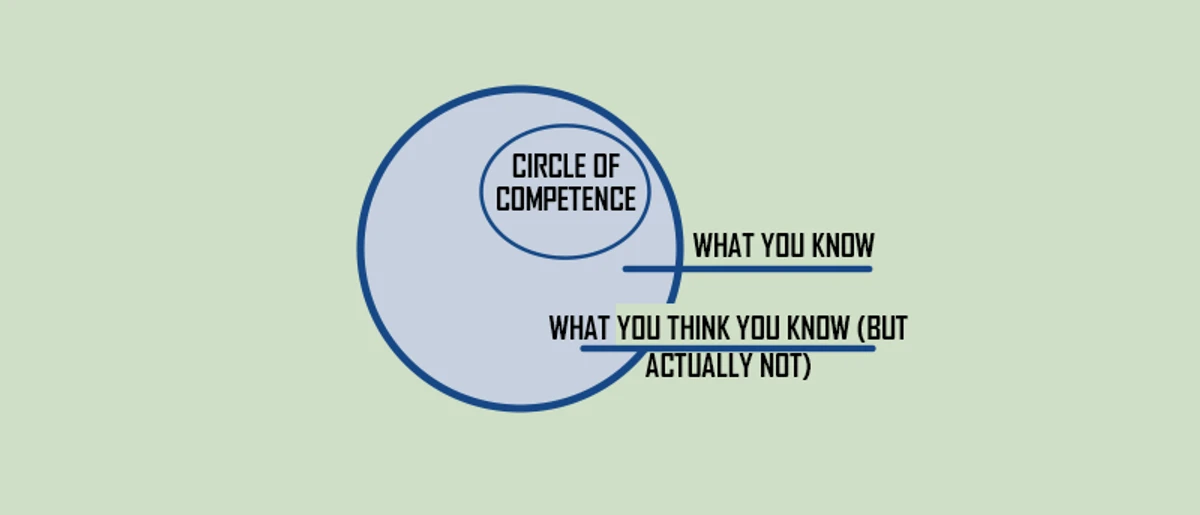
Warren Buffett has said he doesn't need to know where every investment opportunity lies — he needs to know where his circle of competence ends. That boundary, honestly assessed and rigorously maintained, has been worth more to his returns than any analytical technique. The same principle applies to every domain where judgment under uncertainty determines outcomes.
What Is the Circle of Competence?
The circle of competence is a mental model for understanding the boundaries of your genuine knowledge. Inside the circle: domains where your understanding is deep enough that you can reason reliably about cause and effect, anticipate likely outcomes, and recognize when something is wrong. Outside the circle: domains where your understanding is insufficient for reliable judgment — where you're operating on analogy, assumption, or surface familiarity rather than genuine expertise.
The model has two components that are equally important and frequently confused. The first is the circle itself — the domain of genuine competence. The second is the boundary — the edge that separates what you genuinely understand from what you only think you understand. Buffett's insight is that most people have a reasonably accurate sense of their circle but a systematically overestimated sense of where the boundary lies. They think the circle is larger than it is, and this overestimation is where most serious errors originate.
The Two Failure Modes
Failure mode 1 — Ignoring the boundary: Operating as if you have competence everywhere, making decisions in domains you don't understand, and discovering the boundary only when you're wrong in ways you didn't anticipate. This is how sophisticated, intelligent people lose money in investments they don't understand, fail at businesses in industries they've only read about, and give confident advice in domains where their knowledge is thinner than their confidence.
Failure mode 2 — Underestimating the circle: Being so conservative about claiming competence that you fail to act decisively in areas where you genuinely have edge. This is less common than overestimation but equally costly — it produces excessive deference to experts who may have less practical knowledge than you, and missed opportunities in exactly the domains where your judgment is most reliable.
Buffett and Munger: The Original Framework
Buffett introduced the circle of competence concept in his 1996 Berkshire Hathaway shareholder letter, though the underlying practice predates that articulation by decades. His description is worth reading closely:
Buffett on the Circle of Competence
"What an investor needs is the ability to correctly evaluate selected businesses. Note that word 'selected': You don't have to be an expert on every company, or even many. You only have to be able to evaluate companies within your circle of competence. The size of that circle is not very important; knowing its boundaries, however, is vital."
The critical phrase is "knowing its boundaries." Buffett is not claiming a large circle — he explicitly says the size doesn't matter. What matters is the accuracy of the boundary assessment. A small, accurately-known circle produces better decisions than a large, inaccurately-known one, because inside an accurately-known circle you can act with appropriate confidence, and outside it you know to defer.
Buffett's own circle is famously narrow for someone of his stature. He has consistently avoided technology companies for most of his career, explicitly because he couldn't reliably predict which ones would have durable competitive advantages a decade out. He passed on Microsoft in the 1990s — a decision that cost him enormous returns — and explained it not as a prediction that Microsoft would fail but as an honest acknowledgment that he couldn't confidently assess its long-term economics. The discipline to decline a potentially enormous opportunity because it fell outside his circle is the same discipline that protected him from countless bad investments in domains he didn't understand.
Charlie Munger extends the framework with characteristic directness: "We have three baskets: in, out, and too hard. We just throw most things in the too hard pile and act on the few remaining opportunities." The "too hard" pile is not a judgment about the quality of the opportunity — it's a judgment about whether Munger and Buffett have the competence to evaluate it. Many excellent investments have gone into the too-hard pile. Many catastrophic investments have been avoided because they were correctly identified as outside the circle.
How Buffett Built His Circle
Buffett didn't start with a large circle and narrow it. He built his circle deliberately over decades by reading obsessively within specific domains — consumer brands, insurance, banking, newspapers — until he understood the underlying economics at a level that let him predict with reasonable confidence how those businesses would perform across economic cycles. The circle is the product of sustained, focused study, not broad exposure.
His reading habit — reportedly 500 pages per day early in his career — was not random. It was concentrated in domains where he had commercial interest and existing partial knowledge. He was deepening understanding in areas where he already had some foundation, not sampling widely across everything. This is the correct way to expand a circle: build on genuine foundations rather than accumulating superficial familiarity across many domains. The compounding nature of deliberate daily practice is exactly what produces genuine expertise over time.
The Boundary Problem: Why Most Circles Are Too Large
The consistent finding in research on expertise and self-assessment is that people systematically overestimate the boundaries of their competence. This is not primarily a problem of arrogance or poor character — it's a structural feature of how knowledge and confidence develop.
When you first learn about a domain, you're aware of your ignorance — you can see clearly how much you don't know. As you develop partial knowledge, something counterintuitive happens: you become more confident, because the knowledge you've acquired is real and the questions you now know how to answer are genuinely questions you couldn't answer before. But the partial knowledge is insufficient to reveal the full scope of what you still don't know. You've moved from knowing nothing to knowing something, which feels like knowing a lot — without yet knowing enough to see how much remains.
The Four Stages of Competence
Unconscious incompetence: You don't know what you don't know. The circle feels unlimited because the boundaries are invisible. This is dangerous.
Conscious incompetence: You know you don't know. The circle feels small and the boundaries are visible. This is uncomfortable but accurate.
Conscious competence: You can perform reliably with effort and attention. The circle is real but requires active management. This is where most practitioners operate.
Unconscious competence: You perform reliably without having to think about it. The circle's contents feel natural and the boundaries are clear from experience. This is genuine expertise.
The boundary problem occurs most acutely at the transition from unconscious incompetence to conscious incompetence — the moment when you learn enough to feel confident but not enough to see where confidence is unwarranted. Experienced professionals in almost every domain can identify the moment they first felt genuinely competent — and recognize in retrospect that they were nowhere near as competent as they felt at that moment. The feeling came first; the actual competence arrived later, through accumulated experience and error.
Dunning-Kruger and the Illusion of Competence
David Dunning and Justin Kruger's 1999 research formalized what practitioners had long observed: people with limited knowledge in a domain systematically overestimate their competence, while experts systematically underestimate theirs. The research showed this pattern across domains — logical reasoning, grammar, humor — and proposed a specific mechanism: the skills required to perform well in a domain are largely the same skills required to evaluate performance in that domain. Novices lack both, so they can't accurately assess how poorly they're performing.
The practical implication for circle of competence is significant. If your circle is actually small, you're likely to perceive it as larger than it is — which means your self-assessment of the boundary is exactly the information you most need and least have. This creates a structural challenge: the most important time to question your circle is when your confidence is highest, which is precisely when questioning it feels least necessary.
The Expert Underestimation Trap
The Dunning-Kruger research also showed that genuine experts tend to underestimate their competence — partly because they're aware of how much remains unknown in their domain, and partly because tasks that are difficult for others have become automatic for them and feel easy. This produces a different kind of boundary error: dismissing genuine competence because it feels too simple. The guard against this is calibration against actual outcomes, not self-assessment of difficulty.
The connection to inversion thinking is direct here: instead of asking "what do I know?", ask "what would I need to know to be genuinely competent in this domain that I probably don't know yet?" The inverted question surfaces the gaps that forward-looking confidence assessment misses.
How to Define Your Actual Circle
Defining your circle honestly requires more than introspection. It requires external calibration — testing your judgments against outcomes and comparing your predictions against what actually happens. Self-reported competence is unreliable; outcome-tracked competence is the real measure.
The Track Record Test
The most reliable way to define your circle is to examine your track record in a domain over a meaningful sample of decisions. Where have your predictions been systematically accurate? Where have they been systematically wrong? Where have you been right but for reasons you didn't anticipate (lucky rather than competent)? The pattern across a sufficient sample of outcomes is far more informative than any self-assessment.
This requires the discipline of actually tracking predictions and outcomes — which most people avoid because it produces uncomfortable information. Buffett and Munger maintain "decision journals" precisely for this reason: to have an accurate record of their reasoning at the time of each decision, separate from the post-hoc rationalization that typically replaces actual reasoning once outcomes are known.
The Explanation Test
Feynman's test for genuine understanding applies directly here: if you can't explain the mechanisms in your domain in plain language — not just describe outcomes but explain why those outcomes occur — you don't have competence, you have familiarity. Familiarity feels like competence from the inside and is completely different in terms of predictive reliability.
Action Steps
- Choose a domain where you believe you have competence. State it specifically — not "I understand investing" but "I understand the unit economics of subscription software businesses."
- Explain the key causal mechanisms without jargon. Why do the good outcomes happen? Why do the bad ones? What makes some businesses in this domain succeed and others fail? If you can't explain the mechanisms clearly, you're working from pattern recognition rather than genuine understanding.
- Identify what would change your view. What evidence would tell you a business in this domain was excellent? What would tell you it was failing? If you can't specify what would change your mind, your view isn't based on genuine understanding — it's based on belief.
- Test against cases you haven't seen before. Apply your understanding to new examples outside your experience and check your predictions against outcomes. The novel cases are where the boundary between competence and familiarity becomes visible.
- Find an expert and compare assessments. Present your analysis to someone with genuine depth in the domain and ask where they disagree. The disagreements reveal where your understanding has gaps you weren't aware of.
The Confidence Calibration Check
A well-calibrated confidence in a domain means your 70% confidence predictions are right about 70% of the time, your 90% confidence predictions are right about 90% of the time, and so on. Most people are overconfident — their 90% confidence predictions are right far less than 90% of the time. Tracking your confidence levels alongside your outcomes over time reveals your actual calibration and, by extension, where your circle really ends.
Expanding the Circle Deliberately
Staying inside your circle is not a permanent constraint — it's a discipline that coexists with the project of deliberately expanding the circle over time. The key word is deliberately. Random exposure to new domains doesn't reliably expand competence; structured, intensive study does.
Munger's Method for Circle Expansion
Munger describes his approach to entering new domains: read everything available about the domain, seek out the best practitioners and study their reasoning, build a mental model of how the domain works from first principles, and then test that model against specific cases before trusting it with significant decisions.
The process is slow — months to years for meaningful expansion — and it's intentional. Munger doesn't try to expand his circle into many domains simultaneously. He picks one, works it thoroughly, and adds it to his toolkit only when he can meet his own standard for genuine understanding. Speed is explicitly not the goal.
The Adjacent Possible
Circle expansion is most efficient at the boundary — in domains adjacent to your existing competence where your existing knowledge provides genuine foundation. A deep understanding of retail economics gives you real foundation for understanding e-commerce. Deep knowledge of traditional media gives you real foundation for understanding digital advertising. Trying to expand into completely unrelated domains requires building from scratch, with no existing knowledge to accelerate learning.
The practical implication: identify the domains adjacent to your current circle and prioritize expansion there. This is how Buffett eventually expanded into technology — through Apple, which he framed not as a technology investment but as a consumer brand and ecosystem investment, domains where he already had deep competence. He found the entry point through adjacent knowledge rather than trying to learn semiconductor economics from scratch.
The Apprenticeship Shortcut
The fastest reliable way to expand competence in a new domain is structured exposure to genuine experts — not reading their public writing but engaging with their actual decision-making process. Understanding not just what experts decide but how they think about decisions, what variables they weight, what warning signs they recognize, and what they've learned from their mistakes compresses the learning curve dramatically. This is why apprenticeship and mentorship produce expertise faster than independent study in almost every domain. For more on building this kind of systematic learning infrastructure, see using AI as a thinking partner for accelerated learning.
What to Do Outside Your Circle
Knowing you're outside your circle doesn't mean you can't act — it means you need to change how you act. Outside your circle, the appropriate response is not confidence but structured humility: recognizing that your judgment is unreliable and compensating with process.
When You Must Decide Outside Your Circle
Default to base rates. When you lack specific knowledge, statistical base rates are usually more reliable than specific judgment. "What percentage of businesses in this category succeed?" is a more reliable input than your impression of this particular business.
Seek genuine experts, not credentialed ones. The person with the most relevant track record in the specific decision you're facing, not the most prestigious credential in a related field.
Make the decision reversible if possible. Outside your circle, the risk of being wrong is higher, so the cost of being wrong should be reduced. Stage decisions, use options, and avoid irreversible commitments.
Common Mistakes Outside Your Circle
Mistaking enthusiasm for expertise. Finding a domain interesting and reading about it for a few months does not constitute competence. Enthusiasm is a predictor of learning, not a substitute for it.
Confusing narrative with analysis. A compelling story about why something will succeed is not the same as understanding the causal mechanisms. Outside your circle, stories are especially dangerous because you can't evaluate their accuracy.
Deferring to confident presenters. Confidence in presentation correlates weakly with accuracy of judgment. Outside your circle, you can't distinguish genuine competence from performed confidence.
Munger's "too hard" pile is the institutional version of this principle. When Berkshire encounters an opportunity outside their circles, it doesn't go into a different analytical process — it goes into the pile. The discipline to not try harder when you're outside your circle is, paradoxically, a form of intellectual strength.
Circle of Competence Across Domains
Investing: The Original Application
In investing, the circle of competence principle has a precise implication: your returns should be concentrated in the industries and business types you understand deeply, and you should achieve market or below-market returns in everything else. If you're a software engineer who has spent a career building and selling SaaS products, you have genuine insight into the economics of software businesses that most investors don't. That insight is your edge — and it's concentrated, not broad.
The mistake most retail investors make is diversifying into domains outside their circle (foreign emerging markets, commodity cycles, pharmaceutical pipelines) because diversification is conventionally recommended. But diversification outside your circle doesn't reduce risk — it moves you from the area where you might have edge to areas where you definitely don't. Within your circle, concentration is appropriate; outside it, index funds are the correct default, because they get you market returns without the additional risk of decisions made outside your competence.
Career: Choosing Where to Compete
The same principle governs career decisions. Genuine career advantage comes from depth in a specific domain, not from breadth across many. The person who deeply understands one industry, one function, or one type of problem develops compounding advantage over time — each year of experience deepens and widens the circle, creating knowledge and relationships that are increasingly difficult to replicate.
Career mistakes that follow from circle of competence errors: accepting roles in domains where you lack genuine competence because the status or compensation is attractive; changing industries frequently enough that you never develop the depth that creates genuine edge; and overvaluing generalist credentials relative to specific depth in domains where deep knowledge is what the market actually rewards.
Leadership and Advice
Leaders who understand their circle of competence delegate more effectively — they recognize which decisions benefit from their judgment and which should go to people with deeper competence in the relevant domain. Leaders who don't understand their circle make decisions they shouldn't, override people with better judgment than theirs, and create organizations that systematically underperform their talent base.
The same applies to giving advice. The most valuable advice is specific and domain-informed. Generic life advice given with confidence outside your actual experience is worse than silence — it occupies the space where useful domain-specific advice could be, and it comes with false authority. As explored in second-order thinking, well-meaning advice outside your circle produces second-order effects (misplaced confidence, wrong decisions) that the first-order good intention (being helpful) doesn't account for.
Circle of Competence vs. Comfort Zone
The circle of competence is sometimes confused with the comfort zone — the range of activities that feel comfortable and familiar. They overlap but are distinct in ways that matter practically.
The comfort zone is defined by emotional state — what feels safe, familiar, and low-anxiety. The circle of competence is defined by epistemic state — what you genuinely understand well enough for reliable judgment. Activities can be inside your comfort zone without being inside your circle of competence (things you do confidently but poorly), and outside your comfort zone while being inside your circle of competence (things you do well but that feel difficult).
Comfort Zone ≠ Circle of Competence
Public speaking might be outside your comfort zone but inside your circle of competence — you're an expert communicator, it just makes you nervous. Cryptocurrency trading might be inside your comfort zone (you've done it before, it's familiar) but outside your circle of competence — you don't understand the underlying economics well enough for reliable judgment.
Conflating the two leads to avoiding activities where you have genuine edge (because they're uncomfortable) and pursuing activities where you have no edge (because they're familiar).
The Growth Relationship
The productive relationship between circle and comfort zone: deliberately operate at the edge of your circle, where you're expanding genuine competence into new territory. This is almost always uncomfortable — learning at the frontier of understanding requires wrestling with uncertainty and frequent error.
But it's different from operating outside your circle: at the edge, you have the foundation to learn from error. Outside your circle, you often can't even tell when you're wrong, which means errors don't produce learning — they just produce losses.
This distinction resolves what appears to be a tension between the circle of competence principle and growth mindset philosophy. Growth mindset advocates pushing beyond comfort; circle of competence advocates staying within genuine understanding. Both are right, properly understood: push beyond comfort while staying connected to genuine foundation. The goal is not comfortable stagnation or reckless expansion — it's deliberate growth from a base of honest self-knowledge.
The Synthesis
The circle of competence is not a reason to stay small. It is a reason to grow with accuracy rather than with ambition alone. Buffett's circle in 1960 was smaller than his circle in 1990, which was smaller than his circle in 2020. Each expansion was deliberate, domain-specific, and tested against outcomes before being trusted with significant decisions. The circle grew because he worked at its edges — not because he simply declared the edges further out. That discipline — honest about the current boundary, committed to expanding it carefully — is what transforms a small genuine circle into a large one over decades. Combined with the first principles approach to understanding why things work and the inversion framework for identifying where you're most likely to be wrong, circle of competence thinking completes a foundational toolkit for decisions that compound over time.


