Most people confuse familiarity with understanding. They've read the chapter, attended the lecture, watched the video — and because the material feels familiar, they believe they've learned it. Then someone asks them to explain it, and the explanation falls apart. The Feynman Technique exists precisely to close the gap between familiarity and genuine understanding — and it does so through one of the most powerful learning mechanisms available: the attempt to teach.
Who Was Richard Feynman?
Richard Feynman was an American theoretical physicist who won the Nobel Prize in Physics in 1965 for his work on quantum electrodynamics. He is widely regarded as one of the greatest physicists of the 20th century — but his influence extends far beyond physics into teaching, learning theory, and the philosophy of understanding.
Feynman was famous not just for what he knew but for how he knew it. He had an unusual relationship with understanding: he was deeply skeptical of the kind of rote knowledge that passes for expertise in academic settings, and he maintained a practice of deriving fundamental results from first principles rather than relying on remembered conclusions. His intellectual style was defined by a refusal to accept that he understood something until he could explain it plainly.
Feynman's Notebook
When Feynman was a graduate student at Princeton, he kept a notebook labeled "Notebook of Things I Don't Know About." He regularly identified gaps in his understanding — things he could name but couldn't actually explain — and worked through them systematically until he could explain them clearly. The notebook wasn't about things he hadn't heard of. It was about things he'd encountered but hadn't yet genuinely understood.
This practice — deliberately cataloguing your own ignorance and working to close those gaps — is the intellectual foundation of what became the Feynman Technique.
Beyond his research, Feynman became famous as a teacher. His undergraduate physics lectures at Caltech were so popular that graduate students and faculty attended alongside freshmen. What made them remarkable was not the complexity of the content — Feynman made complex things simple — but the clarity with which he exposed the actual mechanisms underlying phenomena, rather than just describing the phenomena themselves. He modeled, in every lecture, the difference between knowing and understanding.
Knowing vs. Understanding: The Core Distinction
Feynman drew a sharp and important distinction between knowing the name of something and understanding it. His most famous illustration of this distinction was a story about birds:
Feynman's Bird Story
"You can know the name of a bird in all the languages of the world, but when you're finished, you'll know absolutely nothing whatever about the bird. You'll only know about humans in different places, and what they call the bird. So let's look at the bird and see what it's doing — that's what counts."
His father had taught him this lesson as a child, walking him through the woods and explaining birds not by their names but by their behaviors, their physical adaptations, their evolutionary context. The name "brown-throated thrush" tells you nothing about the bird. Understanding why its beak is shaped the way it is — what prey it evolved to catch, how that shape enables that catching — tells you something real about the bird and about how the world works.
The distinction matters practically because knowing and understanding produce different outcomes when applied. Someone who knows the name of a concept can answer recognition questions: "What is confirmation bias?" They can provide the definition. But they may not be able to identify it in real decisions, apply it to novel situations, or explain why it occurs at a mechanistic level. Understanding, by contrast, enables all of these — because it is knowledge of the mechanism, not just knowledge of the label.
This distinction is directly connected to the circle of competence — one of the most reliable ways to probe whether you're inside or outside your genuine circle is to test whether you can explain the mechanisms or only describe the outcomes. Familiarity with outcomes is often mistaken for competence; genuine competence requires understanding the mechanisms that produce them.
The Illusion of Explanatory Depth
Cognitive scientists Philip Fernbach and Steven Sloman documented a phenomenon they called the "illusion of explanatory depth": people consistently overestimate how well they understand the mechanisms of things they encounter regularly. In their research, people who rated their understanding of everyday objects — toilets, zippers, bicycles — very highly were unable to provide mechanistic explanations when asked. The familiarity of the object created a false sense of understanding its mechanism.
The same phenomenon operates in professional and intellectual domains. People who regularly use economic concepts, psychological frameworks, or business strategies often cannot explain the mechanisms underlying them — they can apply them by pattern recognition in familiar contexts but break down in novel ones. The Feynman Technique is specifically designed to reveal and close this illusion of explanatory depth.
The Four Steps of the Feynman Technique
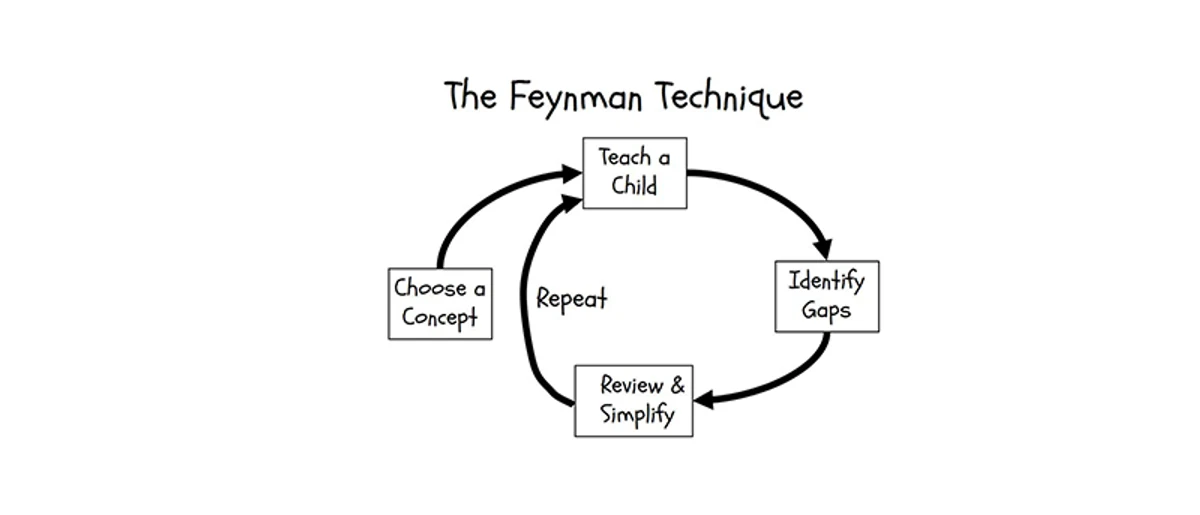
The Feynman Technique is a four-step learning process built around the act of teaching. The core insight is that attempting to explain something clearly is the most reliable way to identify what you actually understand versus what you merely think you understand.
Step 1: Choose a Concept
Select a specific concept, topic, or idea you want to understand. Write it at the top of a blank page. Be specific — "quantum entanglement" is better than "quantum physics." The specificity forces you to define the boundaries of what you're trying to understand.
Step 2: Explain It Simply
Write an explanation of the concept as if you were teaching it to a child — or to someone with no background in the subject. Use plain language, simple analogies, and concrete examples. No jargon allowed. No technical terms unless you can define them in plain language first.
Step 3: Identify Gaps
When your explanation breaks down — when you reach for jargon instead of plain language, when you use circular definitions, when you can't give a concrete example, when a critical step in the explanation is missing — you've found a gap. These gaps are not failures. They are the most valuable output of the technique: precise locations of incomplete understanding.
Step 4: Simplify and Refine
Return to your source material — not to copy the explanation, but to understand the specific part that was unclear. Then rewrite your explanation, filling the gaps you identified. Repeat until the explanation is complete, clear, and free of borrowed jargon. The test: could someone with no background actually follow this explanation?
The technique's power comes from the interaction between steps two and three. The attempt to explain without jargon is not the point — it is the mechanism for finding the gaps. Jargon is a hiding place for incomplete understanding: technical terms allow us to gesture at concepts without actually explaining them. The prohibition on jargon forces the exposure of every gap, because every technical term you reach for is a place where you've outsourced the explanation to a label rather than providing the actual understanding.
Step-by-Step: How to Apply It
Setting Up the Session
The Feynman Technique works best with pen and paper rather than a computer, for a specific reason: the physical act of writing is slower than typing, which forces more deliberate thinking and makes it harder to produce fluent-sounding but hollow explanations. You should be writing to yourself — not producing a polished document, but genuinely working through what you know and don't know.
Action Steps
- Choose one concept and write it at the top of a blank page. Don't choose a whole subject — choose the specific piece you want to understand. "Bayesian updating" not "probability theory." "How the immune system recognizes pathogens" not "immunology."
- Write everything you currently know about it in plain language. Don't look anything up yet. This draft is a test of current understanding, not a research document. Write as if explaining to a curious ten-year-old who is smart but has no background.
- Identify every place your explanation falters. Mark these explicitly: "I don't actually know why this is true." "I used this term but can't define it without circular reasoning." "I don't have a concrete example for this." "I can't explain the mechanism, only the outcome." These marks are your learning agenda.
- Go back to your sources for the specific gaps only. Read to understand the mechanism behind each gap, not to re-read everything. Then close the book and rewrite that portion of your explanation in plain language again.
- Use analogies actively. For every abstract concept, try to find a concrete analogy from everyday experience. A good analogy is not decoration — it is evidence of genuine understanding, because constructing it requires you to identify the structural similarities between the concept and the familiar thing.
- Test the final explanation. Ideally, explain it to an actual person with no background. Their confusion will reveal residual gaps you didn't notice. If no person is available, read your explanation aloud — the act of hearing your own explanation makes gaps more visible than reading it silently.
The Analogy Construction Test
Feynman's favorite test of his own understanding was whether he could construct a good analogy. A useful analogy requires identifying the structural relationship between two things — which means understanding the mechanism of the original concept well enough to find something else that works the same way. You cannot construct a genuinely useful analogy by surface description; you need the mechanism.
If you're struggling to find an analogy for a concept, that struggle itself is diagnostic: it means you haven't yet identified the underlying mechanism clearly enough. The search for an analogy is not a rhetorical exercise — it is an epistemic test that forces mechanistic understanding.
Why It Works: The Cognitive Science
The Feynman Technique is not just a teaching trick — it is grounded in several well-established cognitive science principles that explain why explaining produces deeper learning than passive exposure.
The Testing Effect
Decades of research on memory and learning have established what cognitive scientists call the "testing effect" or "retrieval practice effect": attempting to recall information from memory produces stronger, more durable learning than re-reading or re-studying the same material. The act of retrieval — even when it fails — strengthens the memory trace more effectively than passive exposure.
The Feynman Technique's second step — writing everything you know without looking — is a retrieval practice exercise. The attempt to explain without notes forces retrieval, and the points where retrieval fails (the gaps) are precisely the points that need more encoding. Studying those specific gaps and then attempting retrieval again produces far more efficient learning than reviewing the whole topic again from the beginning.
The Generation Effect
A related phenomenon: material that is generated by the learner — constructed in their own words rather than copied from a source — is remembered better and understood more deeply than material that is passively received. When you rewrite a concept in plain language, construct an analogy, and fill in gaps with your own explanations, you are generating rather than copying. The generation process creates multiple retrieval routes and forces deeper processing of the material.
Elaborative Interrogation
A closely related technique from educational psychology: "elaborative interrogation" — asking "why" and "how" about each piece of information rather than accepting it at face value. Why is this true? How does this mechanism work? What would change if this weren't the case? These questions force the kind of mechanistic processing that distinguishes understanding from familiarity. The Feynman Technique operationalizes elaborative interrogation by requiring an explanation that answers all the "why" and "how" questions implicitly — you can't give a plain-language explanation without answering them.
Metacognitive Calibration
Perhaps the most important cognitive function of the Feynman Technique is its effect on metacognition — your awareness of your own understanding. The illusion of explanatory depth documented by Fernbach and Sloman is a failure of metacognition: people don't know what they don't know. The Feynman Technique is a systematic metacognitive calibration tool: it reliably produces an accurate assessment of what you actually understand by forcing you to demonstrate it rather than self-report it.
This calibration function is directly valuable for the circle of competence problem — one of the most reliable ways to audit your actual circle is to apply the Feynman Technique to the domains where you believe you have competence. The gaps you find are the edges of your actual circle, not your perceived one.
Feynman Technique in Practice: Real Examples
Example 1: Compound Interest
Most people know that compound interest means "interest on interest." Can they explain it simply? Try: "When you put money in a savings account, the bank pays you a percentage of what you have. Next time, it pays you that same percentage — but now of the bigger amount that includes last time's interest. So each period you earn interest on slightly more than before, which means the growth accelerates over time. The longer you wait, the faster the number grows — not because anything changes about the rate, but because the base keeps getting bigger."
That explanation works without jargon and makes the mechanism clear. Now test it: can you explain why the growth is exponential rather than linear? Can you give a concrete numerical example? Can you explain why the effect is small early and dramatic later? Working through these questions using the technique is how plain-language explanation becomes genuine understanding.
Example 2: Natural Selection
"Animals that have traits helping them survive long enough to reproduce will have more offspring than animals without those traits. Since offspring inherit traits from parents, over many generations the helpful traits become more common and harmful ones less common. Nothing is 'trying' to evolve — it's just that the ones with better-suited traits leave more descendants, so the next generation looks more like them."
Gaps that typically appear in this explanation: Why does reproduction require survival long enough to produce offspring? (Not all traits that help survival also help reproduction.) Why don't traits revert to the mean? (The mechanism of inheritance — how traits are transmitted — needs explanation.) What's the actual mechanism of variation? (Mutation, recombination — this is where most plain-language explanations break down.) Each gap is a learning target.
Example 3: Sunk Cost Fallacy
"Money you've already spent can't be unspent — it's gone regardless of what you do next. So the fact that you've spent it shouldn't affect your decision about what to do next. But people feel like they need to 'make good' on past spending by continuing to invest in something, even when the best forward-looking decision is to stop. The feeling is understandable — waste feels bad — but it leads to making bad future decisions to justify past bad ones, which makes things worse."
This explanation is serviceable. Gap: Why do humans have this bias at all? What was the evolutionary or social function that produced it? (This question leads into the psychology of commitment, loss aversion, and consistency — each of which requires its own explanation.) The technique reveals not just gaps in the current explanation but adjacent concepts worth understanding.
Adapting for Complex and Technical Topics
The standard objection to the Feynman Technique for highly technical subjects — advanced mathematics, quantum physics, molecular biology — is that they genuinely cannot be explained without technical language. This objection is partially right and mostly wrong.
It's right that some concepts require technical vocabulary once you're working at the frontier of a field — the vocabulary exists because it encodes distinctions that plain language can't make efficiently. But it's wrong to conclude that the Feynman Technique therefore doesn't apply. What changes for technical topics is the audience level: instead of explaining to a curious ten-year-old, you explain to a curious first-year student in the field, or a curious expert from an adjacent field.
The Modified Test for Technical Topics
For technical material, the test is not "can a ten-year-old follow this?" but "can someone with a general undergraduate education follow this, using only terms I explicitly define?" The prohibition on borrowed jargon still applies — you can use technical terms, but every one of them must be defined in your explanation, not assumed to be known. And the underlying mechanism must be explained, not just labeled.
Feynman himself demonstrated that even quantum mechanics could be explained at multiple levels of depth, each one using only the vocabulary established in the layers below. The Nobel Prize lecture he gave was accessible to physicists from adjacent fields. His popular books made the concepts accessible to educated laypeople. The mechanism was the same — build from foundations, explain each term, never gesture at what you haven't actually explained.
Building Concept Maps
For complex multi-concept topics, a useful extension of the Feynman Technique is the concept map: a visual diagram showing the concepts in a domain and the relationships between them. Building a concept map forces you to identify not just whether you understand individual concepts but whether you understand how they relate — which connections are causal, which are correlational, which are definitional, and which you can't actually articulate.
The gaps in a concept map are often more revealing than gaps in a linear explanation, because they expose the relationship-level misunderstandings that a sequential explanation can gloss over. You might understand each node but not know why they connect — which is a different and deeper kind of gap than not knowing a definition.
Common Mistakes and How to Avoid Them
Mistake 1: Explaining to Yourself
Writing an explanation you already understand — one that uses your existing vocabulary and assumes your existing context. This produces a document that feels like an explanation but tests nothing, because you're explaining to someone (yourself) who already knows the answer.
Fix: Explicitly imagine a specific, concrete other person — someone you know who has no background in this topic. Write for that person. When you reach for jargon, ask "would they know what this means?"
Mistake 2: Copying Instead of Generating
Looking at the source material while writing the explanation. This defeats the retrieval practice function of the technique and allows you to produce fluent-sounding explanations by copying rather than understanding.
Fix: Always write step 2 from memory. Only open the source material in step 4, and only for the specific gaps you've identified. Close it again before rewriting.
Mistake 3: Settling for Partial Explanations
Accepting an explanation that is mostly clear with a few vague parts as "good enough." The vague parts are exactly where the genuine gaps are — the parts you're glossing over are the parts you don't actually understand.
Fix: Mark every vague sentence explicitly. "I'm not clear on this mechanism." "I don't have an example for this." Don't finalize any explanation that contains marked passages.
Mistake 4: Skipping the Analogy
Producing an explanation that is technically accurate but entirely abstract — no concrete examples, no analogies, no real-world illustrations. This explanation may be correct but doesn't demonstrate genuine understanding, because genuine understanding always enables concrete application.
Fix: Every explanation must contain at least one concrete analogy or example for each key concept. If you can't produce one, you haven't understood the mechanism well enough yet.
Building a Feynman Learning Practice
The Feynman Technique is most powerful not as an occasional intervention when you need to understand something difficult, but as a regular practice that systematically deepens understanding across the domains that matter most to you.
The Weekly Concept Review
Choose one concept per week from your current area of study or professional practice. Apply the full Feynman process: blank page, plain language explanation, gap identification, targeted study, revised explanation. Over a year, this produces 52 deeply understood concepts — a much smaller number than you could have read about, but a qualitatively different kind of understanding.
The accumulation of deeply understood concepts compounds in the way that all knowledge compounds — each genuinely understood concept creates a richer foundation on which subsequent concepts are understood more quickly and more deeply. The weekly Feynman review is not 52 isolated learning events; it's 52 additions to an interconnected understanding structure that grows more valuable with each addition.
The Pre-Meeting Feynman Test
Before any meeting where you'll be expected to understand and discuss technical material, apply a quick Feynman test: take five minutes to explain the core concepts to yourself in plain language. Every place where you reach for jargon without being able to define it is a gap to fill before the meeting — which is far better than discovering the gap during it.
The Post-Learning Audit
After completing any significant learning activity — a course, a book, an intensive research period — apply the Feynman Technique to the five most important concepts. This serves two functions: it consolidates genuine understanding and it reveals which concepts you only thought you understood, giving you a specific remediation agenda rather than a vague sense that you need to review.
Feynman's Deeper Lesson
The Feynman Technique is ultimately an expression of an intellectual ethic: the commitment to actually understand things rather than to appear to understand them. Feynman himself maintained this ethic throughout his career — not because it was strategically useful (though it was) but because he genuinely could not tolerate the hollowness of pretended understanding. The technique works because it embodies this ethic in a concrete practice.
The deeper lesson is that the standard we hold ourselves to in learning determines what we actually learn. If the standard is "can I recognize this in a test?" we learn to recognize. If the standard is "can I explain this to someone who knows nothing?" we learn to understand. The Feynman Technique changes the standard — and changing the standard changes the outcome. For building the broader thinking toolkit that genuine understanding enables, see the complete guide to mental models for success and first principles thinking — the combination of these frameworks with deep Feynman-style understanding produces the kind of knowledge that actually transfers to novel situations.


