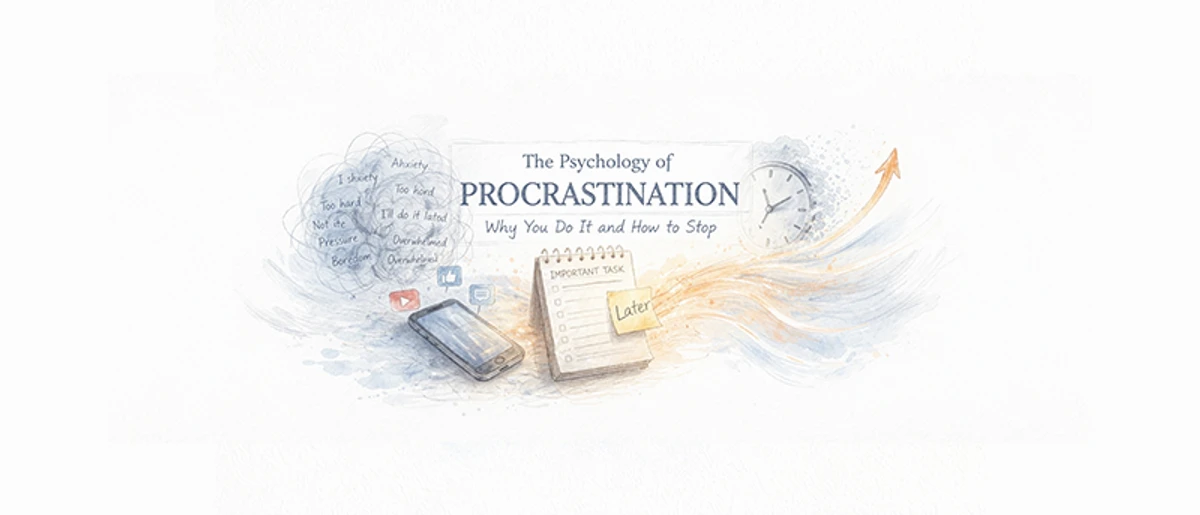
You know the feeling. The important task sits on your list. You are aware of it. You intend to do it. And yet hours pass — filled with emails answered, surfaces cleaned, articles read, anything but the thing that actually matters. You are not lazy. You are not undisciplined. You are experiencing one of the most well-studied psychological phenomena in human behavior, and understanding it correctly is the first step toward changing it for good.
What Procrastination Actually Is (Not What You Think)
The most consequential misconception about procrastination is that it is a time management problem. This framing leads to the most common and least effective interventions: better calendars, stricter schedules, more detailed to-do lists. If procrastination were a time management problem, these tools would fix it. They don't — and the reason they don't reveals what procrastination actually is.
Procrastination researcher Fuschia Sirois and her colleagues have established through extensive research that procrastination is fundamentally an emotion regulation problem. When you procrastinate, you are not failing to manage your time — you are succeeding at managing a negative emotional state. The avoided task generates anxiety, boredom, self-doubt, resentment, frustration, or some other aversive feeling, and procrastination is the strategy your brain deploys to escape that feeling immediately, at the cost of your future self's time, stress, and opportunity.
This reframe has profound practical implications. It explains why willpower-based approaches to procrastination consistently fail: telling yourself to "just do it" does nothing to address the underlying emotional aversion. It explains why procrastinators often complete tasks they enjoy efficiently and delay only specific categories of work — the delay is not about time management capacity but about specific emotional responses to specific types of tasks. And it points toward the interventions that actually work: ones that address the emotional experience of the avoided task, not just its scheduling.
The Research Definition
Procrastination researcher Piers Steel, who has synthesized over 800 studies on the subject, defines procrastination as "the voluntary delay of an intended action despite expecting to be worse off for the delay." This definition highlights three critical features: the delay is voluntary (not forced by circumstances), the intention to act exists (procrastinators typically want to do the task), and the person knows the delay is harmful. Procrastination is not forgetting to do something or rationally deprioritizing it — it is knowing you should do something, intending to do it, and choosing not to anyway.
The Emotional Roots of Procrastination
The specific emotions that trigger procrastination vary by person and task, but research has identified the most common culprits. Anxiety is the most prevalent — fear of failure, fear of judgment, fear that the completed work won't be good enough. Boredom is the second most common — tasks that feel tedious, repetitive, or disconnected from meaningful goals generate a low-level aversion that accumulates into chronic avoidance. Resentment — a sense that the task has been imposed unfairly or conflicts with one's values — is a significant but underrecognized trigger, particularly in workplace procrastination.
Self-doubt is another powerful driver: the implicit belief that you are not capable of doing the task well enough creates an anticipatory shame that makes starting feel dangerous. If you never start, you can never fail — a psychologically coherent defense that is practically catastrophic. And frustration — the emotional response to tasks that feel blocked, unclear, or dependent on factors outside your control — triggers avoidance as reliably as anxiety.
What makes the emotional root important is that it determines which interventions will work. Anxiety-driven procrastination responds to interventions that reduce the perceived stakes and increase the sense of competence. Boredom-driven procrastination responds to interventions that increase the intrinsic interest of the task. Resentment-driven procrastination responds to reconnecting the task to personally meaningful values. Identifying which emotion is driving your avoidance in a specific situation is the first step toward selecting the right response — which is why generic productivity advice so often fails: it doesn't address the specific emotional driver that is active for you.
Emotional Triggers of Procrastination
Anxiety — fear of failure, judgment, or inadequacy
Boredom — tasks that feel tedious or meaningless
Self-doubt — implicit belief you can't do it well enough
Resentment — tasks that feel imposed or unfair
Frustration — unclear, blocked, or ambiguous tasks
Overwhelm — tasks that feel too large to begin
What Procrastination Provides
Immediate relief from the aversive emotional state
Temporary protection from the risk of failure or judgment
The illusion of control — choosing when to act
Short-term mood improvement through distraction
Maintained self-image — "I could have done it if I'd tried"
The Six Types of Procrastinator
Not all procrastination is the same, and not all procrastinators share the same psychological profile. Researchers and clinicians have identified several distinct procrastinator types, each driven by different underlying dynamics and responding to different interventions.
The perfectionist procrastinator delays because standards are impossibly high — starting means risking a gap between the imagined ideal and the actual output. The dreamer procrastinator has large visions but finds the details tedious and difficult, and delays the implementation that would make the vision real. The worrier procrastinator delays due to anxiety about uncertainty and change, preferring the familiar discomfort of the current state to the unknown discomfort of action. The crisis-maker procrastinator delays until the pressure of an imminent deadline creates the adrenaline needed to override the avoidance — a pattern that works in the short term but accumulates stress and reduces output quality over time.
The overdoer procrastinator takes on too many commitments and then procrastinates on all of them because there is genuinely not enough time, creating a chronic overwhelm that feels like procrastination but is partly a capacity problem. And the defier procrastinator resists tasks that feel externally imposed, procrastinating as an implicit assertion of autonomy — the delay is not about the task but about the relationship to whoever assigned it.
Identifying which type resonates most strongly is diagnostically useful because the interventions differ. Perfectionist procrastinators need permission to produce imperfect first drafts. Worrier procrastinators need to reduce uncertainty through planning and incremental commitment. Defier procrastinators need to reconnect tasks to their own values rather than experiencing them as external impositions. The generic advice to "just start" addresses none of these specific dynamics and fails predictably as a result.
The Neuroscience: Your Brain on Procrastination
Neuroimaging research on procrastination has identified a consistent pattern: chronic procrastinators show greater amygdala activity and weaker connections between the amygdala and the dorsal anterior cingulate cortex (dACC) compared to non-procrastinators. The amygdala is the brain's emotional alarm system — it processes threat and generates avoidance responses. The dACC is responsible for translating intentions into actions. When the connection between these regions is weak, the emotional alarm generated by an aversive task more easily overrides the intention to act on it.
This neurological picture clarifies why procrastination feels involuntary even when the person knows rationally they should be working. The amygdala's aversion response is faster than conscious deliberation — it shapes behavior before the prefrontal cortex has had time to override it. By the time you're consciously aware that you've opened social media instead of starting the report, the avoidance has already happened. This is also why emotional regulation skills are central to procrastination management: the capacity to recognize and tolerate the aversive emotional response to a task, rather than immediately escaping it, is the neurological prerequisite for sustained work on difficult things.
The research also implicates the dopamine system. Tasks with clear, proximate rewards activate the dopamine reward circuitry reliably. Tasks with distant, abstract, or uncertain rewards activate it weakly. Procrastination is partly a dopamine allocation problem: your brain is preferentially directing dopaminergic attention toward high-reward, low-effort activities (scrolling, social media, entertaining content) and away from the low-immediate-reward, high-effort activities that actually matter for long-term goals. Understanding the dopamine dynamics of the digital age is directly relevant here — the attention economy is deliberately optimized to win the competition for your dopaminergic engagement.
Perfectionism and Procrastination
The relationship between perfectionism and procrastination is one of the most consistent findings in the literature, and one of the most misunderstood. The common assumption is that perfectionism causes procrastination by raising the bar so high that starting feels impossible. The research picture is more nuanced: not all perfectionism leads to procrastination, and the specific type of perfectionism matters enormously.
Researchers distinguish between self-oriented perfectionism (high personal standards applied to oneself) and socially prescribed perfectionism (the belief that others have impossibly high standards for you and that failing to meet them will result in negative judgment or rejection). Self-oriented perfectionism, when combined with self-compassion, can actually support performance — the high standards drive quality without the avoidance that fear of judgment produces. Socially prescribed perfectionism, however, is strongly associated with procrastination because the anticipated judgment creates exactly the anxiety-based avoidance response that drives delay.
The practical implication is that perfectionism-driven procrastination is not primarily about standards — it is about the relationship between your self-worth and your performance. When your identity is contingent on performing well, every task becomes a self-worth referendum. Not starting is a protection strategy: an unfinished task cannot be judged, and an unjudged task cannot threaten the self-image. The intervention is not to lower standards but to decouple self-worth from performance — to develop the psychological security to produce imperfect work without experiencing it as evidence of personal inadequacy. This connects directly to the growth mindset research: people with a growth mindset treat output as information about their current process, not as a fixed judgment of their worth, which makes starting far less threatening.
Why Self-Criticism Makes It Worse
The instinctive response to procrastination — for the procrastinator and for anyone advising them — is self-criticism. You should be working. You're lazy. You're failing. Just do it. This response is not only unhelpful; it actively worsens procrastination. The research on this is unambiguous and important.
A landmark 2010 study by Michael Wohl and colleagues found that students who forgave themselves for procrastinating on their first exam were significantly less likely to procrastinate on the second exam. Self-forgiveness broke the procrastination cycle; self-criticism sustained it. The mechanism is straightforward: self-criticism generates shame and anxiety, which are themselves aversive emotional states — exactly the kind of states that trigger further avoidance. Beating yourself up for procrastinating adds a new layer of emotional aversion on top of the original task aversion, making the whole situation more emotionally threatening and therefore more likely to be avoided.
Kristin Neff's research on self-compassion provides the theoretical framework here. Self-compassion — treating yourself with the same kindness and understanding you would extend to a friend in the same situation — is not self-indulgence or lowered standards. It is the psychological safety that makes honest self-assessment and constructive change possible. Procrastinators who practice self-compassion show reduced shame, reduced emotional avoidance, and better follow-through on intended actions. The counterintuitive finding is consistent: being kinder to yourself about procrastinating is more effective at reducing procrastination than being harsher.
The Self-Compassion Reframe
When you notice you've been procrastinating, try this reframe: "I've been avoiding this because it generates [anxiety/boredom/self-doubt — name the specific emotion]. That's a normal human response to an aversive experience. A lot of people feel this way about similar tasks. I can choose to act despite that feeling." This three-component response — acknowledging the emotion, normalizing it, and committing to action despite it — is the structural application of self-compassion to procrastination and consistently outperforms self-criticism in research settings.
Temporal Discounting: Why the Future Self Loses
One of the most powerful mechanisms underlying procrastination is temporal discounting — the well-documented tendency to value immediate rewards more highly than equivalent future rewards, and to underweight future costs relative to immediate ones. The farther away a consequence is in time, the less psychological weight it carries in the present moment's decision-making.
For procrastination, this means that the immediate relief of not doing the aversive task is weighted far more heavily than the future cost of the delay — even when the person can accurately predict that the cost will be substantial. The deadline that is two weeks away generates less urgency than the one that is two hours away, even when the two-week task is objectively more important. The stress of a missed deadline two weeks from now is less vivid and emotionally present than the immediate discomfort of starting the report now.
Neuroimaging research suggests that we experience our future selves in a way that is neurologically similar to how we experience strangers — with less emotional identification and less felt responsibility. This is why procrastination can be understood as a form of harm to your future self: you are transferring stress, work, and consequences to a person who feels psychologically distant, even though that person is you. Hal Hershfield's research has shown that people who feel a stronger sense of psychological continuity with their future selves procrastinate less and make better long-term decisions. Strategies that make the future self feel more vivid, real, and personally relevant — writing a letter to your future self, visualizing yourself experiencing the consequences of delay — have measurable effects on procrastination behavior.
Task Aversion: The Real Trigger
If procrastination is emotion regulation in response to an aversive emotional state, then the key variable is not your character or discipline — it is the specific properties of the avoided task that generate aversion. Piers Steel's research identified the task characteristics most reliably associated with procrastination: tasks that are boring, frustrating, difficult, ambiguous, unstructured, or lacking in intrinsic meaning. Tasks that are enjoyable, clear, structured, and personally meaningful are rarely procrastinated — even by chronic procrastinators.
This means that task design is a more powerful intervention than character development. Making the avoided task less aversive — by clarifying it, breaking it into smaller pieces, finding aspects that connect to intrinsic values, or pairing it with inherently rewarding elements — addresses the root cause more directly than exhortations to be more disciplined. The most aversion-generating tasks tend to share a specific feature: they are large, vague, and have no clear first action. "Work on the business plan" generates more aversion and more procrastination than "write the executive summary section of the business plan today between 9 and 10 am."
The flow state research is directly relevant here: the task properties that enable flow — clear goals, immediate feedback, appropriate challenge level — are also the properties that reduce task aversion and procrastination. Designing tasks for flow is, simultaneously, designing tasks against procrastination. The two are different framings of the same intervention: making the work itself more engaging to the brain that has to do it.
Evidence-Based Strategies That Actually Work
With the psychological mechanisms clear, the effective interventions become specific and derivable. Here are the strategies with the strongest research support:
Action Steps
- Implementation intentions: specify when, where, and how. Research by Peter Gollwitzer found that forming "if-then" implementation intentions — "If it is 9am on Monday and I am at my desk, then I will open the document and write the first paragraph" — more than doubles follow-through rates compared to simple goal intentions ("I will work on the report this week"). The specificity eliminates the decision-making that precedes action and creates a conditional reflex that fires when the triggering conditions are met. The more specific the implementation intention, the more reliably it works.
- The two-minute rule for task initiation. The most aversion-generating moment is the transition from not-working to working. Commit only to starting — to doing two minutes of the task, no more required. In most cases, the actual starting reduces the aversion substantially because the dreaded task turns out to be less terrible in practice than in anticipation. The commitment to stop after two minutes eliminates the psychological threat of the full task and reduces the barrier to initiation to near zero. This is the behavioral application of the insight that task aversion is highest before starting, not during the work itself.
- Temptation bundling. Developed by Katherine Milkman, temptation bundling pairs an intrinsically rewarding activity you want to do with an aversive task you've been avoiding. Allow yourself to listen to an engaging podcast only while doing administrative work. Allow yourself a specific enjoyable activity only after completing the avoided task. This directly addresses task aversion by pairing the aversive task with an immediate reward, changing its emotional valence from purely negative to mixed. Milkman's research showed significant improvements in gym attendance and other avoided behaviors through systematic temptation bundling.
- Reduce task ambiguity before ending each work session. One of the most reliable procrastination triggers is starting a session without knowing exactly what to do first. Before finishing each work session, spend five minutes defining precisely what the first action will be next time: "Tomorrow I will open the spreadsheet and fill in columns D through G for the Q1 data." This eliminates the cold-start problem that makes initiation most difficult and reduces the cognitive load at the moment when resistance is highest.
- Practice self-compassion when you notice avoidance. As the research above establishes, self-criticism worsens the procrastination cycle and self-compassion interrupts it. When you notice you've been procrastinating, practice the three-step self-compassion response: name the aversive emotion driving the avoidance, normalize it as a common human experience, and recommit to action. This is not indulgence — it is the psychologically accurate response that the research shows is more effective at changing behavior than shame and self-criticism.
- Make your future self vivid. Write a short paragraph describing what your life will look like in six months if you consistently avoid the category of work you've been procrastinating on. Then write a paragraph describing what it will look like if you follow through consistently. Read both at the beginning of each work session. This intervention draws on Hershfield's research on future-self continuity: the more vivid and emotionally present the future self becomes, the more the present-moment decision-making system weighs future consequences appropriately.
- Use commitment devices to make avoidance costly. Commitment devices — mechanisms that make future procrastination materially costly — are one of the most effective behavioral interventions for chronic procrastination. Public commitments to specific deliverables by specific dates, financial stakes tied to completion (platforms like Beeminder formalize this), accountability partnerships with meaningful social consequences for non-delivery. The mechanism is temporal discounting reversal: by making the cost of avoidance immediate rather than future, commitment devices restore the decision-making balance that temporal discounting distorts.
Building Systems That Make Procrastination Harder
Individual strategies address specific procrastination moments. Systems make avoidance structurally more difficult and action structurally easier — which is a more durable solution than relying on repeated acts of willpower. The goal of system design is to change the default: instead of action requiring an effortful override of avoidance, avoidance should require an effortful override of action.
Environmental design is the most powerful lever. Remove distraction-generating applications from your primary work devices. Use website blockers during work blocks — tools like Freedom or Cold Turkey that require deliberate effort to override create the friction needed to interrupt automatic avoidance behavior. Create a physical workspace that is associated exclusively with focused work, not with leisure or distraction, so that the environmental cue of being at your desk activates a working-mode association rather than a neutral or avoidance-mode one.
Accountability structures are the social equivalent. A weekly accountability partner who you report your intended and actual outputs to creates a social commitment mechanism that operates differently from private intentions. The anticipation of having to report non-completion to someone whose opinion you value engages loss aversion (the pain of losing face) in the service of follow-through. Research consistently shows that public commitments outperform private ones, and that accountability partnerships improve follow-through substantially over self-monitoring alone.
The habits research is also directly applicable: reducing the activation energy required to start is more reliable than increasing willpower. Lay out your work materials the night before. Have the document open when you sit down. Position your workspace so that starting work requires fewer steps than not starting it. James Clear's concept of reducing friction for desired behaviors and increasing friction for avoidance behaviors is one of the most practical frameworks for making your environment work for follow-through rather than against it. His book Atomic Habits provides the most complete treatment of this approach and is the single most recommended resource for anyone serious about behavioral change.
The Weekly Procrastination Audit
Once a week, review the tasks you consistently avoid and ask three questions: What is the specific emotional response this task generates for me? What type of procrastinator am I being with this task (perfectionist, worrier, overwhelmed, resentful)? What is the minimum first action that would constitute progress? The audit converts vague avoidance into specific psychological material you can work with, and consistently generates clearer next actions that reduce the ambiguity that task aversion feeds on. Five minutes of this reflection weekly is more useful than an equivalent amount of time spent in self-recrimination about not having done the work yet.
When to Seek Professional Support
For most people, the strategies and systems above are sufficient to substantially reduce procrastination and its costs. But chronic, severe procrastination — particularly when it is producing significant consequences in career, finances, relationships, or mental health — can be a symptom of underlying conditions that benefit from professional attention. Attention-deficit/hyperactivity disorder (ADHD) involves neurological differences in executive function that make task initiation and sustained effort genuinely harder, not just emotionally aversive. Depression reduces motivation and the felt connection to future consequences in ways that overlap substantially with procrastination. Anxiety disorders can drive avoidance that goes beyond normal task aversion. If procrastination is pervasive across all domains, resistant to behavioral interventions, and accompanied by significant distress, a clinical assessment is worth pursuing.
Conclusion: Procrastination Is a Solvable Problem
The insight that transforms the relationship with procrastination is simple but underappreciated: you are not procrastinating because there is something wrong with your character. You are procrastinating because a normal human brain is doing exactly what it is designed to do — avoiding immediate discomfort. The discomfort is real. The avoidance is functional. And neither of those facts makes procrastination less costly.
What changes things is not more self-discipline applied to the same ineffective approaches. It is understanding the specific emotional mechanism driving your avoidance in each situation, selecting the intervention matched to that mechanism, and building environmental systems that make action the path of least resistance rather than avoidance. This is a solvable engineering problem, not a character flaw requiring correction.
Start with the smallest possible step on your most avoided task. Not the full task — just the first two minutes of it. The research is clear about what happens next: starting is the hardest part, and once you've started, the aversion that seemed insurmountable typically drops to a manageable level within minutes. The task that looked threatening from the outside is almost always less threatening from the inside. That discovery — repeated enough times — is what gradually dismantles the procrastination habit and replaces it with something more useful: the experience of tolerating discomfort long enough to find out it was survivable.
Your First Step: The Two-Minute Commitment
Identify the single task you have been avoiding longest. Right now — before finishing this article — write down what the first two minutes of that task would look like. Not the full task: just the opening action. "Open the document." "Write one sentence." "Make one phone call." Commit to doing exactly that much today — two minutes, nothing more required. Use this as your entry point. The research strongly suggests that in most cases, you will continue past two minutes once you've started. But even if you don't, you will have interrupted the avoidance pattern once — and that interruption is where lasting change begins.
Further Reading
📚 Recommended Reading



Affiliate links — we may earn a small commission at no extra cost to you.