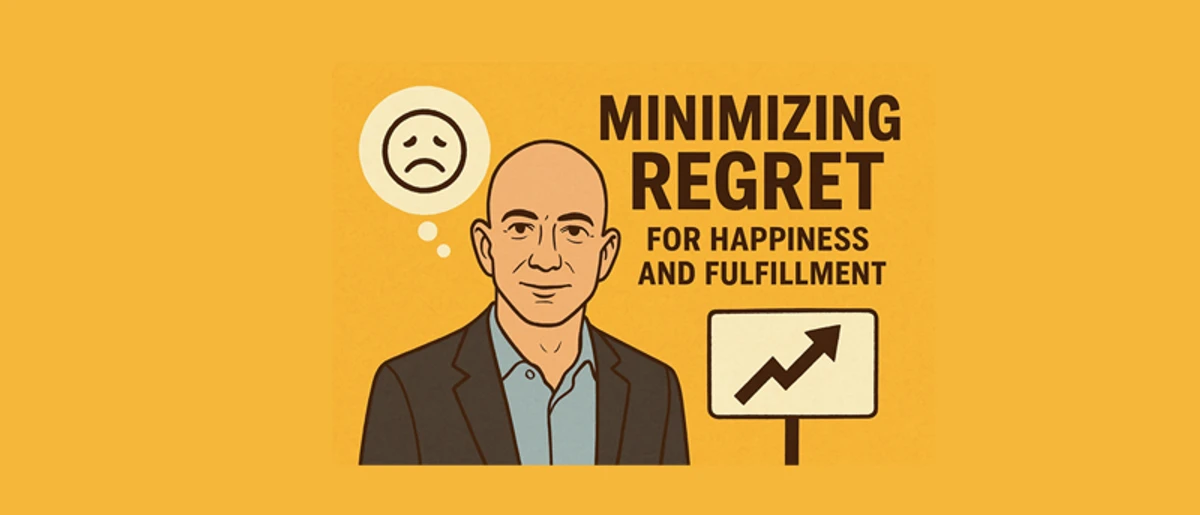
In 1994, Jeff Bezos had a comfortable, well-paying job at D.E. Shaw, one of the most prestigious quantitative hedge funds on Wall Street. He was on a career trajectory that most people would have envied and defended. Then he read about the explosive growth of the internet and began thinking about whether to leave and start a company. The framework he used to make that decision — projecting himself forward to age 80 and asking what he would regret — became one of the most widely cited decision-making tools of the last 30 years.
The Decision That Changed Everything
Bezos has described the decision-making process for founding Amazon in several interviews, most notably in a 2010 Princeton commencement address. The situation in 1994 was genuinely difficult: he had a well-paying job, a clear career path, and a supportive employer (his boss at D.E. Shaw, David Shaw, actually tried to convince him to stay, and Bezos describes Shaw as being very reasonable about it). Leaving for an internet startup was objectively risky — most internet companies of that era failed, and the business model was unproven.
Bezos in His Own Words
"I wanted to project myself forward to age 80 and say, 'Okay, now I'm looking back on my life. I want to have minimized the number of regrets I have.' I knew that when I was 80 I was not going to regret having tried this. I was not going to regret trying to participate in this thing called the Internet that I thought was going to be a really big deal. I knew that if I failed I wouldn't regret that, but I knew the one thing I might regret is not ever having tried."
The framework resolved the decision immediately for Bezos. The question was not "should I risk my comfortable job?" but "at age 80, looking back, which version of this decision would I regret more?" The answer was obvious from the 80-year perspective in a way it wasn't from the 30-year-old present perspective. The present-day anxiety — the financial risk, the career risk, the social risk of leaving a prestigious job — shrank dramatically when viewed through the lens of an 80-year-old evaluating a life.
Bezos has said he gives himself credit for being able to make unconventional choices comfortably, and he attributes much of that comfort to the regret minimization framework. It converts a decision that feels overwhelming from the perspective of present-day stakes into a decision that feels obvious from the perspective of lifetime meaning.
The Regret Minimization Framework Explained
The Regret Minimization Framework is a decision-making tool for major, long-horizon life choices — the ones where the stakes feel highest and the fear of the wrong decision is most paralyzing. It has three essential components.
Action Steps
- Project yourself to age 80. Imagine yourself at the end of a full life, with the clarity of retrospection. You are looking back at the decision you're currently facing. You can see how your life unfolded from both possible choices. You have the perspective that comes from living with the consequences rather than fearing them.
- Ask which choice you would regret more. Not which was safer. Not which was more financially optimal. Not which made other people more comfortable. Which version of the decision, looking back from 80, would produce the deeper, more lasting regret? The one where you took the risk and it didn't work out — or the one where you never tried?
- Make the decision that minimizes that regret. Once the 80-year-old perspective makes the regret asymmetry clear, the decision becomes straightforward. The framework doesn't promise the outcome will be good. It promises the decision will be made with the right time horizon and the right criterion.
The power of the framework lies in the temporal shift it creates. Most major life decisions are evaluated from an immediate perspective — the present-day costs and risks are vivid and specific, while the future benefits are abstract and uncertain. The regret minimization framework reverses this asymmetry: it makes the future cost of inaction (regret) vivid and specific, while allowing present-day fears to be seen in their proper proportion from a lifetime perspective.
What the Framework Is Not
The Regret Minimization Framework is not a tool for everyday decisions — it would be paralyzingly slow for routine choices. Bezos himself applies it specifically to "the major decisions in life" — the ones where the choice has long-term, difficult-to-reverse consequences and where the fear of getting it wrong tends to produce inaction by default. For routine decisions, faster heuristics are more appropriate. The regret framework is for the decisions that genuinely deserve the most careful deliberation.
The Psychology of Regret: What Research Shows
The Regret Minimization Framework is grounded in a substantial body of psychological research on how regret actually works — what produces it, how long it lasts, and how it differs from other forms of negative emotion.
Regret vs. Disappointment
Regret and disappointment are distinct emotions that arise from different cognitive appraisals. Disappointment occurs when an outcome is worse than expected, regardless of the choice made. Regret occurs specifically when a bad outcome is attributed to a choice you made — when you can clearly imagine a better alternative path that was available. The "if only I had..." quality is essential to regret; it requires a counterfactual — an alternative that could have been chosen but wasn't.
This distinction matters because regret is specifically sensitive to the choices you make and don't make, not just to outcomes. A bad outcome that resulted from a reasonable decision under uncertainty produces disappointment but rarely lasting regret. A bad outcome that resulted from failing to act on a clear opportunity — or from ignoring a clear warning — produces regret that can persist for decades.
The Temporal Pattern of Regret
Research by Carrie Shu and colleagues on the temporal dynamics of regret shows a consistent pattern: in the short term, people tend to regret actions (things they did that turned out badly) more than inactions (things they didn't do). But over longer time horizons — months, years, decades — this pattern reverses. The regrets that prove most persistent and most painful are overwhelmingly regrets of inaction: chances not taken, paths not pursued, relationships not maintained, risks not accepted.
Gilovich and Medvec on Long-Term Regret
Thomas Gilovich and Victoria Medvec's landmark research on regret found that when people describe their biggest life regrets, inactions dominate: the major they didn't pursue, the career change they didn't make, the relationship they didn't pursue, the risk they didn't take. Actions that turned out badly — bad investments, failed relationships, wrong career moves — are more painful in the short term but tend to be resolved and integrated over time. Inactions that precluded meaningful paths tend to remain open wounds, because the imagined alternative path ("what might have been") remains available as a source of persistent counterfactual regret.
This temporal asymmetry is exactly what the Regret Minimization Framework exploits. By projecting to age 80, it forces evaluation from the time horizon where inaction regrets dominate — rather than the present-day time horizon where action regrets feel most salient. The framework essentially accelerates the psychological process that naturally converts action-regret into inaction-regret over decades, making the long-term perspective available at the moment of decision.
Why We Regret Inaction More Than Action
The consistent finding that long-term regret is dominated by inactions rather than actions has a specific psychological explanation. Understanding the mechanism makes the framework more compelling and more applicable.
The Counterfactual Availability Problem
When you take an action that turns out badly, the actual outcome is a fact. It happened. You know what it produced. Over time, you adapt to it, find meaning in it, or at least achieve psychological closure on it — the outcome is finalized and the counterfactual ("what would have happened if I hadn't done this?") becomes increasingly speculative and inaccessible.
When you fail to take an action, the imagined alternative remains perpetually available. "What might have happened if I had started that company?" never gets resolved because you never started it. "What would that relationship have been?" never gets answered. The counterfactual stays open and continues to generate regret, because it can always be imagined as better than the path you actually took — and the imagination is unconstrained by the disappointments and complications that would have inevitably occurred on the other path.
Adaptation and Rationalization
Psychologist Daniel Gilbert's research on affective forecasting shows that humans consistently overestimate how long negative outcomes will make them unhappy. We have a "psychological immune system" that adapts to bad outcomes — we find silver linings, revise our expectations, find meaning in adversity, and eventually achieve equanimity about things that seemed devastating in prospect. This adaptation occurs for actions that turn out badly: the failed startup, the bad investment, the wrong career move — these are painful but ultimately adapted to.
The adaptation is much weaker for inaction regrets. Because the inaction didn't produce a concrete outcome, there's nothing concrete to adapt to — only the persistent imagination of the alternative path. The psychological immune system can't close the wound because the wound has no defined shape. This is why inaction regrets tend to fester while action regrets tend to heal. The Regret Minimization Framework is implicitly calibrated to this asymmetry: it specifically asks which regret you'd rather have in the long run, not in the short run.
The 'I Can't Believe I Never Tried' Regret
The most persistent and painful form of long-term regret is not "I tried and failed" — it is "I never tried." The person who attempts a bold move and fails has a concrete story: they tried, it didn't work, they learned, they moved on. The person who never attempts has only the permanent question: "What would have happened?" The first story has an ending. The second never does. The regret minimization framework is specifically designed to make this distinction visible before the decision is made, rather than after.
How to Apply the Framework
The framework is conceptually simple but requires genuine effort to apply well. The 80-year-old perspective is easy to invoke superficially and easy to invoke badly. Here is a protocol for using it rigorously.
Creating the 80-Year-Old Perspective
The projection to age 80 is not just a mental exercise — it requires genuinely inhabiting the perspective, which takes deliberate effort. The 80-year-old version of you has different information, different priorities, and different emotional relationships to the decision than your current self does. Accessing that perspective requires temporary suspension of current concerns and fears.
Action Steps
- Find physical quiet. The framework works poorly when you're rushed, anxious, or surrounded by immediate pressures. It requires the cognitive space to genuinely project forward — which means removing yourself from the immediate context of the decision, at least temporarily.
- Construct the 80-year-old context specifically. Don't just think "when I'm 80." Think about what your life will actually look like: your relationships, your health, the world context, what will and won't matter. The more specific the projection, the more useful the perspective.
- Explicitly consider both paths. Imagine your life at 80 on Path A (you took the action) and your life at 80 on Path B (you didn't). Both include the realistic downsides — Path A includes the possibility of failure; Path B includes the possibility that the thing you feared turned out to be manageable. Which life has more regret?
- Notice what the 80-year-old you actually cares about. Not what you currently believe you should care about — what the experienced version of you, with the benefit of a full life's perspective, would actually evaluate as meaningful. The current fear of financial risk often looks much smaller from 80 than it does from 30.
- Ask the specific regret question. "At 80, which version of this decision would I regret more — having taken this action and had it not work out, or not having taken it and lived with the question?" Answer honestly, not aspirationally.
When the Answer Is Ambiguous
The framework works most cleanly when one option clearly dominates from the 80-year perspective. When it doesn't — when both paths produce roughly equal imagined regret — that ambiguity is itself informative. It usually means either that the decision is genuinely close and you should use other frameworks to evaluate the specifics, or that the decision is less important than it feels and the anxiety is disproportionate to the actual stakes.
Ambiguity in the regret minimization framework is not a failure of the framework — it's useful signal. If your 80-year-old self doesn't clearly prefer one path, the decision is probably not the momentous life-defining choice it feels like from the inside. That realization is itself clarifying: it often converts a paralyzing decision into a manageable one.
What the Framework Clarifies
The Regret Minimization Framework is particularly effective at resolving certain specific types of decision confusion that other frameworks handle poorly.
Status Quo Bias
The status quo is always available as the safe default option — the choice that requires no action and produces no immediate risk. Status quo bias systematically overweights this option relative to its actual long-term value, because its opportunity costs are invisible and its risks are zero in the immediate term.
The regret minimization framework directly counteracts status quo bias by making the long-term cost of the status quo — the accumulated regret of paths not taken — vivid from the 80-year perspective. The question is no longer "should I disrupt my comfortable current situation?" but "at 80, will I regret having stayed in this comfortable situation?" For genuinely important opportunities, the answer is often yes — and the framework makes that answer available before it becomes irreversible. This connects to the opportunity cost framework — the regret minimization framework makes the opportunity cost of inaction visceral rather than abstract.
Decisions Where the Framework Excels
Major career pivots or entrepreneurial leaps. Pursuing a creative project you've been postponing. Moving to a new city or country for opportunity. Pursuing a relationship or ending a stagnant one. Going back to school or pursuing significant skill development. Any decision where fear of failure is the primary obstacle to action.
Decisions Where It's Less Useful
Reversible, low-stakes choices where the decision can be corrected if it turns out wrong. Decisions involving others' welfare where your regret minimization may not capture the full ethical picture. Decisions where the 80-year perspective is genuinely too distant to be informative — for very near-term concerns, a 5-year or 10-year horizon may be more appropriate.
Fear Calibration
The most common obstacle to bold decisions is not genuine analysis of likely outcomes — it's fear that has lost its proportionality to actual risk. The fear of leaving a stable job feels enormous at 30; at 80, the question of whether you kept a specific job at 30 is almost certainly irrelevant. The fear of starting a company and failing feels catastrophic in the moment; the actual consequences of most startup failures — you learn something, you find a new job, life goes on — are manageable in ways the fear doesn't reflect.
The 80-year perspective calibrates these fears by placing them in a lifetime context. The worst realistic outcome of most bold decisions looks much smaller from 80 than it does from the present. The framework doesn't eliminate legitimate risk assessment — it restores proportion to the risk assessment, preventing the fear of immediate failure from dominating decisions that should be evaluated on much longer time horizons.
The Limits and Risks
The Regret Minimization Framework is genuinely powerful for the decisions it's designed for, and genuinely problematic when misapplied. Understanding its limits is as important as understanding its applications.
The Survivorship Bias Risk
Bezos founded Amazon and it became the most successful e-commerce company in history. His use of the regret minimization framework and his extraordinary success have made the framework famous. But many other people have used the same framework, projected themselves to age 80, decided they wouldn't regret taking the risk, and then failed. The framework helped Bezos make his decision — it did not guarantee his outcome. Conflating the decision quality with the outcome quality is survivorship bias.
The regret minimization framework is a decision-making tool, not a prediction of success. It helps you make the decision that is most aligned with your values and least likely to produce lasting regret — regardless of outcome. A bold decision made with this framework that fails is still, in the framework's terms, better than the paralysis that would have left you with the persistent "what if" regret. But that framing requires genuine acceptance of the possibility of failure before the decision is made, not just rhetorical acknowledgment of it.
The Motivated Projection Problem
The 80-year-old perspective is a projection — a mental construction — and projections are vulnerable to motivated reasoning. If you already know what you want to do, the "80-year-old version of yourself" will conveniently confirm that choice. The framework can become a sophisticated rationalization engine rather than a genuine decision tool.
The guard against this is to genuinely inhabit both paths — not just the path you want to take. Spend equal time imagining the life where you don't take the risk: what do you build instead? What alternative goods come from the stable path? Is the regret on the stable path actually as strong as it feels, or have you constructed a strawman of the alternative? The framework is only as honest as the projection is balanced.
When Regret Is Not the Right Criterion
Regret minimization is a criterion centered on your own subjective experience. For decisions that significantly affect others — family, employees, partners, community — minimizing your personal regret may not be the right criterion. A decision that you won't regret can still be harmful to others, and the 80-year-old perspective is limited by its focus on your own life story.
For decisions with significant ethical dimensions or significant impact on people close to you, regret minimization should be one input among several rather than the primary criterion. The framework is most cleanly applicable to personal life choices where the primary affected party is you.
Combining with Other Frameworks
The Regret Minimization Framework works best as part of an integrated decision toolkit rather than in isolation. It is particularly powerful when combined with specific complementary tools.
With Inversion
Inversion thinking asks: what would guarantee failure on each path? What are the most reliable failure modes? This complements regret minimization by ensuring that the 80-year projection is based on realistic outcomes rather than idealized ones. The inversion analysis tests whether the bold path has fatal flaws that would turn "I tried and failed" into "I was reckless and should have known better" — a different kind of regret.
With Second-Order Thinking
The regret minimization framework naturally focuses on first-order regret: did I take this chance? Second-order thinking extends this: what are the second-order consequences of taking the action that I might regret? If the action produces second-order effects that harm others or preclude more important opportunities, the regret minimization calculation is incomplete. The 80-year-old perspective should include not just "did I take the risk?" but "what were the downstream consequences of the path I chose?"
With Opportunity Cost
Every path forecloses others — choosing one opportunity means not choosing all alternatives. The opportunity cost framework asks what the best foregone alternative is worth. The regret minimization framework asks which foregone alternative would produce more lasting regret. Together, they produce a more complete picture: the opportunity cost framework quantifies what you give up; the regret minimization framework evaluates whether you'd regret giving it up more or less than the alternative.
The Integration
The most powerful use of these frameworks together: for any major life decision, run the regret minimization framework to establish the lifetime-perspective criterion, use inversion to stress-test the preferred path against its most likely failure modes, use second-order thinking to trace downstream consequences, and use opportunity cost to make the trade-off explicit. Each framework asks a different question about the same decision, and the combination produces an analysis that is far more comprehensive than any single framework alone.
The regret minimization framework provides the emotional compass — which direction does the full life perspective point? The other frameworks provide the analytical map — what does the terrain actually look like on each path? The compass and the map together are what you need for navigating genuinely consequential decisions. For a full library of the thinking tools that complement this framework, see 15 mental models that successful people use.
Building a Regret-Aware Decision Practice
The Regret Minimization Framework is not a tool you apply once to a single decision. It is a perspective that, practiced consistently, changes your relationship with risk and inaction across the full range of important choices.
The Annual Regret Review
Once a year, ask yourself: what am I currently not doing that my 80-year-old self would regret? This is not a to-do list of bold actions — it is a deliberate search for the specific things you're avoiding through fear, inertia, or excessive caution. The annual review catches the gradual accumulation of small inactions before they compound into significant regrets.
The Decision Journal Regret Dimension
For significant decisions, add a regret minimization entry to your decision journal: record the question "at 80, which path would produce more regret?" at the time of the decision. Revisit this entry years later to see how your perspective evolved and whether the framework's prediction proved accurate. Over time, this builds calibration — you learn which types of decisions your 80-year-old perspective reliably clarifies and which it handles less well.
The "Good Story" Test
Bezos has a related heuristic he calls the "good story" test: when making decisions, consider whether the decision will make a good story when you're telling the narrative of your life. This is a less formal version of the regret minimization framework — it accesses the same lifetime perspective by asking about narrative rather than regret. Decisions that make good stories are usually ones where you acted with courage, took meaningful risk, learned something, and ended up somewhere interesting — regardless of whether the specific outcome was positive. Decisions that make poor stories are ones where you chose safety, avoided discomfort, and stayed exactly where you were.
The Deepest Application
The Regret Minimization Framework, at its deepest application, is not a decision tool. It is a life philosophy: the commitment to live in a way that the fullest perspective — the perspective of a life fully lived — would endorse. This means regularly asking what the accumulated sum of your choices is building, whether the trajectory of your days reflects your actual values or merely your fears, and whether the version of yourself at the end of a long life would recognize the life being built now as genuinely yours.
Bezos has spoken about this dimension explicitly: the framework helped him not just with the Amazon decision but with a broader orientation toward his life — toward acting rather than deferring, toward taking the risks that align with his values rather than the risks that optimize for safety. That orientation, practiced consistently, is the difference between a life that is fully inhabited and one that is carefully avoided. The framework is the tool; the philosophy is the destination.