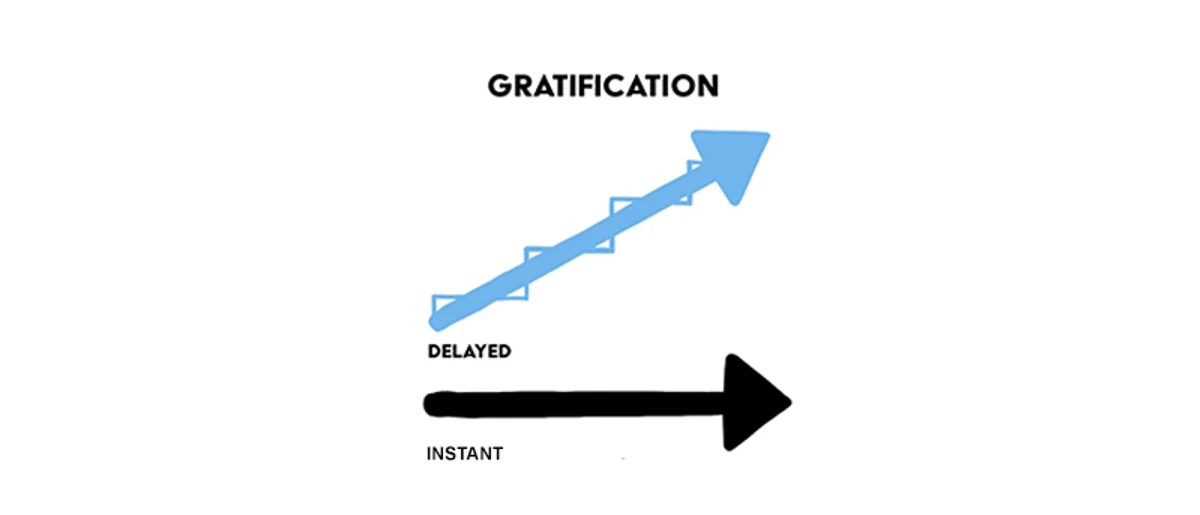
If you could identify a single psychological capacity most predictive of long-term success across health, wealth, relationships, and career — delayed gratification would be a strong candidate. The ability to trade immediate reward for larger future benefit is not just self-control in the ordinary sense. It is a cognitive and motivational architecture that determines how you relate to time, effort, and compounding — and building it deliberately is one of the highest-leverage investments you can make in your own future.
What Delayed Gratification Actually Is
Delayed gratification is the capacity to resist an immediately available reward in order to obtain a more valuable reward later. It sits at the intersection of several psychological constructs: impulse control (inhibiting automatic responses), future orientation (valuing future outcomes), self-regulation (managing behavior toward goals), and temporal discounting (how steeply you devalue rewards as they recede into the future).
It is important to distinguish delayed gratification from simple deprivation or asceticism. The person who delays gratification is not denying themselves enjoyment — they are making a deliberate trade, exchanging a smaller immediate reward for a larger future one. The key cognitive operation is the comparison of values across time: this now versus that later. The skill lies in performing that comparison accurately and acting on it consistently rather than being captured by the immediate option simply because it is present and the future option is abstract.
The Compounding Connection
Delayed gratification and compounding are the same phenomenon viewed from different angles. Compounding is what happens in the world when you consistently defer consumption in favor of reinvestment — whether of money, effort, skill, or relationships. Delayed gratification is the psychological capacity that makes compounding behaviorally possible. Every compounding success story — from Warren Buffett's investment returns to the skill development of elite performers — is, at its psychological root, a story about the sustained capacity to choose future value over present comfort. This is why we explore compounding extensively in our article on mental models used by successful people.
The Marshmallow Studies: What They Really Showed
Walter Mischel's marshmallow experiments, conducted at Stanford's Bing Nursery School in the late 1960s and early 1970s, became one of the most cited studies in psychology. Children aged four to six were offered one marshmallow immediately or two marshmallows if they could wait fifteen minutes while the researcher left the room. Follow-up studies tracking participants into adolescence and adulthood found that children who waited longer showed better SAT scores, lower BMI, lower rates of substance abuse, better social skills, and more positive life outcomes across multiple domains.
These findings launched decades of research and popular fascination with delayed gratification. However — as we discussed in our article on the science of self-control — the picture is more complex than the popular account suggests. A 2018 replication by Tyler Watts and colleagues with a larger, more representative sample found that when socioeconomic background and cognitive ability were controlled for, the predictive power of marshmallow-waiting dropped substantially. Many children who couldn't wait were making rational decisions based on their experience of whether adults in their environment kept promises.
What the marshmallow studies most clearly demonstrate is not that some children have superior willpower, but that the capacity to delay gratification is embedded in a broader psychological and environmental context — including trust in the reliability of future rewards, cognitive tools for managing present temptation, and the degree to which long-term thinking has been modeled and rewarded in the child's environment. This contextual understanding is what makes delayed gratification a trainable skill rather than a fixed trait.
Temporal Discounting: Why the Brain Devalues the Future
The psychological mechanism underlying difficulty with delayed gratification is temporal discounting — the universal human tendency to assign lower value to rewards as they recede further into the future. A reward available now is worth more to us, psychologically, than the same reward available in a week — and substantially more than the same reward available in a year. This discount rate varies enormously between individuals and is one of the most powerful predictors of financial decision-making, health behavior, and long-term goal pursuit.
Temporal discounting is not irrational — it reflects genuine uncertainty about the future. A reward now is certain; a reward later depends on many things going right. The problem arises when discount rates are so steep that people systematically choose options that serve short-term comfort at the expense of long-term welfare — turning down investments that would clearly be beneficial if they could be evaluated coolly, choosing immediate consumption over savings that compound dramatically, or avoiding difficult-but-worthwhile activities because the reward feels too distant to motivate present effort.
High Temporal Discounting
Future rewards feel psychologically distant and abstract.
Immediate rewards trigger strong approach motivation.
Long-term consequences feel less real than present temptations.
Results in systematically short-sighted decisions across domains.
Associated with impulsivity, lower savings rates, poorer health outcomes.
Low Temporal Discounting
Future rewards feel psychologically vivid and real.
Immediate rewards are evaluated in their long-term context.
Long-term consequences weigh heavily in present decisions.
Results in more patient, strategic decision-making.
Associated with wealth accumulation, better health, career achievement.
The Neuroscience of Waiting
Neuroimaging studies of delayed gratification reveal a consistent pattern: immediate rewards activate the limbic system — particularly the nucleus accumbens and ventral striatum — generating strong approach motivation that is visceral and immediate. Future rewards activate the prefrontal cortex more selectively, engaging the deliberative, planning-oriented neural systems that can evaluate options across time but are less emotionally compelling in the moment.
Samuel McClure and colleagues' 2004 neuroimaging study showed that when people face choices between immediate and delayed rewards, two competing neural systems are engaged. The limbic system fires strongly for immediate rewards and weakly for future ones. The prefrontal-parietal system engages more evenly across time horizons and is selectively activated when people choose delayed rewards. The capacity to delay gratification, at a neural level, is the capacity of the prefrontal system to modulate the limbic system's immediate reward signal — the same prefrontal-limbic dynamic we explored in our article on the neuroscience of self-control.
Critically, this prefrontal capacity is strengthened by the same practices that improve self-regulation generally: mindfulness meditation (which strengthens prefrontal-limbic connectivity), deliberate practice of choosing future over present options, and the habit formation that makes patient behavior automatic rather than effortful. The brain that practices delaying gratification becomes structurally better at it — which is the deepest argument for building this capacity through consistent practice rather than relying on momentary willpower.
Why Delayed Gratification Predicts So Much
The predictive power of delayed gratification across life domains is explained by a simple insight: almost everything worthwhile requires accepting short-term costs for long-term benefits. Fitness requires consistent effort today for health decades hence. Wealth requires saving and investing rather than consuming. Deep expertise requires years of deliberate practice before it becomes genuinely useful. Meaningful relationships require sustained investment of time and vulnerability before they develop the trust and depth that make them valuable. Career achievement requires learning, credentialing, and demonstrated competence before the opportunities it enables become available.
In each case, the person who can consistently choose the future benefit over the present comfort accumulates compounding advantages that the person who cannot simply cannot access. And because these compounding advantages accrue across every domain simultaneously, the effect on life outcomes is multiplicative rather than additive. A modest capacity for delayed gratification, applied consistently across health, finances, relationships, and career over decades, produces outcomes that appear dramatically disproportionate to the self-control involved in any single decision.
"The ability to discipline yourself to delay gratification in the short term in order to enjoy greater rewards in the long term is the indispensable prerequisite for success." — Brian Tracy
This is the same compounding dynamic that successful people's thinking patterns consistently leverage — their long-term orientation is not just a cognitive preference but a practical strategy for accessing the benefits that only compound over time.
The Role of Environment and Trust
One of the most important lessons from the revisionist marshmallow research is that delayed gratification is not purely an individual psychological capacity — it is deeply embedded in environmental context. Children from unstable environments where promised rewards frequently fail to materialize have learned, rationally, that the future is unreliable and present certainty is more valuable than future possibility. Their apparent inability to delay gratification is, in many cases, accurate calibration to their actual environment.
This has two practical implications. First, building the capacity for delayed gratification requires building trust in the reliability of future rewards — which means creating stable, predictable environments and commitments, both personally and for others. Second, it means that the most effective interventions for building delayed gratification are not purely psychological (teaching children to distract themselves from marshmallows) but environmental and relational: creating reliable systems, honoring commitments consistently, and demonstrating that future rewards are trustworthy.
For adults, this translates directly to the systems-based approach to self-control explored in our article on why discipline beats motivation. The person who has built reliable systems — automated savings, scheduled workouts, structured work sessions — has effectively made the future reward more certain and immediate, reducing the psychological distance that makes delayed gratification difficult. The system converts a future benefit into a present commitment, changing the psychological math of the trade-off.
Mischel's Strategies: What Actually Helps People Wait
Walter Mischel's research did not just document that some children waited longer — it identified the specific cognitive strategies that enabled them to do so. These strategies are not about exerting more willpower but about changing the psychological representation of the immediate reward in ways that reduce its motivational pull.
Cognitive Distancing
Children who successfully waited tended to mentally distance themselves from the immediate reward — thinking about the marshmallow as a picture rather than a real object, imagining a frame around it, or thinking of it as something far away. This cognitive distancing reduces the visceral appeal of the immediate reward without requiring the suppression of desire — which tends to backfire by making the suppressed item more salient.
Abstraction
Thinking about the reward in abstract rather than concrete terms significantly reduces its immediate motivational pull. Thinking "I can have two marshmallows later" is more effective than vividly imagining eating them. The abstract representation activates the deliberative prefrontal system rather than the visceral limbic response that concrete sensory imagination triggers. This abstraction strategy applies broadly: thinking abstractly about temptations rather than concretely reduces their pull in virtually every domain.
Attention Redirection
Simply redirecting attention — thinking about something else entirely, or focusing on a non-reward aspect of the situation — was one of the most effective strategies children used spontaneously. This is not suppression; it is redirection. The goal is not to think about the temptation and resist it but to occupy attention with something else so the temptation loses its grip through neglect rather than through active resistance.
The If-Then Implementation Intention
For adults, one of the most research-supported strategies for delayed gratification is the implementation intention: a specific if-then plan created in advance that pre-commits your response to a temptation before it arises. "If I feel the urge to check social media during deep work, I will write it down and check during my scheduled break." "If I'm tempted to spend impulsively, I will wait 48 hours before purchasing." These pre-commitments convert a moment of temptation from an active decision point — where the immediate option has disproportionate pull — into an automatic execution of a pre-decided plan. The research on implementation intentions consistently shows dramatically better follow-through than simple intention alone.
Systems Over Willpower: The Smarter Approach
The research on delayed gratification consistently points toward a counterintuitive conclusion: the people who are best at it rely on willpower the least. Rather than heroically resisting temptation in the moment, they design their environments and decision structures so that temptation rarely needs to be resisted directly.
Ulysses pre-committed to his mast before he heard the Sirens — not because he trusted his in-the-moment willpower, but because he understood that it would fail. The modern equivalents are everywhere: automated savings transfers that remove money before you can spend it, not keeping junk food in the house, blocking distracting websites during work hours, paying for a gym membership that creates accountability, scheduling difficult conversations rather than hoping the motivation to have them arises organically. Each of these is a pre-commitment device — a structural arrangement that makes the future-oriented choice the default, so that in-the-moment willpower is rarely the critical variable.
This systems orientation is the practical bridge between understanding delayed gratification and actually practicing it. As we explore in the article on habits, discipline, and momentum, the goal of good systems design is to make desired behavior automatic and undesired behavior inconvenient — which is precisely what pre-commitment devices accomplish for delayed gratification specifically.
How to Build Delayed Gratification Deliberately
Delayed gratification is a skill — and like all skills, it can be strengthened through deliberate practice. The following sequence reflects what the research most consistently supports as an effective approach to building this capacity over time.
Action Steps
Daily Practices for Long-Term Thinking
Delayed gratification is not built through occasional heroic acts of willpower — it is built through consistent small practices that gradually reorient your relationship with time, reward, and the future. The following daily practices, applied over months, produce a genuine shift in your temporal discounting rate and your default orientation toward the future.
The Future Self Journal
Spend five minutes each morning writing from the perspective of your future self — one year, five years, or ten years from now. What decisions did the version of you who became that person make today? What did they choose not to do? What did they invest in that paid off? This practice, developed from Hal Hershfield's research on future self-continuity, reduces temporal discounting by strengthening the psychological connection between your present self and your future self — making the future reward feel less like it belongs to a stranger and more like it belongs to you. Combined with the growth mindset that makes future investment feel worthwhile, the resilience to persist through the long gaps between effort and reward, and the intrinsic motivation that sustains engagement beyond any particular outcome, delayed gratification becomes the behavioral expression of a complete psychological system oriented toward compounding achievement. For the foundational reading on building these long-term habits, Atomic Habits by James Clear remains the most practical guide available, and Poor Charlie's Almanack offers the most compelling real-world demonstration of what decades of patient, compounding investment in knowledge and judgment can produce.


