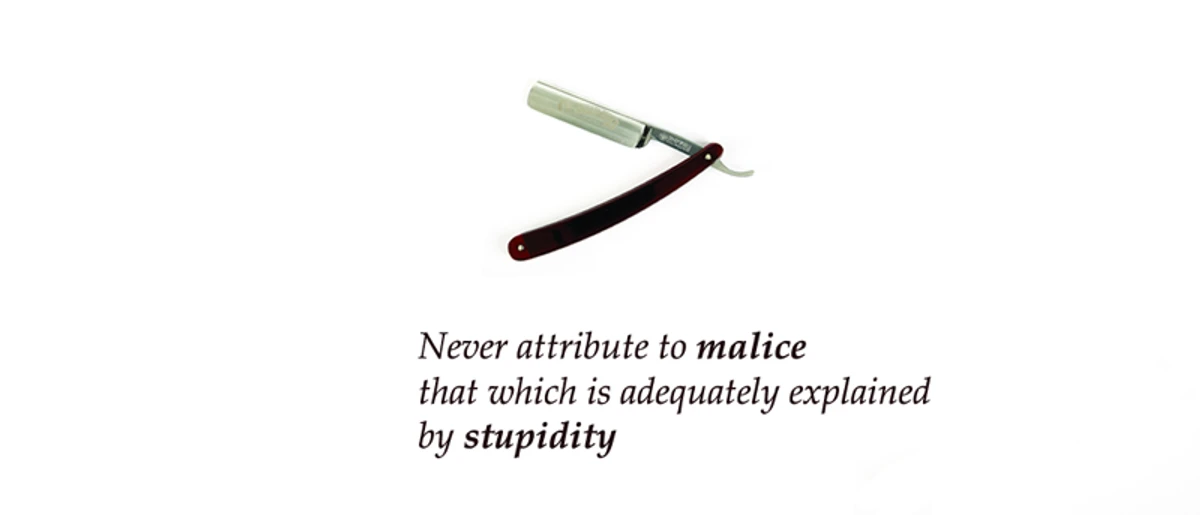
Someone cuts you off in traffic. A colleague doesn't respond to your email. A policy is implemented that makes your work harder. The mind's default response to these experiences is often the same: they did it on purpose. Hanlon's Razor offers a different starting point — one that is usually more accurate, almost always more productive, and substantially less corrosive to your peace of mind and your relationships.
What Is Hanlon's Razor?
Hanlon's Razor is an aphorism and heuristic: "Never attribute to malice that which is adequately explained by stupidity." In its more charitable form, it is sometimes stated as: "Never attribute to malice that which can be adequately explained by ignorance, incompetence, negligence, or carelessness."
The principle is an application of Occam's Razor to human behavior. When an action produces a bad outcome for you, there are two broad categories of explanation: the person intended to harm you (malice), or the person was not thinking carefully, didn't understand the consequences, made a mistake, or was simply indifferent rather than hostile (stupidity/incompetence/negligence). Hanlon's Razor says to start with the latter category — not because malice never occurs, but because incompetence, negligence, and indifference are dramatically more common.
The Core Logic
Genuine malice — the deliberate, intentional desire to harm a specific person — requires several conditions to be simultaneously true: the person must have noticed you specifically, formed a negative intention toward you specifically, and taken deliberate action to harm you while concealing that intention.
Incompetence, negligence, and indifference require only one condition: that the person was not careful, attentive, or thoughtful enough to avoid the outcome. Since the second category requires far fewer assumptions and describes the default operation of ordinary human cognition, it is the more probable explanation in almost every situation.
Origin and Variations
The exact origin of Hanlon's Razor is debated. It is commonly attributed to Robert J. Hanlon, who submitted it to a 1980 compilation called "Murphy's Law Book Two." However, similar ideas appear much earlier in the historical record.
Napoleon Bonaparte is sometimes quoted with a version: "Never ascribe to malice that which is adequately explained by incompetence." Goethe's Maxims and Reflections contains: "Misunderstandings and neglect create more confusion in this world than trickery and malice." Robert Heinlein wrote in "Logic of Empire" (1941): "You have attributed conditions to villainy that simply result from stupidity."
The principle clearly reflects a recurring insight across cultures and centuries — that people consistently overattribute harmful outcomes to deliberate hostile intent rather than to the more mundane explanations of inattention, incompetence, and thoughtlessness. The consistency of this insight across such different contexts suggests it is tracking something genuine about human cognition and human behavior.
The Spectrum of Explanations
A more complete version of Hanlon's Razor recognizes that the full spectrum of non-malicious explanations is wider than "stupidity" alone:
Ignorance: They didn't know their action would affect you this way.
Incompetence: They tried to do something correctly but lacked the skill.
Negligence: They didn't think carefully enough about consequences.
Indifference: They didn't care about your experience specifically, though not hostile to you.
Overwhelm: They were managing too many things and something fell through the cracks.
Each of these is more common than deliberate malice in most everyday and professional contexts. The razor points to the whole category of non-malicious explanations, not just stupidity in the narrow sense.
Why We Default to Malice
If non-malicious explanations are usually more probable, why does the mind so readily reach for malicious ones? The answer lies in the interaction of several cognitive tendencies.
The Fundamental Attribution Error
Lee Ross's fundamental attribution error — one of the most replicated findings in social psychology — describes the tendency to overattribute others' behavior to their character and intentions while underattributing it to situational factors. When someone cuts you off in traffic, the mind attributes it to their character (they're aggressive, inconsiderate, hostile) rather than their situation (they didn't see you, they're distracted by an emergency, their visibility is poor).
The attribution to character produces malice-adjacent interpretations: if their behavior reflects who they are, and their behavior harmed you, they are the kind of person who harms people. The attribution to situation produces Hanlon-compatible interpretations: their behavior reflects circumstances that produced a bad outcome without reflecting any hostile intent.
Threat Detection and Evolutionary Mismatch
Human threat detection evolved in an environment where genuinely hostile actors were a significant and immediate danger. The cost of failing to detect a hostile actor was potentially fatal; the cost of falsely detecting hostility in a non-hostile person was merely social discomfort. This asymmetry drove the evolution of a threat-detection system biased toward false positives — better to assume malice when there is none than to miss malice when it exists.
In the modern world, this bias produces systematic errors. The vast majority of negative interactions are not produced by genuinely hostile actors — they are produced by the same everyday inattention, incompetence, and self-absorption that characterizes ordinary human cognition. But the threat-detection system, calibrated for a different environment, keeps flagging them as potentially hostile.
Ego Protection and Narrative Coherence
Attributing bad outcomes to malice offers a specific psychological benefit: it makes you the victim of deliberate hostility rather than simply someone who experienced an unfortunate but impersonal outcome. Victimhood of deliberate malice is narratively coherent in a way that random incompetence is not — it implies significance, it identifies a clear antagonist, and it justifies strong emotional responses that might otherwise seem disproportionate.
This narrative function is why malice attributions are particularly common in situations where self-esteem is at stake. If your colleague's dismissive response to your idea reflects their general inattention rather than deliberate disrespect, the experience is mundane. If it reflects their deliberate dismissal of you specifically, it becomes personally significant — and the emotional intensity it produces feels more proportionate to the perceived slight.
The Probability Case for Hanlon's Razor
Beyond the cognitive science, there is a straightforward probabilistic case for Hanlon's Razor that makes it compelling even without any emotional or relational benefits.
Consider the population of people you interact with in a typical day or week: colleagues, strangers, service providers, family members, acquaintances. Now ask: what proportion of the negative outcomes you experience from these interactions are the result of deliberate hostile intent, versus inattention, incompetence, negligence, or indifference?
For most people in most contexts, the honest answer is that deliberate malice is rare — probably under 5% of negative interactions, and likely much less. The other 95%+ are produced by the ordinary failures of human attention and competence that characterize everyone, including yourself.
The Base Rate Test
Apply base rate thinking to any specific situation. Your colleague didn't respond to your email. What's the base rate for each explanation?
Deliberate avoidance (malice-adjacent): Occurs in some fraction of email non-responses, concentrated in situations of known conflict.
Email overlooked: Extremely common — the average knowledge worker receives 100+ emails per day.
Forgot to respond after reading: Very common, happens to everyone regularly.
Caught up in something urgent: Common, especially in busy organizations.
The base rate for deliberate avoidance is substantially lower than the base rate for any of the non-malicious explanations. Hanlon's Razor is simply the instruction to let base rates guide your initial interpretation.
Applications: Where It Changes Everything
Personal Relationships
In personal relationships, malice attribution is one of the most reliable accelerants of conflict. When a partner, friend, or family member does something that hurts you, interpreting it as deliberate hostility produces a fundamentally different response than interpreting it as thoughtlessness or poor communication. The malice interpretation demands confrontation and defense; the Hanlon interpretation opens the possibility of understanding what actually happened and addressing it constructively.
John Gottman's research on relationship quality found that one of the four factors most predictive of relationship failure — which he called "contempt" — involves exactly this dynamic: attributing your partner's hurtful behavior to deep character flaws and hostile intent rather than to situational factors and ordinary human imperfection. Couples who maintain Hanlon-compatible interpretations ("they didn't realize how that would land") have qualitatively different outcomes from couples who default to malice-adjacent ones ("they knew exactly what they were doing").
Workplace Dynamics
In workplace settings, malice attribution creates a specific and destructive dynamic: once a colleague or manager is perceived as deliberately hostile, all subsequent interactions are interpreted through that lens. Neutral actions become evidence of hostility; ambiguous communication becomes confirmation of bad intent; coincidental difficulties become deliberate obstruction.
Most workplace friction that escalates to serious conflict has a Hanlon-compatible origin: unclear communication, different priorities, competing pressures, and the general chaos of organizational life produce outcomes that feel hostile but weren't intentionally produced. The escalation happens when one party attributes the friction to malice and begins responding as if under deliberate attack — which typically produces genuinely defensive or hostile responses from the other party, confirming the original malice attribution in a self-fulfilling dynamic.
Hanlon's Razor Applied
Scenario: Your manager assigns a high-profile project to a colleague rather than you.
Malice interpretation: They're deliberately undermining your career, showing favoritism, trying to squeeze you out.
Hanlon interpretation: They thought the colleague was a better fit for this particular project, didn't fully consider your interest in it, or made the decision quickly without thinking through all the implications.
Different response: Malice → defensive posturing and resentment. Hanlon → conversation about your career development and interest in future opportunities.
The Conversation Test
Hanlon's Razor doesn't mean passively accepting outcomes that affect you negatively — it means approaching the conversation from a different starting position.
From malice attribution: "Why are you doing this to me?" (confrontational, assumes hostile intent)
From Hanlon attribution: "I wanted to understand the decision — I was interested in that project and would like to understand what factors were considered." (curious, assumes good faith, opens dialogue)
The second approach produces useful information; the first produces defensiveness.
Customer and Service Interactions
Service failures — delayed packages, billing errors, incorrect orders, unhelpful support — are almost never the result of deliberate malice toward any individual customer. They are the result of systemic failures, human error, inadequate training, and the sheer complexity of large-scale operations. Interpreting them as personal affronts produces an emotional response that is both disproportionate and counterproductive.
The practical benefit of Hanlon's Razor in service interactions: approaching a service failure as a systemic problem to be solved rather than a personal attack to be avenged produces better outcomes. The calm, specific, solution-focused customer gets better results than the outraged, attributing-malice customer — because they're treating the person on the other end as a fallible human trying to help rather than as the face of a conspiracy against them.
Hanlon's Razor in Organizations
Organizations produce enormous volumes of outcomes that affect their members negatively: poor decisions, unclear communication, inconsistent policies, resource constraints, leadership failures. The interpretation of these outcomes — as malice or incompetence — has profound effects on organizational culture and individual wellbeing.
Policy and Bureaucracy
Bureaucratic processes and organizational policies frequently produce outcomes that seem designed to frustrate. The temptation is to attribute them to deliberate obstruction — someone, somewhere, made these rules to make your work harder. The Hanlon-compatible explanation is almost always more accurate: the rules were made by people who weren't thinking carefully about all use cases, or who were solving different problems than the ones you're currently facing, or who no longer work at the organization and left behind policies nobody remembers the rationale for.
The practical difference: malice attribution produces resentment of the organization and cynicism about its intentions. Hanlon attribution produces a diagnostic question — why does this policy exist? — which often leads to either understanding why it makes sense or identifying a legitimate process for changing it.
Leadership Decisions
When leadership makes decisions that negatively affect employees — restructuring, budget cuts, strategy pivots — malice attribution is common and almost always incorrect. Leaders making these decisions are typically operating under constraints, with incomplete information, under time pressure, and often with genuine intention to serve the organization's long-term interests. The decisions may be wrong; they are almost never malicious.
Organizations where employees default to Hanlon-compatible interpretations of leadership decisions have qualitatively different cultures from those where malice attribution dominates. The former have difficult conversations about reasons and tradeoffs; the latter have grievance cycles that produce neither understanding nor constructive change.
Politics, Media, and Conspiracy Thinking
The domain where Hanlon's Razor is most violated — and where the consequences are most severe — is political and institutional analysis. The consistent pattern in contemporary political culture is to attribute bad outcomes not to the incompetence, poor judgment, and competing interests that actually drive most policy failures, but to deliberate malicious coordination.
This attribution error produces conspiracy thinking: the belief that coordinated deliberate malice, rather than the ordinary chaos of large organizations staffed by fallible humans, is the primary cause of negative political and social outcomes. The appeal is the same as in personal malice attribution — it provides narrative coherence, identifies clear antagonists, and justifies intense emotional responses. The cost is a systematically distorted model of how institutions actually function.
The Coordination Problem
Genuine malicious coordination at scale requires an implausibly large number of things to be simultaneously true: many people must share the same hostile intention, they must coordinate effectively enough to produce the alleged outcome, they must maintain secrecy across a large group over an extended period, and they must do all of this while evading the normal countermeasures that organizations deploy against deliberate bad actors.
Each of these requirements is independently unlikely. Together they make genuinely coordinated malice at institutional scale extremely rare — far rarer than the simple incompetence, misaligned incentives, and poor judgment that are present in every large organization without requiring any conspiracy at all. Hanlon's Razor applied to institutions: before concluding coordinated malice, ask whether the same outcome would be produced by ordinary institutional dysfunction — and it usually would.
This doesn't mean institutions never act badly or that deliberate wrongdoing never occurs. It means that the base rate for institutional incompetence and dysfunction vastly exceeds the base rate for deliberate coordinated malice — and that starting with the more probable explanation produces more accurate models and more productive responses. The second-order thinking question applies here: what are the downstream consequences of attributing institutional failure to malice rather than incompetence? One answer: it prevents the accurate diagnosis needed to actually fix the problem.
When Hanlon's Razor Fails
Hanlon's Razor is a starting heuristic, not an absolute principle. There are specific situations where beginning with the charitable interpretation is genuinely incorrect and potentially harmful.
Repeated Patterns
Hanlon's Razor applies most cleanly to isolated incidents — a single negative outcome in the absence of prior history. When negative outcomes form a consistent pattern directed at a specific person, Hanlon becomes less applicable. A colleague who repeatedly "forgets" to include you in meetings, consistently fails to credit your work, and regularly interrupts you in discussions has moved beyond what simple incompetence explains. Patterns require explanation, and once a pattern is established, the prior probability of negligence falls and the prior probability of intent rises.
High-Stakes Situations with Clear Incentives
In situations where someone has clear incentives to harm you and the capacity to do so deliberately, the base rate for malice is higher than in ordinary interactions. A competitor in a zero-sum situation, someone with a demonstrated history of bad faith, or someone in a context where your failure directly benefits them deserves less initial charitable interpretation than a random stranger or colleague with no obvious incentive to harm you.
When Negligence and Malice Are Equally Bad
For certain decisions, whether harm was caused by malice or negligence doesn't change the appropriate response. A financial advisor who lost your money through deliberate fraud and one who lost it through gross negligence may deserve different moral judgments, but they deserve the same practical response: get your money back and find a new advisor. In high-stakes, irreversible situations, the distinction between malice and incompetence matters less than the fact of the harm and the prevention of future harm.
The Charitable Interpretation Trap
Hanlon's Razor can be misapplied as a reason to tolerate harmful behavior indefinitely. "They didn't mean it" is not a permanent pass for continued harm. The correct application: start with the charitable interpretation, act on it once (conversation, clarification, direct communication), and update based on the response. If the pattern continues after the charitable response, the interpretation must be updated. Hanlon's Razor governs the starting assumption, not the permanent conclusion regardless of evidence.
Building a Charitable Interpretation Practice
The goal of Hanlon's Razor is not to be naively charitable or to deny that genuine hostility exists — it is to start from the more probable interpretation and update based on evidence. This starting position requires deliberate practice, because the mind's default moves in the opposite direction.
Action Steps
- Notice the attribution you're making. When you feel wronged by someone's action, pause to identify what explanation your mind has produced. Is it malice, or is there a simpler explanation? The first step is simply noticing the attribution before acting on it.
- Generate at least three non-malicious explanations. Before accepting a malice interpretation, generate three specific, plausible non-malicious alternatives. What if they were simply overwhelmed? What if they didn't realize the impact? What if there was a miscommunication? The exercise of generating alternatives forces the mind out of the first interpretation and into a more considered one.
- Apply the base rate check. In general, how often does this kind of behavior in this kind of context reflect deliberate malice versus ordinary incompetence or negligence? Let the base rate guide your prior.
- Act on the charitable interpretation first. Respond as if the non-malicious explanation is correct — which typically means direct, curious, non-accusatory communication. "I noticed X — I wasn't sure if you were aware of how it landed" rather than "Why did you do X to me?"
- Update based on the response. If the response confirms the charitable interpretation (genuine surprise, apology, correction), it was correct. If the response reveals indifference or confirms deliberate intent, update accordingly. The razor governs the starting point, not the conclusion.
The Peace of Mind Dividend
Beyond its accuracy benefits, Hanlon's Razor has a significant wellbeing dividend. Living in a world populated by people who are mostly negligent and incompetent rather than mostly malicious is substantially more peaceful than the alternative. The emotional load of perceiving widespread deliberate hostility — the chronic vigilance, the accumulating resentment, the exhausting vigilance — is enormous. Hanlon's Razor doesn't require denying that hostile people exist; it requires recognizing that they are rarer than the pattern-matching mind suggests, and that most of the friction in daily life is impersonal rather than targeted.
This connects directly to the Stoic practice of distinguishing what is and isn't in your control. The intentions of other people are not in your control — but your interpretation of their actions is. Hanlon's Razor applied as a habitual first response produces a relationship with daily social friction that is more accurate, more proportionate, and substantially less corrosive to equanimity. Combined with the awareness of confirmation bias — which would otherwise selectively filter evidence toward confirming the malice interpretation — it produces a more reliable model of why people do what they do.
The Deepest Application
At its deepest, Hanlon's Razor is an expression of epistemic humility about other minds. You don't have direct access to other people's intentions — you only have access to their actions and the outcomes those actions produce for you. The inference from action to intention is always uncertain, and the prior probability of malicious intent in most contexts is low. Starting from that uncertainty with a charitable prior, and updating based on evidence, is not weakness or naivety — it is the most accurate response to the actual epistemic situation you're in when trying to understand why another person did something that affected you.


