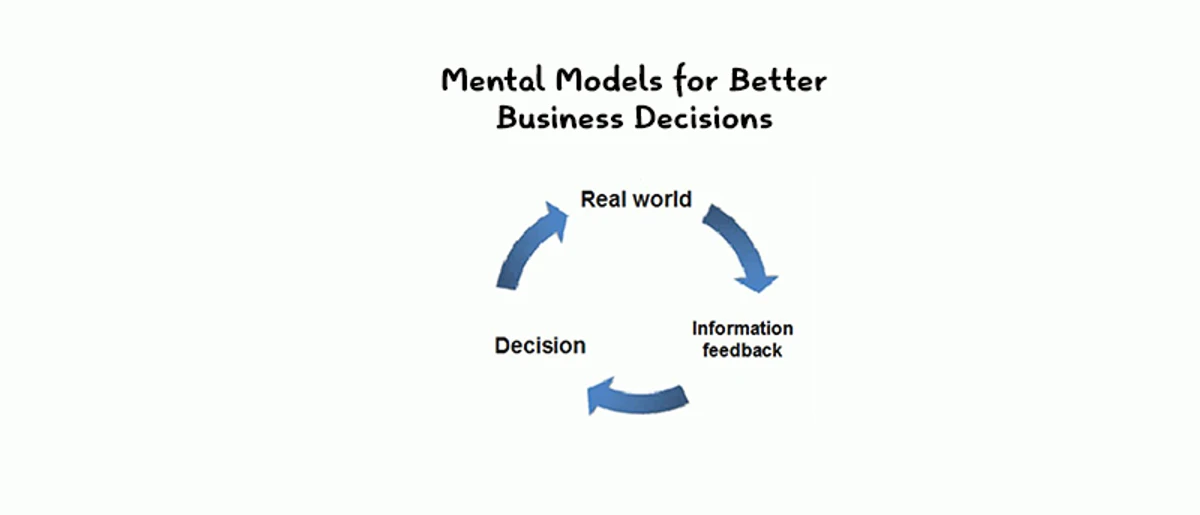
Most business failures aren't caused by bad execution. They're caused by solving the wrong problem, optimizing the wrong metric, or misunderstanding how value actually flows through the business. The mental models in this article are the frameworks that help you see the structure of a business clearly — what drives it, what constrains it, and what would break it — before those misunderstandings become expensive.
Jobs to Be Done: What Customers Actually Buy
Clayton Christensen's Jobs to Be Done (JTBD) theory is the most practically useful framework for understanding customer behavior ever articulated. Its central insight: customers don't buy products — they "hire" them to do a job. Understanding what job a product is being hired for reveals the real competitive landscape, the real customer need, and the real dimensions of value that matter.
The classic example: when McDonald's discovered that a large percentage of its milkshakes were sold in the morning to commuters, it learned something important. The job those milkshakes were hired for wasn't "I want something sweet and cold" — it was "I need something that will keep me occupied during a long commute, fill me up without being messy, and be consumed one-handed while driving." The competitive set for that job wasn't other milkshakes. It was bananas, bagels, coffee, and the radio.
The JTBD Reframe
The JTBD reframe changes how you think about competition, product development, and customer research. If you're building a project management tool, the job isn't "manage projects" — that's too vague. The job might be "help a team of five feel confident that nothing is falling through the cracks while everyone works remotely." That specific job definition reveals competitors you might not have considered (Slack, email, shared spreadsheets), features that matter (reliability, visibility, simplicity) and ones that don't (advanced analytics, complex workflows), and the emotional dimension of the job (confidence, not just coordination).
Functional, Social, and Emotional Jobs
Jobs have three dimensions: functional (what practical task is being accomplished?), social (what does using this product signal about the user?), and emotional (what feeling does the product create or resolve?). Most product development focuses on functional jobs and underweights social and emotional ones — which is why products that are functionally superior often lose to products that are emotionally or socially superior.
Apple's products often have functional equivalents that are technically comparable and cheaper. But they hire for powerful social jobs (I'm creative, design-conscious, status-aware) and emotional jobs (this feels like it was made by people who care). Understanding all three job dimensions reveals the full competitive landscape and explains why purely functional comparisons miss what actually drives purchase decisions.
Applying JTBD to Your Business
The most valuable JTBD research method is not surveys about features — it is interviews about the decision to purchase. What were you doing before you found this product? What were you using instead? What prompted you to look for something different? What was the moment you decided to hire this product for the job? These questions reveal the actual competitive context and the actual job being done, which surveys about features systematically miss.
The Flywheel: Building Compounding Business Momentum
Jim Collins introduced the flywheel concept in Good to Great to describe the cumulative momentum of consistent effort in a single direction. Jeff Bezos applied it to Amazon in one of the most famous business strategy diagrams ever sketched on a napkin — a virtuous cycle in which lower prices drive more customer traffic, which drives more sellers to the platform, which enables lower prices and a larger selection, which drives more customer traffic.
The flywheel mental model captures something that growth-focused business thinking often misses: in the most successful businesses, each component of the business model reinforces every other component in a compounding cycle. The business doesn't grow through the addition of independent activities — it grows through the acceleration of an integrated system where each success makes every other success easier.
Amazon's Flywheel
Lower prices → More customers → More seller volume → Lower cost structure → Lower prices (cycle repeats). More customers → More data → Better recommendations → More purchases → More customers. More seller volume → More selection → More customer value → More customers → More seller volume.
Each element of the flywheel reinforces every other element. Amazon's growth is not the sum of its individual initiatives — it is the acceleration of a system in which each component compounds through the others. This is why Amazon's competitive advantage has proven so difficult to replicate: you can't copy one element of a flywheel; you have to build the entire self-reinforcing system.
Designing Your Flywheel
Every business has the potential for flywheel dynamics, but most businesses don't deliberately design for them. The exercise of mapping your flywheel — identifying the virtuous cycles in your business model where success in one area drives success in another — is one of the most valuable strategic planning activities available.
The questions to ask: what does more revenue enable that makes more revenue easier to get? What does more customers enable beyond the revenue they generate? What does operational scale enable in terms of cost, quality, or selection? What does brand recognition enable in terms of customer acquisition cost? When you find the cycles, you've found the flywheel. When you find the place in the cycle where investment produces the most acceleration, you've found the highest-leverage strategic investment.
The flywheel connects directly to the compounding mental model — the most powerful business flywheels are those where the compounding rate accelerates over time rather than remaining constant. Amazon's data advantage compounds because more transactions produce better recommendations, which produce more transactions, which produce better recommendations — the flywheel accelerates as it spins.
Unit Economics: The Truth Beneath the Revenue Line
Unit economics is the analysis of the revenue and costs associated with a single unit of business — typically a single customer, a single transaction, or a single product unit. It is the most important financial framework for evaluating business model viability, and the most commonly avoided analysis in early-stage companies because it often reveals uncomfortable truths that revenue growth can temporarily obscure.
A business that loses money on every customer while growing rapidly is not a business that will eventually become profitable at scale — unless the unit economics improve with scale, which requires a specific and credible mechanism. Many businesses have grown to large scale while losing money on every unit, relying on investor capital to fund the losses. The capital runs out eventually, and the underlying unit economics determine whether the business is viable at all.
The Unit Economics Analysis
Revenue per unit: What does a single customer pay you, across their entire relationship?
Direct costs per unit: What does it cost to serve a single customer — COGS, support, infrastructure?
Gross margin per unit: Revenue minus direct costs. This is the raw economic engine of the business.
Customer acquisition cost: What does it cost to acquire one customer?
Payback period: How many months of gross margin does it take to recover the acquisition cost?
LTV/CAC ratio: Lifetime value divided by acquisition cost — the ultimate viability metric.
The Warning Signs
Negative gross margin: The business loses money on every transaction regardless of fixed cost allocation. Scale makes this worse, not better.
Payback period > 18 months: Requires sustained capital to fund growth, vulnerable to market shifts and funding conditions.
LTV/CAC < 3: The business is spending too much to acquire customers relative to their lifetime value. Either acquisition costs must fall or retention must improve.
LTV assumptions requiring long retention: Lifetime value projections that depend on customers staying for 5+ years in a product category where 18-month churn is common are not reliable.
Unit economics become the central strategic question when they're poor: what is the mechanism for improving them? Lower acquisition costs (brand building, word-of-mouth, SEO)? Higher retention (product improvement, switching costs, community)? Higher average revenue per user (expansion revenue, upsells, price increases)? Lower direct costs (automation, scale, improved processes)? The strategic roadmap of a company with poor unit economics should be organized around answering these questions — because no amount of growth helps if the underlying unit economics are structurally negative.
Product-Market Fit: The Only Thing That Matters Early
Marc Andreessen's concept of product-market fit — "being in a good market with a product that can satisfy that market" — is the most important milestone in any early-stage business. Before product-market fit, almost nothing else matters. After it, almost everything is possible. The failure to achieve product-market fit is the primary cause of startup failure; the achievement of it is the primary cause of startup success.
Product-market fit is not a binary state — it exists on a spectrum. But it has a distinctive phenomenological signature: customers are pulling the product from you rather than you pushing it to them. Retention is high without heroic effort. Word-of-mouth grows without a dedicated acquisition program. The team's capacity to serve demand is the limiting factor, not demand itself.
Sean Ellis's PMF Test
Sean Ellis, who helped Dropbox and Eventbrite reach scale, developed a simple survey question for diagnosing product-market fit: "How would you feel if you could no longer use this product?" with response options including "Very disappointed," "Somewhat disappointed," and "Not disappointed."
Ellis found empirically that companies where 40%+ of users would be "very disappointed" to lose the product reliably had product-market fit and were able to grow sustainably. Companies below that threshold typically struggled with growth regardless of marketing spend. The threshold isn't a law of nature — but the underlying insight is: a product that a large proportion of users would genuinely miss has found a real job to do for real people, which is the foundation everything else is built on.
The Most Common PMF Mistake
The most common product-market fit mistake is premature scaling — investing heavily in growth before product-market fit has been achieved. The result is spending marketing budget to acquire customers who don't retain, building sales infrastructure for a product whose pitch isn't yet resonating, and hiring operational staff for a product whose requirements aren't yet understood.
The correct sequencing: find product-market fit first, with a small team, through direct customer engagement and rapid iteration. Then scale the thing that's working, not the thing you hope will work once it's been scaled. This sequencing requires resisting the pressure — from investors, from vanity metrics, from competitive anxiety — to scale before the foundation is solid.
Organizational Design: Two-Pizza Teams and Reversible Decisions
Two of Jeff Bezos's most influential organizational mental models address the design of teams and the classification of decisions — and both reflect the same underlying principle: complexity is the enemy of speed and quality, and the right way to manage complexity is to reduce it at the structural level rather than to manage it with processes.
Two-Pizza Teams
The two-pizza rule — teams should be small enough to be fed by two pizzas — is not primarily about pizza. It is a heuristic for the maximum size at which a team can coordinate efficiently without the communication overhead that larger groups require. Research on team dynamics consistently shows that communication complexity grows roughly as the square of team size (each person must coordinate with every other person), and that teams above 8-10 people face qualitatively higher coordination costs than those below it.
The practical implication: when a problem requires more than a two-pizza team to solve, the right response is usually not to build a larger team but to decompose the problem into components that can be addressed by multiple small teams working in parallel with clean interfaces between them. Amazon's microservices architecture — which Bezos mandated in a famous 2002 API memo — is the technical embodiment of this organizational principle applied to software systems.
Type 1 and Type 2 Decisions
Bezos's distinction between Type 1 (irreversible, consequential) and Type 2 (reversible, low-consequence) decisions is among the most practically useful organizational frameworks for avoiding the dysfunction that comes from applying the same decision-making process to every choice.
Type 1: One-Way Doors
Irreversible decisions with major consequences: major acquisitions, foundational technology choices, key hires into senior leadership, business model pivots, regulatory commitments. These deserve careful deliberation, broad input, and slow process. Getting them wrong is expensive and potentially catastrophic.
Default: Slow down. Gather more information. Involve more stakeholders. Use full decision-making infrastructure.
Type 2: Two-Way Doors
Reversible decisions with limited consequences: product feature experiments, marketing channel tests, pricing experiments, operational process changes, most hiring decisions below senior level. These should be made quickly by empowered individuals or small teams, because the cost of the wrong decision is low and the cost of slow decision-making is high.
Default: Speed up. Delegate. Accept 70% information and move. Correct course quickly when wrong.
The organizational dysfunction that Bezos identified — and that most large organizations exhibit — is treating Type 2 decisions like Type 1 decisions: requiring broad consensus, extensive documentation, and slow approval processes for choices that are easily reversible. This produces organizations that are slow at everything because they apply the same friction to inconsequential decisions as to consequential ones. The Type 1/Type 2 distinction is a mental model for calibrating decision-making effort to decision consequence.
Theory of Constraints: Finding the Bottleneck
Eli Goldratt's Theory of Constraints (TOC), developed in his 1984 business novel The Goal, is based on a single insight: every system has exactly one bottleneck — the constraint that limits the system's overall throughput. Improving any part of the system other than the bottleneck produces no improvement in overall output, because the bottleneck determines the maximum rate at which the system can produce.
The implication is radical: if you are not working on the constraint, you are not improving performance. All non-constraint improvements are locally optimal and globally irrelevant until the constraint is addressed.
The TOC Process
Action Steps
- Identify the constraint. Where does work pile up? What single resource, process, or capability determines the maximum throughput of the system?
- Exploit the constraint. Before adding capacity, maximize the utilization of the existing constraint. Ensure it is never idle. Remove activities from the constraint that don't contribute to throughput.
- Subordinate everything else to the constraint. Every other part of the system should be organized around feeding the constraint work at the rate it can process, no faster and no slower.
- Elevate the constraint. Only after maximizing constraint utilization should you invest in increasing constraint capacity.
- Repeat. When the constraint is resolved, a new constraint emerges elsewhere. The process is continuous improvement through sequential constraint identification and elimination.
TOC applied to business strategy reveals a counterintuitive truth: the right investment is almost never the most obvious one. In a software company where the constraint is sales capacity, investing in engineering (which is not the constraint) produces no throughput improvement. In a manufacturing company where the constraint is a single machine, running every other machine at full capacity just creates inventory piles in front of the bottleneck. The constraint analysis tells you where to invest; investing everywhere else is waste regardless of how compelling the non-constraint improvements look in isolation.
This connects directly to the 80/20 principle applied to organizational improvement: the constraint is the vital few; everything else is the trivial many. The entire leverage of the system lies at the constraint.
Power Law Markets: Why Winner-Take-Most Dominates
Many technology markets exhibit power law dynamics — where the winner captures dramatically more value than the second-place player, and the second-place player captures dramatically more than everyone else. Understanding why this occurs and whether a given market is likely to exhibit power law dynamics is one of the most important strategic questions in business.
Power law markets typically arise from network effects, switching costs, or extreme scale economies — exactly the sources of economic moat we identified in the investing section. When a product becomes more valuable as more people use it, or when switching costs make it difficult to move to a competitor once established, or when the economics of serving customers improve dramatically with scale, the market tends toward concentration at the top.
The Implications for Strategy
In a power law market, being second is often nearly as bad as being last. The winner captures the majority of the economics; the second-place player captures a fraction; everyone else fights over scraps. This dynamic changes the strategic calculus fundamentally: in a power law market, the right goal is not "build a good business in this category" but "win this category" — because good businesses in a category dominated by a network-effects winner are structurally disadvantaged.
The strategic implication: if you're entering a power law market, you need either a credible path to the top position or a credible segmentation strategy that carves out a defensible position outside the dominant player's core. Being a "good second" in most technology markets is not a stable long-term position.
Is This a Power Law Market?
The key diagnostic questions: Does the product get more valuable as more people use it (network effects)? Are switching costs high enough that early leaders keep customers regardless of quality gaps? Does serving customers get dramatically cheaper at scale (extreme scale economies)?
If the answer to any of these is strongly yes, the market is likely to exhibit power law dynamics. Strategy in that market needs to prioritize achieving leading position over achieving profitability in the short term — because the leading position determines whether any profitability is available long term.
LTV/CAC: The Ratio That Determines Viability
The ratio of customer lifetime value (LTV) to customer acquisition cost (CAC) is the single most important metric for evaluating the economic engine of any subscription or recurring-revenue business. It determines whether the business model is viable at all, how aggressively the business can grow, and where the strategic leverage for improvement lies.
What the Ratio Means
An LTV/CAC ratio of 1.0 means you spend exactly as much acquiring a customer as you earn from them over their lifetime — you're running to stand still. A ratio of 3.0 means you earn three times what you spend acquiring a customer — a viable business with room for operational costs and profit. A ratio of 10.0 means you earn ten times the acquisition cost — an extraordinary business with significant competitive advantages in retention, pricing power, or acquisition efficiency.
The ratio below 3.0 is a warning sign that requires strategic attention. Either lifetime value must increase (better retention, higher pricing, expansion revenue) or acquisition cost must decrease (better channels, word-of-mouth, brand) before the business can scale sustainably. Growing a business with an LTV/CAC below 3.0 is burning capital without building enterprise value.
The Payback Period Companion Metric
Alongside LTV/CAC, the payback period — the number of months of gross margin required to recover the acquisition cost — determines the business's capital requirements and vulnerability to market disruption. A 6-month payback period means the business can fund its own growth efficiently. An 18-month payback period means the business needs external capital to fund customer acquisition while waiting for those customers to pay back. A 36-month payback period means the business is making very long-duration bets on customer retention that may not materialize.
The combination of LTV/CAC and payback period tells you both whether the business is economically viable (LTV/CAC) and whether it can grow efficiently without continuous external capital (payback period). A business with excellent LTV/CAC but a very long payback period has great unit economics but requires significant capital discipline.
Integrating Business Mental Models
The mental models in this article cover different layers of business analysis — from understanding what customers actually need (JTBD) to understanding how value flows through the system (flywheel, unit economics) to understanding where the leverage for improvement lies (TOC) to understanding the competitive structure of the market (power law, moats). Together they form a framework for thinking about any business with the depth that distinguishes exceptional operators from competent ones.
The Sequence That Matters
In early-stage businesses, the models apply in rough sequence: JTBD and product-market fit are the questions that must be answered first. Unit economics determines whether the answer to those questions produces a viable business. The flywheel identifies the compounding dynamics that will make the business defensible over time. TOC identifies where to invest for the highest throughput improvement. Power law analysis determines whether the competitive dynamics require winner-take-most strategy or allow for sustainable mid-tier positioning.
In established businesses, the models apply simultaneously. Unit economics may be excellent while the flywheel is spinning slowly — which suggests the compounding mechanisms aren't engaged. Product-market fit may have been achieved for the core product while new initiatives fail the PMF test. The constraint may have moved from one part of the organization to another as the business scales.
The Business Builder's Mental Model Stack
The strongest business thinkers use these models simultaneously rather than sequentially — like a doctor who takes a patient's temperature, blood pressure, and mental state at the same time rather than running tests one by one. A new business opportunity gets evaluated through all relevant lenses simultaneously: what job is being done (JTBD)? Are the unit economics viable? What flywheel dynamics could this create? Is this a power law market? What would the constraint be at scale? Only by running all relevant models in parallel can you identify both the opportunity and the structural challenges before committing resources.
Combined with the thinking frameworks from earlier in this series — inversion to identify the most reliable failure modes, second-order thinking to trace downstream consequences of strategic choices, and circle of competence to know where your judgment is reliable — these business-specific models complete a toolkit for making decisions that create durable competitive advantage rather than temporary revenue.


