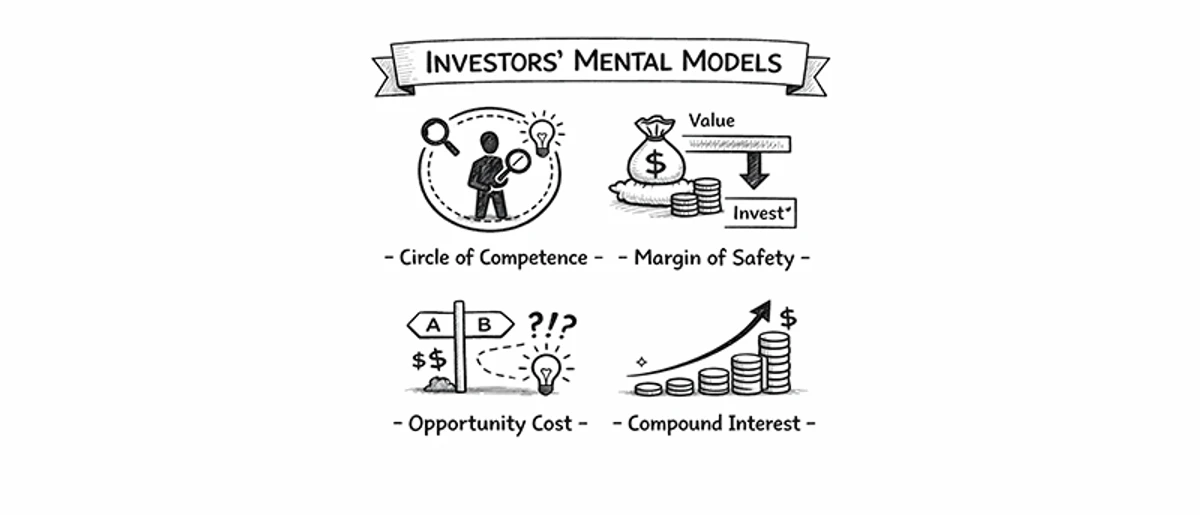
The most successful investors in history are not distinguished by superior access to information or superior financial modeling skills. They are distinguished by superior thinking frameworks — mental models for evaluating businesses, understanding markets, managing psychology, and making decisions under uncertainty. These frameworks are learnable. Applying them consistently is what separates investors who build wealth over decades from investors who achieve market returns at best and self-inflicted losses at worst.
Why Mental Models Matter More Than Financial Models
A financial model — a discounted cash flow analysis, an earnings model, a sum-of-parts valuation — tells you what an asset is worth given a set of assumptions. A mental model tells you which assumptions to trust, how to evaluate the quality of a business, how to manage your own psychology, and how to think about the market's behavior relative to your analysis.
The financial model is a tool; the mental model is judgment about how to use the tool. And judgment is where the returns come from — because financial models are widely available, methodologically similar across analysts, and therefore produce similar outputs from similar inputs. The differentiation happens at the level of the assumptions and the judgment about what those assumptions mean for decision-making.
Munger's Latticework Applied to Investing
Charlie Munger's concept of the "latticework of mental models" has its most direct application in investing. A single-model investor — one who only uses a discounted cash flow model, or only thinks about valuation multiples — is predictably blind to dimensions of investment quality that their model doesn't capture. The multi-model investor who thinks simultaneously about competitive dynamics, management quality, industry structure, psychological factors, and macroeconomic context builds a richer picture of an investment's actual prospects.
Each additional relevant mental model is not just additive — it is multiplicative. A business that looks cheap on a valuation model but has a deteriorating competitive position is not a good investment. A business that looks expensive on a valuation model but has a widening moat and decades of compounding ahead may be an excellent one. The models interact, and the interaction is where the insight lives.
Mr. Market: Ben Graham's Most Important Idea
Benjamin Graham — the father of value investing and Warren Buffett's teacher — introduced Mr. Market in his 1949 book The Intelligent Investor. It remains, 75 years later, the most useful single mental model for managing the psychological dimension of investing.
Graham asked investors to imagine that they owned a share in a private business alongside a partner named Mr. Market. Mr. Market is a helpful fellow — every day, he offers to buy your share or sell you his at a specific price. The crucial characteristic: Mr. Market is manic-depressive. Some days he is euphoric, seeing only sunny prospects, and offers a very high price. Other days he is despondent, seeing only difficulties, and offers a very low price. His price swings have no necessary relationship to the actual value of the business.
Graham's Core Insight
"The investor who permits himself to be stampeded or unduly worried by unjustified market declines in his holdings is perversely transforming his basic advantage into a basic disadvantage. That man would be better off if his stocks had no market quotation at all, for he would then be spared the mental anguish caused him by other persons' mistakes of judgment."
The Mr. Market metaphor reframes what the market is: not an oracle of value, but a voting machine in the short run and a weighing machine in the long run (in Graham's formulation). The daily price is an offer, not a verdict. You are under no obligation to transact with Mr. Market at any given price — you can ignore him when his prices are irrational and take advantage of him when his irrationality works in your favor.
The Practical Applications of Mr. Market
The Mr. Market model has several specific practical implications that most investors acknowledge but few consistently implement.
First: price declines are not inherently bad news. If a business you own at fair value declines 20% in price without any change in its fundamental prospects, Mr. Market has become more pessimistic about a business whose actual value hasn't changed. This is an opportunity to buy more at a better price, not a signal to reassess your thesis. The mental model prevents the most common investor error: treating price movements as fundamental information when they're often noise.
Second: price increases are not inherently good news. If a business you own at fair value increases 30% without any change in its fundamental prospects, Mr. Market has become more optimistic. The business hasn't become 30% better; it's become 30% more expensive. The mental model prevents the opposite error: interpreting price appreciation as validation of your thesis when it may simply reflect a mood swing.
Third: the emotional component of investing — the anxiety of drawdowns, the excitement of gains — is a feature of your own psychology interacting with Mr. Market's mood swings, not information about your investments' underlying quality. Managing that interaction is one of the most important investment skills, and the Mr. Market model makes the interaction legible. This connects to what we explored in the neuroscience of dopamine — the anxiety of watching a portfolio decline is a neurological response to loss that may have nothing to do with the investment's actual trajectory.
Margin of Safety: The Central Concept of Value Investing
The margin of safety is the difference between a security's intrinsic value — what it is genuinely worth based on its future cash flows and competitive position — and the price you pay for it. Graham called it the central concept of value investing: buying at a significant discount to intrinsic value provides a buffer against errors in your analysis, unforeseen adverse developments, and the inevitable uncertainty about the future.
The principle is borrowed from engineering: a bridge rated to hold 10,000 pounds is designed to hold 30,000 pounds. The 20,000 pound margin of safety is not waste — it is protection against the engineer's errors, unforeseen loads, and material degradation over time. Similarly, buying a security worth $100 at $60 provides a $40 margin of safety: the estimate of intrinsic value would have to be wrong by more than 40% before the investment produces a loss.
Why Margin of Safety Works
Intrinsic value estimates are always uncertain. Even the most careful analysis involves assumptions about future growth rates, profit margins, competitive dynamics, and macroeconomic conditions — all of which can deviate from expectations. The margin of safety doesn't eliminate this uncertainty; it provides a buffer that allows you to be wrong in your analysis and still not lose money (or lose significantly less).
The larger the margin of safety, the more conservatively you can invest. Berkshire's history shows this: Buffett rarely pays full price for any business, even ones he believes are exceptional. The discount provides the buffer that converts good analysis into reliable outcomes over time.
The Common Misapplication
Many investors apply margin of safety only to price — buying at a discount to stated book value or recent earnings multiples — without adequately analyzing intrinsic value. A security trading at half its book value may still have no margin of safety if the book value overstates economic reality (assets that are deteriorating, liabilities that are understated, earnings that are unsustainable).
True margin of safety requires an honest estimate of intrinsic value first, then verification that the price provides a meaningful discount to that estimate. The discount to a bad estimate provides no protection.
Margin of Safety Across Asset Classes
The margin of safety concept applies beyond individual stock selection. In any investment decision, the question is: what is the genuine expected value of this investment, and how much cushion exists between the price and that expected value?
In real estate: buying at a price where the property generates positive cash flow from day one (rather than depending on appreciation) provides a margin of safety against declining markets and rising costs. In fixed income: buying bonds at below-par prices or with significant yield above comparable-risk alternatives provides cushion. In private equity: investing at valuations below what a strategic buyer would pay provides downside protection that pure financial-model valuation doesn't.
The Economic Moat: Durable Competitive Advantage
The economic moat — a term Buffett popularized — describes the durable competitive advantages that allow a business to maintain above-average profitability over long periods despite competitive pressure. Without a moat, profits attract competition, which erodes those profits until they return to the cost of capital. With a moat, a business can maintain premium economics while competitors repeatedly fail to replicate them.
The moat mental model is the most important framework for evaluating business quality — and business quality is what determines whether the compounding of a long-held investment works for you or against you. A business without a moat held for ten years delivers ten years of eroding competitive position. A business with a strong and widening moat held for ten years delivers ten years of compounding advantage.
The Five Sources of Moat
Morningstar's framework identifies five primary sources of economic moat, each of which represents a different structural basis for durable competitive advantage:
Action Steps
- Intangible assets. Brands, patents, regulatory licenses, and proprietary data that competitors cannot easily replicate. A strong brand allows premium pricing (consumers pay more for Coca-Cola than a store-brand cola not because the beverage is demonstrably superior but because the brand has decades of trust and association embedded in it). Patents create temporary monopolies. Regulatory licenses create permanent ones in constrained industries.
- Switching costs. When customers face significant friction — financial, operational, or psychological — in changing to a competitor, the incumbent has pricing power and churn protection. Enterprise software is the canonical example: once a company's operations are built around a specific ERP or CRM system, switching requires massive retraining, data migration, and operational risk. The switching cost is a moat that doesn't depend on the software being better than alternatives — it depends on alternatives being worse than the pain of switching.
- Network effects. When a product or service becomes more valuable as more people use it, early scale advantages compound into durable competitive position. Visa's payment network is more valuable to merchants because more consumers carry Visa cards; it's more valuable to consumers because more merchants accept it. Each additional user makes the network more valuable for all existing users, creating a virtuous cycle that is extremely difficult for a competitor to break.
- Cost advantages. Structural cost advantages — from scale, proprietary processes, or unique resource access — allow a business to profitably undercut competitors or earn higher margins at the same price. The key word is "structural": a cost advantage from management efficiency can be copied; a cost advantage from being ten times larger than any competitor in a scale-intensive industry cannot.
- Efficient scale. In markets that are large enough to support only one or a few competitors profitably, existing competitors have natural protection: a new entrant would face pricing pressure from incumbents with the scale to sustain low prices, making entry economically unattractive even when the market appears profitable.
Moat Width and Moat Direction
Not all moats are equal in width — some competitive advantages are more durable than others. But equally important to moat width is moat direction: is the competitive advantage widening or narrowing? A wide moat that is being eroded by technology, regulation, or competitive dynamics is less valuable than a narrower moat that is being deepened by each passing year of operations.
Buffett's evolution from Graham's statistical cheapness approach to Munger's quality business approach was fundamentally a shift from moat-agnostic buying to moat-centric buying. The insight: a wonderful business at a fair price, held for decades as its moat compounds, beats a fair business at a wonderful price that erodes over the holding period.
Circle of Competence Applied to Investing
The circle of competence in investing means maintaining rigorous discipline about the types of businesses you can genuinely evaluate versus the types where your analysis is superficial. The discipline is particularly important in investing because the market generates constant opportunities in every sector — and the temptation to invest outside your circle is highest exactly when those sectors are performing well and generating attention.
Buffett's consistent avoidance of technology companies for most of his career — missing both the devastation of the dot-com bubble and the extraordinary returns of companies like Google and Amazon — reflects this discipline. He correctly identified that he couldn't reliably predict which technology companies would maintain durable competitive advantages a decade out, and declined to invest in the category regardless of how compelling individual opportunities appeared.
Defining Your Investment Circle
Your investment circle of competence is defined not by the industries you find interesting but by the industries where your knowledge is deep enough to make reliable judgments about competitive dynamics, unit economics, and management quality. The test is the Feynman standard: can you explain in plain language why a business in this industry succeeds or fails, what drives the economics, and what would change the outlook? If you can, you're inside the circle. If you're relying on stories and surface familiarity, you're outside it.
For most investors, the circle is smaller than they believe. The appropriate response is not to abandon investing outside the circle — index funds exist precisely for that purpose — but to concentrate active analysis and active bets within the circle, where your judgment has genuine edge.
Inversion: The Munger Method
Munger's application of inversion thinking to investing is among the most distinctive and productive aspects of his approach. Rather than starting by asking "why would this be a great investment?" he starts by asking "what would make this a terrible investment?" — and building a checklist of failure modes that the investment must not exhibit.
The inversion checklist approach produces several specific advantages over forward-looking analysis:
It counteracts confirmation bias by structurally requiring engagement with the negative case before the positive case has embedded itself. When you build the bear case first, you're constructing it before emotional commitment to the investment has formed — which produces a more honest analysis than constructing the bear case after you've already decided you like the investment.
It identifies catastrophic failure modes that standard analysis underweights. DCF models and earnings estimates focus on the expected case; they systematically underweight the tail risks — the scenarios where the investment goes to zero or near-zero. Inversion asks explicitly: what are the paths to catastrophic loss? What would have to be true for this investment to produce a permanent loss of capital? These scenarios deserve analysis disproportionate to their probability, because their outcome is disproportionate to typical cases.
Munger's Inversion Checklist
Munger's inversion-derived investment filters include some well-known rules. Never invest in a business with dishonest or incompetent management — the combination of capital allocation decisions and asymmetric information creates irreversible destruction of value. Never invest in industries with structurally deteriorating economics — being in a business that faces permanent headwinds requires that the business swim against the current to maintain position. Never invest in situations you don't genuinely understand — the circle of competence boundary, applied as a filter rather than an invitation to learn more before investing.
Each of these is an inversion: what are the reliable ways for investments to fail? Dishonest management, deteriorating industry, and incomprehensible business models. Avoid these failure modes and the remaining universe has a dramatically higher proportion of investments that can compound positively.
Second-Level Thinking in Markets
Howard Marks's second-level thinking, which we explored in the second-order thinking article, has its most direct application in investing. Markets are second-order environments by definition: asset prices reflect not just the fundamental value of assets but the consensus view of that value across all market participants. To outperform, you need to be right about something the consensus is wrong about — which requires thinking at least one level deeper than the average participant.
Marks's Second-Level Investor Questions
First-level: "This is a great company. I should buy its stock."
Second-level: "This is a great company, but everyone thinks it's great, so the price already reflects that greatness. Is there anything about its future that the consensus is underestimating? Is there any reason to believe it will be even better than the consensus expects — or worse?"
The second-level question is where the investment returns live. A correctly identified great company at a price that reflects its greatness earns the market return. A correctly identified great company at a price that underestimates its greatness earns above-market returns. The difference is second-level thinking.
Consensus vs. Variant Perception
Michael Steinhardt — one of the most successful hedge fund managers of the 20th century — articulated this as "variant perception": the requirement that any investment idea represent a view that differs from the consensus in a way that is both specific and, if correct, not yet reflected in the price.
Variant perception is not contrarianism for its own sake. A view that differs from consensus is valuable only if it is right — and being right requires having better information, better analysis, or a longer time horizon than the consensus. The most reliable sources of variant perception for individual investors: deeper understanding of a specific industry or business type (circle of competence), longer time horizon than institutions that face quarterly pressure, and greater patience to hold through volatility that forces other investors to sell.
Time Preference and the Long Game
One of the most underappreciated sources of investment edge is time preference — the willingness to hold investments over time horizons that institutional investors cannot maintain. Mutual funds face quarterly redemption pressure; hedge funds face annual performance evaluation; pension funds face regulatory constraints; most retail investors face their own psychological limits on holding through drawdowns.
These structural constraints create a systematic market-wide preference for shorter time horizons. A business that will be worth dramatically more in five years but will face headwinds over the next two years is systematically undervalued by a market that discounts future value heavily. The patient long-term investor — one who genuinely has the conviction and the psychological constitution to hold through the headwind period — has a structural advantage that requires no informational edge.
The Compounding Dimension
Combined with the compounding mental model, time preference produces the most powerful force available to individual investors: the compound growth of excellent businesses over decades. A business that compounds its intrinsic value at 15% annually for 20 years produces a 16x return on intrinsic value — independent of the entry price, though the entry price determines the return on capital invested.
Buffett's most important investment decisions weren't the clever trades — they were the decisions to hold Coca-Cola, American Express, and other businesses through decades of growth, allowing the compounding to produce returns that no shorter-term strategy could match. The mental model is: find businesses with durable moats, buy at reasonable prices, and then do something very difficult — almost nothing.
The Temperament Requirement
Buffett has said repeatedly that the most important quality in an investor is temperament, not intellect. The specific temperament required: the ability to remain emotionally stable while Mr. Market swings between euphoria and despair, the discipline to act on analysis rather than sentiment, and the patience to allow compounding to work over time horizons that feel uncomfortably long.
This temperament requirement is why many intelligent people underperform in investing: intelligence can construct a correct analysis but temperament determines whether that analysis is actually implemented and held through the period required for it to be validated. The analysis is the easier part; the psychology is the harder part, and it's where most investors lose their edge.
Building Your Personal Investment Framework
The mental models in this article are not a complete investment system — they are the conceptual components from which a personal investment framework is constructed. The framework needs to be genuinely yours: calibrated to your circle of competence, consistent with your time horizon and psychological constitution, and grounded in principles you understand well enough to maintain through periods of underperformance.
Action Steps
- Define your circle of competence honestly. What industries and business types can you genuinely evaluate? Start narrow and expand deliberately through study rather than through the temptation of interesting opportunities. Your circle is the universe of investments where your analysis has genuine edge.
- Build your investment checklist from inversion. What are the reliable ways for investments in your circle to fail? What management behaviors destroy value? What industry dynamics erode competitive advantage? What financial structures produce fragility? Your checklist should be built from observed failures, not theoretical risks.
- Develop your intrinsic value approach. How do you estimate what a business is genuinely worth? Whatever method you use — discounted cash flows, earnings power value, sum-of-parts — understand its assumptions deeply enough to know where it works and where it misleads. Apply margin of safety to compensate for the inevitable uncertainty in any estimate.
- Define your Mr. Market relationship explicitly. What will you do when the market declines 30%? What will you do when individual holdings decline 40%? Having explicit answers to these questions before they happen — and rehearsing the Mr. Market mental model during calm periods — prevents the most costly investment errors from occurring in exactly the moments when emotions are highest.
- Set your time horizon and commit to it. What is the minimum time frame over which you evaluate your investment decisions? Evaluating investments over periods shorter than a full business cycle introduces noise that corrupts the feedback process. Most investment approaches require at least three to five years of consistent application before their results can be meaningfully evaluated.
The Synthesis
The mental models covered in this article — Mr. Market, margin of safety, economic moat, circle of competence, inversion, second-level thinking, time preference — are not independent frameworks. They form an integrated approach to the problem of deploying capital intelligently under uncertainty. Mr. Market tells you how to relate to prices. Margin of safety tells you how to protect against analytical error. The moat tells you what kind of business quality deserves a long hold. Circle of competence tells you where your analysis is reliable. Inversion tells you what to avoid. Second-level thinking tells you what edge you're competing with. Time preference tells you what structural advantage to exploit.
Together, they constitute what Buffett and Munger have assembled over 60 years: a framework for making investment decisions that is robust to the inevitable uncertainty of the future, the inevitable irrationality of markets, and the inevitable frailties of human psychology. It's not a formula — formulas don't work in investing. It's a set of principles for thinking clearly about the allocation of capital, which is ultimately what investing is.


