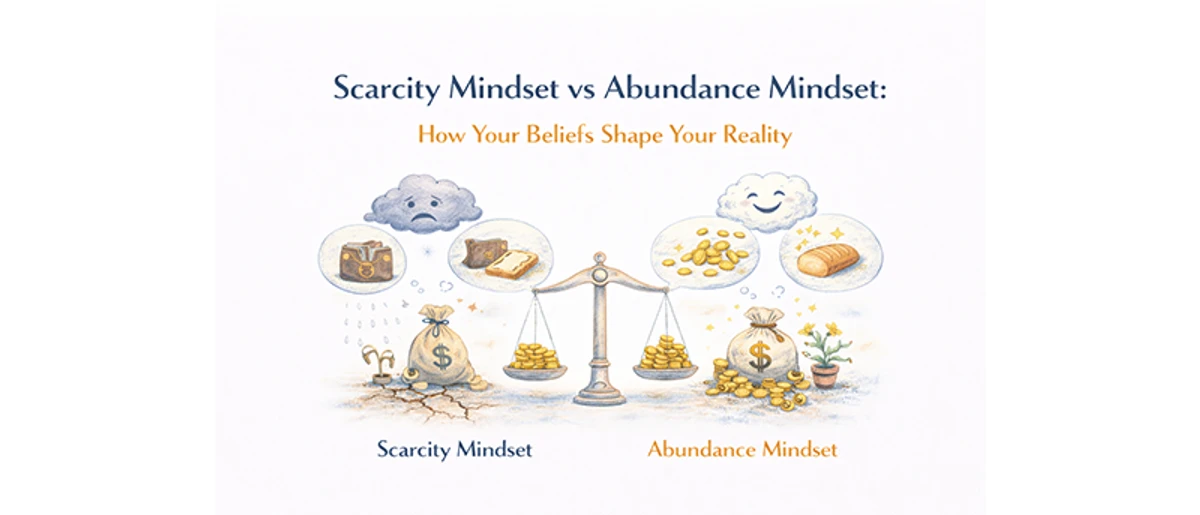
Two people can look at the same opportunity, the same market, the same relationship, and see entirely different realities — not because the facts differ, but because their underlying belief about the nature of the world differs. One sees finite resources being competed over. The other sees expandable value being created. This is the scarcity vs abundance divide, and it shapes every significant decision you make — often without your awareness.
Defining Scarcity and Abundance Mindsets
Stephen Covey popularized the scarcity/abundance distinction in The 7 Habits of Highly Effective People, describing it as one of the most fundamental differences between highly effective people and everyone else. A scarcity mindset operates from the assumption that there is only so much — of money, opportunity, success, recognition, love — and that what one person gains, another must lose. It is fundamentally zero-sum. An abundance mindset operates from the assumption that value can be created, that the pie can grow, that one person's success does not diminish another's, and that opportunities are generative rather than finite.
These are not just philosophical orientations — they are cognitive frameworks that filter perception and guide behavior in concrete and measurable ways. The scarcity mindset person and the abundance mindset person make systematically different decisions about risk, generosity, collaboration, competition, and long-term investment — and those differences compound over time into dramatically different life outcomes.
Scarcity Mindset Beliefs
"There's not enough opportunity for everyone."
"Their success reduces my chances."
"I need to protect what I have."
"Sharing knowledge gives away my advantage."
"Life is a competition with limited prizes."
Abundance Mindset Beliefs
"New opportunities can always be created."
"Their success shows what's possible for me."
"Generosity tends to return multiplied."
"Sharing knowledge builds relationships and reputation."
"The best outcomes emerge from collaboration."
The Neuroscience of Scarcity Thinking
Scarcity is not just a mindset — it is a neurological state. Research by Sendhil Mullainathan and Eldar Shafir, documented in their book Scarcity, found that experiencing genuine scarcity — of money, time, or social belonging — produces a cognitive state called tunneling: intense focus on the scarcity problem at the expense of everything else. People experiencing scarcity literally have less cognitive bandwidth available for unrelated tasks, make worse decisions, and struggle to plan beyond the immediate crisis.
The evolutionary logic is clear: when resources are genuinely limited and survival is at stake, tunnel focus on the immediate scarcity problem is adaptive. The problem is that the brain can produce this same cognitive state in response to perceived scarcity — even when objective circumstances are not threatening. A person with a scarcity mindset activates the tunneling response in situations of normal ambiguity or moderate challenge, producing the cognitive narrowing, short-term orientation, and threat sensitivity that genuine scarcity would warrant, but applied to contexts where they are counterproductive.
This neurological dimension connects directly to the science of self-control: scarcity mindset literally reduces the prefrontal cognitive bandwidth that self-regulation requires. People under scarcity pressure — whether genuine or perceived — show reduced impulse control, shorter planning horizons, and greater susceptibility to immediate-reward temptations. The mindset shift toward abundance is partly a shift in neurological operating state, not just in beliefs.
The Bandwidth Tax
Mullainathan and Shafir's research found that poverty — a genuine scarcity condition — reduced cognitive performance by the equivalent of losing a full night's sleep or a 13-point IQ drop. The cause was not stress or nutrition but the constant cognitive load of managing scarcity, which consumed the mental bandwidth that would otherwise be available for planning, decision-making, and self-regulation. The practical implication extends beyond poverty: any persistent preoccupation with what you don't have — whether money, time, recognition, or opportunity — imposes a similar bandwidth tax on your thinking capacity.
How Scarcity Mindset Shapes Behavior and Outcomes
Scarcity mindset produces a cluster of behaviors that are internally coherent — each makes sense given the underlying belief that resources are limited — but that systematically undermine the very outcomes the person is trying to protect or achieve.
Hoarding Information and Opportunity
Scarcity thinkers tend to withhold knowledge, connections, and opportunities — treating them as finite resources whose sharing reduces the holder's advantage. In reality, generosity with knowledge and connections tends to build reputation, deepen relationships, and generate reciprocal generosity that more than compensates for any competitive disadvantage. The person who freely shares expertise becomes the trusted authority in their network; the person who hoards it becomes the isolated one.
Avoiding Collaboration
If success is zero-sum, collaboration is risky — your partner's success comes at your expense. Scarcity thinkers therefore tend toward competitive rather than collaborative orientations, missing the compounding benefits of genuine partnership. The most significant achievements in business, science, and social change are almost always collaborative — the scarcity mindset structurally prevents access to the leverage that collaboration provides.
Short-Term Extraction Over Long-Term Creation
Scarcity thinking drives short-term extraction: take what you can now before it disappears. This produces transactional relationships where trust is low, negotiations where both parties seek to maximize their immediate gain, and business decisions that sacrifice long-term relationship value for short-term transaction value. The delayed gratification research maps directly onto this: scarcity mindset makes the present loom larger and the future recede, systematically favoring immediate extraction over patient value creation.
How Abundance Mindset Unlocks Different Possibilities
Abundance mindset is not naive optimism or the denial of real constraints. It is a fundamentally different operating assumption about the nature of value — that it can be created, expanded, and shared without diminishing the creator. This assumption, when genuinely held, produces behaviors that tend to generate the abundant outcomes the mindset anticipates.
Abundance thinkers invest in relationships generously because they believe the relationship itself creates value. They share knowledge freely because they believe their reputation as a generous expert is worth more than any competitive advantage knowledge-hoarding might provide. They celebrate others' success because they experience it as evidence of what's possible rather than as a threat to their own position. And they take long-term risks because they believe the value created through genuine effort and innovation is not subject to zero-sum competition.
The most successful entrepreneurs and investors consistently demonstrate abundance orientation in their approach to competition, collaboration, and knowledge sharing. Jeff Bezos's genuine enthusiasm about Amazon's competitors entering the market — because competition improves the overall customer experience and expands the category — reflects an abundance belief that the growing market is more valuable than a larger share of a shrinking one. This connects to the billionaire mindset patterns we explored — the most successful people are almost uniformly characterized by abundance orientation at the belief level.
Zero-Sum Thinking: The Core of Scarcity Mindset
The philosophical heart of scarcity mindset is zero-sum thinking — the belief that the total amount of some valued resource (wealth, success, recognition, opportunity) is fixed, so that any gain by one party necessarily comes at another's expense. This is occasionally true in narrow competitive contexts — there is only one first-place finisher in a race, only one person gets a specific job. But it is catastrophically wrong as a general model of how value works in the world.
Wealth is not fixed — it is created through productive activity. The total global wealth today is orders of magnitude larger than it was 200 years ago, not because one group took it from another but because productive enterprise created it. Opportunity is not fixed — new industries, technologies, and social changes constantly create opportunities that didn't previously exist. Even recognition and status are not strictly zero-sum in most contexts — the presence of multiple respected experts in a field enhances rather than diminishes each individual's standing.
Recognizing the specific domains where zero-sum thinking is accurate (competitive athletics, certain promotions, some negotiations) versus where it is systematically wrong (entrepreneurship, knowledge creation, relationship building, most career development) is one of the most important cognitive discriminations for developing an abundance orientation. The mental models framework provides tools for making exactly these kinds of domain-specific calibrations — recognizing when a model applies and when it misleads.
"There is enough for everyone's need, but not for everyone's greed." — Mahatma Gandhi
Scarcity and Abundance in Relationships
The scarcity vs abundance distinction manifests with particular clarity in relationships. Scarcity mindset in relationships produces jealousy (their attention to others reduces their attention to me), possessiveness (I must protect what I have before it's taken), competition rather than collaboration between partners, and difficulty celebrating others' successes. Abundance mindset produces generosity, genuine celebration of others' wins, and the capacity for deep trust that only develops when both parties believe the relationship itself creates value rather than merely distributing it.
Research on relationships by John Gottman identified a pattern in successful long-term partnerships that maps precisely onto abundance orientation: the "positive sentiment override" — a general positive interpretation of a partner's behavior that extends the benefit of the doubt in ambiguous situations. Scarcity-minded relationships tend toward negative sentiment override — interpreting ambiguous partner behavior through a threat lens, which produces the defensiveness and criticism that Gottman identifies as primary predictors of relationship failure.
In professional relationships, scarcity orientation produces the hoarding of credit, reluctance to share networks, and competitive framing of colleagues that undermines the collaborative environments where the best work happens. The most effective professional environments — the ones that attract and retain exceptional talent — are almost universally characterized by abundance norms: generosity with credit, genuine investment in colleagues' success, and belief that the team's achievement is more valuable than any individual's competitive advantage within it.
The Money Dimension: Wealth and Scarcity Beliefs
Scarcity beliefs about money are among the most persistent and damaging forms of scarcity thinking. Common money scarcity beliefs include: "There's never enough money," "Rich people got theirs by taking from others," "Money is inherently corrupting," "I'm not the kind of person who accumulates wealth," and "Spending money on myself is selfish." These beliefs produce behaviors — avoidance of financial planning, reluctance to invest, sabotage of income opportunities, excessive frugality that prevents productive investment — that reliably maintain the scarcity they fear.
Abundance beliefs about money, by contrast, include: "Value creation generates wealth," "Money is a tool that amplifies impact," "Learning to manage money well is a skill I can develop," and "Investing in myself and in productive assets compounds over time." These beliefs produce behaviors — active financial planning, investment in skill development, entrepreneurial risk-taking, generous contribution — that tend to generate the wealth that the abundance orientation anticipates.
This is not magical thinking — abundance beliefs about money do not create wealth without action. But they remove the psychological barriers that prevent the actions necessary for wealth creation. As we explored in our article on the psychology of goal setting, identity-level beliefs determine what goals feel available to pursue. A person with deep scarcity beliefs about money will not set or pursue ambitious financial goals with genuine commitment — the belief system forecloses the possibility before the first step is taken.
Seeing Opportunity: How Mindset Shapes What You Notice
One of the most practically significant effects of abundance vs scarcity mindset is on perception — specifically, on what opportunities you notice in your environment. The reticular activating system (RAS) — the brain's attention-filtering mechanism — tends to surface information that is consistent with existing beliefs and goals. A person operating from scarcity mindset, focused on threats and limitations, will literally perceive fewer opportunities than an abundance-oriented person in the same environment, because the RAS filters toward threat-relevant rather than opportunity-relevant information.
This is not metaphysical — it is straightforward cognitive science. Attention is selective and belief-guided. The person who believes opportunities are abundant actively scans for them; the person who believes resources are scarce and threatened actively scans for dangers. Both find what they are looking for, not because the world conforms to their beliefs but because perception is selective and the selection criteria are set by beliefs.
The practical implication is that shifting toward abundance orientation doesn't just change how you feel about your circumstances — it changes what you perceive in those circumstances. Abundance thinkers operating in the same environment as scarcity thinkers will consistently notice more opportunities, more potential collaborators, and more paths forward. This perceptual advantage compounds over time as abundance-perceived opportunities are pursued and scarcity-perceived threats are avoided. The thinking patterns of successful people consistently reflect this opportunity-orientation — they ask what's possible before they ask what could go wrong.
How to Shift from Scarcity to Abundance Thinking
Scarcity mindset is often deeply rooted in early experience — in environments where resources genuinely were limited, where competition was necessary, or where generosity was not modeled or rewarded. Shifting it requires more than positive thinking; it requires consistent cognitive practice, behavioral experimentation, and deliberate exposure to evidence that contradicts the scarcity narrative.
Action Steps
Daily Practices for an Abundance Orientation
Like all mindset shifts, the move from scarcity to abundance requires consistent daily practice — not just understanding the concept but repeatedly choosing abundance interpretations and behaviors until they become the default cognitive and behavioral response.
The Daily Abundance Check-In
Each morning, spend two minutes on one question: where is there more value, opportunity, or possibility in my situation than I am currently seeing? This question directly counteracts the threat-scanning bias of scarcity thinking by deliberately orienting perception toward possibility. Each evening, note one instance where abundance thinking produced a better outcome than scarcity thinking would have — a collaboration that created value, a generous act that returned multiplied, an opportunity noticed because you were looking for it. This daily practice, maintained consistently over months, gradually resets the default orientation from scarcity to abundance — not through forced positivity but through the systematic accumulation of accurate evidence. Combined with the psychological resilience that makes setbacks feel temporary rather than confirming of scarcity, and the habit systems that make abundance behaviors automatic rather than effortful, this shift produces compounding improvements in every domain where scarcity thinking has been limiting your decisions and relationships. For the foundational reading, The 7 Habits of Highly Effective People remains the most complete treatment of the abundance mindset in practice, and Think and Grow Rich explores the belief systems that underlie wealth creation and their relationship to abundance orientation.


