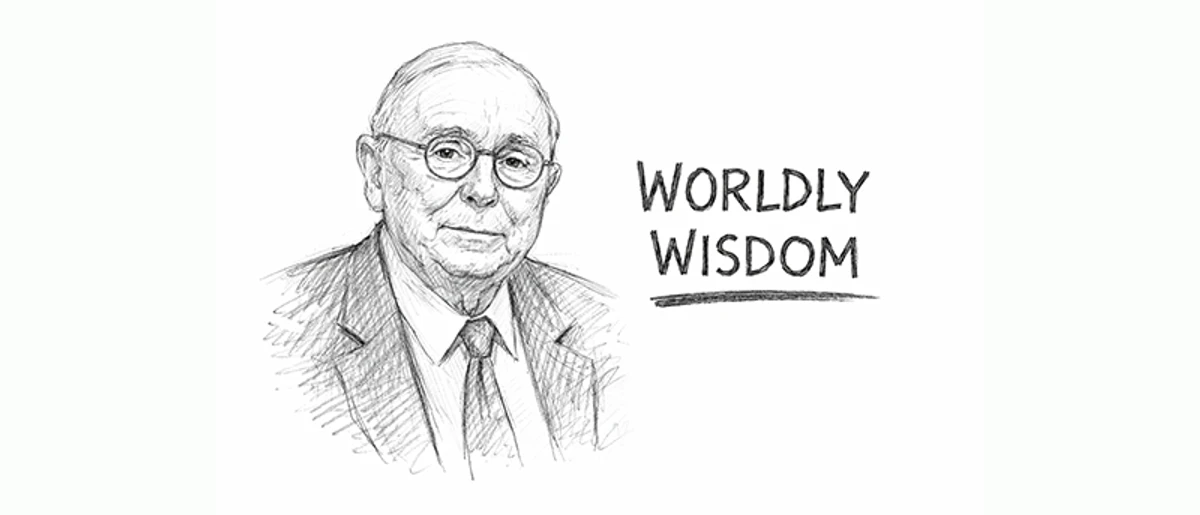
Charlie Munger spent 99 years accumulating what he called "worldly wisdom" — an interlocking framework of mental models drawn from every major discipline of human knowledge. He applied this framework to investing, business, psychology, ethics, and life, with results that speak for themselves: Berkshire Hathaway's 50-year compounding record, an intellectual legacy that has influenced a generation of thinkers, and a reputation for judgment that stood unrivaled in his field. This is how he thought.
The Munger Method: Worldly Wisdom
Munger's intellectual approach is best captured in his own words from a 1994 lecture at USC Business School, titled "A Lesson on Elementary Worldly Wisdom":
Munger on Worldly Wisdom
"What is elementary, worldly wisdom? Well, the first rule is that you can't really know anything if you just remember isolated facts and try and bang 'em back. If the facts don't hang together on a latticework of theory, you don't have them in a usable form. You've got to have models in your head. And you've got to array your experience — both vicarious and direct — on this latticework of models."
The essence of the Munger method is this: genuine understanding comes not from accumulating facts but from building an interconnected structure of models — drawn from mathematics, physics, chemistry, biology, psychology, economics, history, and philosophy — through which facts can be interpreted, connected, and applied.
Munger was deliberately and aggressively multidisciplinary at a time when most investors were monoculture — steeped in accounting and finance, nearly ignorant of psychology, biology, and systems thinking. This breadth was not intellectual dilettantism. It was Munger's primary competitive advantage: he could see dimensions of a business situation that single-discipline thinkers literally could not perceive, because those dimensions were visible only through frameworks those thinkers didn't possess.
He read voraciously across every field throughout his life — biographies, scientific papers, history, philosophy — not for entertainment but for models. Every new domain he understood became a new lens through which investment and business problems became clearer.
The Latticework: How Mental Models Compound
The metaphor Munger used for his mental model framework — the latticework — is precisely chosen. A lattice is not a collection of independent elements; it is a structure in which each element is connected to others, creating a whole that is more stable and more useful than any individual part. When models are independent, they provide independent insights. When they're connected in a latticework, they provide compound insights — each model illuminates aspects of the others, and their interaction reveals dimensions of reality that no single model captures.
The latticework compounds in the same way that financial capital compounds. Each model added to a rich latticework is more valuable than the same model added to an empty framework, because in the rich latticework it connects to dozens of other models and creates dozens of new insights. The 50th model added to Munger's framework was worth more than the 50th model added to a novice's framework, not because the model was different but because it connected to a richer existing structure.
The Network Effect of Mental Models
Consider the interaction between the evolutionary biology model of adaptation and the economics model of competitive advantage. Separately, they're useful — evolution explains how species survive; competitive advantage explains how businesses persist. Together, they illuminate something neither captures alone: businesses that survive competitive pressure are doing something analogous to biological adaptation — they're occupying niches, developing specialized advantages, and facing selection pressure that eliminates the unfit.
This cross-disciplinary synthesis — seeing businesses through biological models and biological systems through economic models — was characteristic of Munger's thinking. The latticework made it possible; the connections were visible only because both models were present in the same structure.
The Psychology of Human Misjudgment
Munger's most famous single intellectual contribution is his taxonomy of human psychological biases, which he articulated most fully in a 1995 Harvard Law School speech titled "The Psychology of Human Misjudgment." He identified 25 tendencies — cognitive biases, emotional responses, and social dynamics — that predictably cause humans to misjudge situations and make poor decisions.
His motivation was explicitly practical: understanding how human minds fail systematically allowed him to avoid those failures in his own thinking and to exploit the failures of others in markets. Many of these tendencies had been identified by academic psychologists, but Munger synthesized them into a practical framework and applied it specifically to business and investment contexts.
The Most Important Tendencies
Reward and Punishment Superresponse
Munger's most-cited insight: "Show me the incentive and I'll show you the outcome." People respond to incentives with extraordinary reliability, often in ways that produce outcomes their stated values would oppose. Understanding the incentive structure of any situation — what behaviors are rewarded and punished — predicts behavior more reliably than stated intentions, cultural values, or formal rules.
Application: before relying on any agent (employee, advisor, contractor, regulator), map their incentives. Where incentives and your interests align, trust is rational. Where they diverge, design systems that don't depend on trust.
Liking/Loving Tendency
People tend to ignore the faults of, and comply with the wishes of, those they like or love. This tendency distorts judgment in hiring (we hire people we like rather than people who are best for the role), negotiation (we concede more to likeable counterparties), and investment (we are more favorable to companies run by charismatic leaders).
The investment application: distinguish between liking a management team and evaluating the business. A likeable CEO running a structurally deteriorating business is not a good investment regardless of charm.
Doubt-Avoidance Tendency
The brain is designed to reach conclusions quickly, removing the discomfort of uncertainty. This tendency — which Munger connects to the "dedoublement" reflex and to cognitive closure-seeking — causes premature conclusion-reaching and resistance to updating once conclusions are formed.
The manifestation in investing: forming a thesis and then treating subsequent evidence as either confirmation (if it fits) or noise (if it doesn't). The fix is the explicit doubt-preservation practice — actively maintaining uncertainty longer than feels comfortable.
Social Proof Tendency
In ambiguous situations, people look to others' behavior for guidance. This is often reasonable (others may have information you lack) but produces pathological outcomes in financial markets, where social proof creates bubbles — everyone buying because everyone else is buying, with the underlying value becoming irrelevant to price.
Munger's antidote: "It's not supposed to be easy. Anyone who finds it easy is stupid." The correct response to social proof in investment is the second-level thinking question: if everyone already believes this, is it already in the price?
The Reason-Respecting Tendency
One of Munger's most practically useful observations: people comply with requests more readily when given a reason — even an obviously weak or irrelevant reason. Robert Cialdini's research confirmed this experimentally: "May I use the copy machine? I have to make copies" produced nearly as much compliance as a genuinely compelling reason.
The investment application: sellers and promoters who provide reasons for their recommendations — even weak ones — tend to receive less scrutiny than those who provide no reasons. The presence of a reason triggers the reason-respecting tendency and reduces critical evaluation. The antidote: evaluate the quality of reasons independently of their mere presence.
Envy and Jealousy
Munger repeatedly cited envy as among the most destructive of the 25 tendencies — "the only one of the seven deadly sins that doesn't even feel good." The investment manifestation: investing in what others have earned returns on rather than in what makes genuine sense for your portfolio and circle of competence. The career manifestation: optimizing for status and comparison rather than for genuine accomplishment and fit. The life manifestation: the hedonic treadmill driven by comparison rather than genuine preference.
The Big Ideas from the Big Disciplines
Munger argued that genuine worldly wisdom requires mastering the "big ideas" from a small number of fundamental disciplines — not deep expertise in every field, but genuine understanding of the most powerful and broadly applicable concepts from each. He specifically identified mathematics, physics, chemistry, biology, psychology, economics, and history as the essential disciplines.
Mathematics: Compound Interest and the Normal Distribution
From mathematics, the most important mental models are compound interest (which Munger called the most powerful force in the universe) and the normal distribution versus the power law. The compound interest model tells you that consistent small advantages, given time, produce extraordinary outcomes. The distribution models tell you which systems are governed by averages (and where regression to the mean applies) and which are governed by extremes (where a small number of outcomes dominate the total).
Munger's application: investment returns compound; the best businesses have economics that compound internally; small advantages in business — a slightly lower cost structure, a slightly higher customer retention rate — produce enormous differences in outcomes given sufficient time. The model forces long-term thinking as the natural unit of analysis. For a deep exploration, see our article on the compounding mental model.
Physics: Critical Mass and Phase Transitions
From physics, the concepts of critical mass, phase transitions, and equilibrium provide powerful analogies for business and social systems. A nuclear reaction requires critical mass — the point at which the chain reaction becomes self-sustaining. Products and movements have analogous critical mass thresholds: below them, adoption dies out; above them, adoption becomes self-sustaining. Understanding where these thresholds lie in a market informs both strategy (how much initial investment is required to reach critical mass?) and competitive analysis (has a competitor already crossed the threshold?).
Biology: Evolution, Natural Selection, and Adaptation
From biology, Munger draws heavily on evolutionary thinking. The core model: organisms (and businesses) that survive are those best adapted to their environment, not the strongest or the most intelligent in the abstract. Environments change; what constitutes good adaptation changes with them. Successful adaptation in the past may be maladaptation in a changed environment — which is why market leaders in stable industries often fail when the industry undergoes structural change.
The niche concept from ecology is particularly useful: organisms that specialize for specific niches face less competition and can dominate those niches even against larger generalist competitors. The business analogy is direct — specialist businesses with genuine expertise in a narrow domain often outcompete generalists in that domain, even when the generalists are much larger.
Psychology: The Full Misjudgment Catalogue
Munger treats psychology as the most practically important discipline for investment and business, because the actors in markets and businesses are humans, and humans are systematically predictable in their irrationality. The 25 tendencies of human misjudgment are the psychology contribution to his latticework — and they interact with each other in the "lollapalooza" effects discussed below.
Invert, Always Invert
Munger's most frequently quoted principle — "invert, always invert" — borrows from the mathematician Jacobi and applies it universally. We explored this in detail in the inversion mental model article, but Munger's application deserves specific attention because of how central it is to his overall approach.
For Munger, inversion is not a technique reserved for specific problems — it is a habitual first move in thinking about any significant question. Before asking "how do I achieve X?", he asks "what are the most reliable ways to fail at X?" Before asking "what makes this a good investment?", he asks "what would make this a terrible investment?" Before asking "how do I build a good life?", he asks "what would guarantee a miserable one?"
Munger's Inversion in Practice
From Munger's 2007 USC commencement address: "I have a friend who says the best road to happiness is to want what you have rather than to have what you want. Now I was raised with an alternate concept: a man must earn what he receives. But I've learned to be more and more tolerant of my friend's view."
Even here, the inversion: rather than asking "how do I get what I want?", ask "how do I want what I have?" The inverted framing unlocks an entirely different approach — and often a more reliable path to the underlying goal.
The most powerful application of inversion in Munger's investing framework is his checklist of things he won't do. The investment universe is enormous; no investor can analyze everything. Munger's inversion-derived filters — avoid dishonest management, avoid industries with structurally deteriorating economics, avoid businesses you don't understand, avoid situations with excessive complexity — reduce the universe to a manageable set before any positive analysis begins. The filters are built from asking what reliably produces investment disasters, then excluding everything that matches.
Show Me the Incentive
Munger's most-repeated observation about human behavior: "Show me the incentive and I'll show you the outcome." This principle deserves extended treatment because of its extraordinary practical range.
The incentive model is not cynical — it doesn't claim people are purely self-interested or that stated values mean nothing. It claims that where incentives and stated values conflict, incentives win with extraordinary reliability. Not because people are bad, but because incentive structures shape behavior at a level below conscious intention — through what gets noticed, what gets emphasized, what information gets shared, and what actions feel natural versus effortful.
Munger's Incentive Examples
Federal Express: FedEx couldn't get its night shift to transfer packages quickly enough between planes. All the standard management interventions — pep talks, training, supervision — failed. The problem was the incentive structure: workers were paid by the hour, so there was no benefit to working faster. When FedEx switched to paying workers for the shift rather than the hour — so they could go home when the work was done — the transfer problem solved itself immediately. The incentive structure was changed; behavior followed.
Wall Street research: Sell-side research analysts were historically paid largely through investment banking revenue, not through the accuracy of their recommendations. The incentive structure predicted the outcome: research was systematically biased toward optimism about banking clients. The behavior followed the incentive, not the stated commitment to objective analysis.
The practical application: before relying on anyone's advice, recommendation, or analysis, map their incentive structure. Where their incentives align with providing you accurate information, trust is warranted. Where their incentives diverge from your interests — where they benefit from telling you what you want to hear, from recommending products that pay them more, from maintaining a relationship at the expense of honesty — design the interaction to not depend on that trust. This is the skin in the game principle applied through the incentive lens.
The Too-Hard Pile and Circle of Competence
Munger and Buffett have described their decision-making process as having three baskets: "yes," "no," and "too hard." Most things go into the too-hard pile — not because they're bad opportunities, but because evaluating them reliably exceeds the boundaries of their circle of competence.
The too-hard pile is one of Munger's most counterintuitive practices for most people. The natural response to an interesting opportunity is to try harder — to do more research, to consult more experts, to build more elaborate models. Munger's response is the opposite: if you can't understand it well enough to make a reliable judgment, put it in the too-hard pile and move on to the next thing.
The Wisdom of the Too-Hard Pile
The too-hard pile is not intellectual laziness — it is intellectual discipline. The universe of potential investments is enormous. Trying to analyze every interesting opportunity at the level required for genuine conviction would consume all available time for marginal benefit. The too-hard pile reserves analytical effort for the situations where that effort can produce reliable insight.
Munger: "It's not supposed to be easy. Anyone who thinks it's easy is stupid." The corollary: when it's genuinely hard to evaluate something — when the business model is opaque, when the industry dynamics are confusing, when the competitive position is uncertain — the difficulty is signal, not challenge. The too-hard pile is the correct response to that signal.
We explored the circle of competence in detail in its dedicated article. Munger's version has one additional element: the explicit recognition that the too-hard pile is permanent for most items. The correct response to "this is too hard for me to understand" is not "I should work harder to understand it" — it is "this is outside my circle, and there are enough opportunities inside my circle that I don't need this one." The abundance of opportunities within the circle makes the discipline of the too-hard pile possible.
The Lollapalooza Effect
The lollapalooza effect is Munger's term for the phenomenon where multiple psychological tendencies, economic incentives, or other forces combine in the same direction to produce outcomes far more extreme than any single factor would suggest. The word captures something important: when several powerful forces align, the result is not additive — it is multiplicative, producing effects that seem disproportionate to any individual cause.
Lollapalooza in Financial Markets
Market bubbles are the clearest financial lollapalooza. The dot-com bubble of the late 1990s combined social proof (everyone else is buying), envy (others are getting rich), availability bias (vivid recent examples of enormous returns), overoptimism, authority influence (smart people are endorsing these companies), and incentive distortions (financial professionals earned more during the bubble) — all pointing in the same direction. Each factor alone might produce modest price elevation. Together, they produced valuations that were entirely disconnected from fundamental value.
The lollapalooza model predicts that the correction from such extremes will also be extreme — because many of the same forces that drove prices up will reverse simultaneously. Understanding lollapalooza helps avoid being caught in the extremes, but it also creates opportunity: when lollapalooza forces have driven prices dramatically below fundamental value, the same combination of forces applied in reverse creates the conditions for extraordinary returns.
Lollapalooza in Business
Product launches that go viral combine multiple reinforcing factors: genuine utility, social proof, network effects, and often lucky timing that places the product at a moment when latent demand is ready to be served. No single factor explains the virality; the combination does.
Munger's insight is that the most important outcomes — both catastrophic and extraordinary — are almost always lollapalooza effects. Looking for single-factor explanations for extreme outcomes is usually wrong; looking for multiple reinforcing factors that combined to produce the extreme is usually right. The analytical implication: when evaluating any very good or very bad outcome, ask not "what was the main cause?" but "what combination of factors aligned to produce this?"
The Lollapalooza as Design Principle
Understood as a design principle rather than just an analytical tool, lollapalooza thinking suggests that the most powerful positive outcomes come from deliberately combining multiple reinforcing forces. Amazon's flywheel is a designed lollapalooza: lower prices + more customers + lower costs + more selection all reinforce each other simultaneously. The most effective persuasion combines multiple principles of influence. The most powerful habits are those that trigger multiple beneficial reinforcing effects — which is why keystone habits produce disproportionate results.
Designing for lollapalooza — identifying opportunities to combine multiple reinforcing forces toward a desired outcome — is one of the highest-leverage strategic activities available. It is the structural embodiment of Munger's latticework: multiple frameworks applied simultaneously to a single problem, each reinforcing the insights of the others.
Building Your Own Latticework
Munger's latticework was built over 70+ years of voracious reading, deliberate cross-disciplinary synthesis, and continuous testing against real-world decisions. The question for anyone who admires the approach is: how do you build something similar, starting now?
The answer is not "read everything Munger read" — though reading the sources he specifically recommended (Darwin, Benjamin Franklin, Adam Smith, Keynes, William James, and the great scientific biographies) is a good start. The answer is to adopt the method, not just the content.
Action Steps
- Choose a primary domain and go deep. Munger's latticework began with law, then extended into economics, finance, psychology, and the natural sciences. Start with genuine depth in one domain — the one most relevant to your work — and let that foundation anchor the latticework.
- Read the great books in adjacent disciplines. For each major discipline, there are a small number of works that convey the core models most clearly. Darwin's On the Origin of Species for biology. Adam Smith's Wealth of Nations for economics. Kahneman's Thinking, Fast and Slow for psychology. Feynman's Lectures for physics. These works are demanding but irreplaceable — they convey not just the conclusions but the models themselves.
- Look for connections between models. After encountering a new model from a new discipline, ask: where does this connect to models I already have? Where do the models conflict? Where does one model illuminate the limits of another? The connection-building is the latticework work — it's where the compound value is created.
- Apply the models to real decisions. Models that remain theoretical aren't latticework — they're a collection of interesting ideas. Apply them to real decisions you're making, real businesses you're analyzing, real relationships you're navigating. The application tests whether your understanding is genuine and reveals the gaps where the model doesn't yet extend.
- Maintain intellectual humility about the boundaries. Munger's discipline about the too-hard pile was inseparable from his latticework. The broader the framework, the more tempting it is to believe the framework covers everything. It doesn't. The models are powerful tools with specific domains of application; knowing where they apply and where they don't is as important as knowing the models themselves.
Munger's Ultimate Lesson
Munger's most distilled statement of his intellectual method comes from a 1994 address: "If you skillfully follow the multidisciplinary path, you will never wish to come back. It would be like cutting off your hands."
The multidisciplinary path is not a technique for getting better at specific tasks — it is a transformation of the cognitive architecture through which you perceive and reason about the world. The latticework, once built to sufficient richness, becomes the default mode of perception: you don't consciously apply models one by one, you see situations through the entire framework simultaneously. This is what Munger means by worldly wisdom — not knowing many things, but having built a structure through which many things can be seen clearly at once.
The articles in this series — first principles, inversion, second-order thinking, circle of competence, compounding, the 15 mental models, and all the others — are individual threads of the latticework. Munger's lesson is that the threads become valuable only when woven together. Start weaving.


