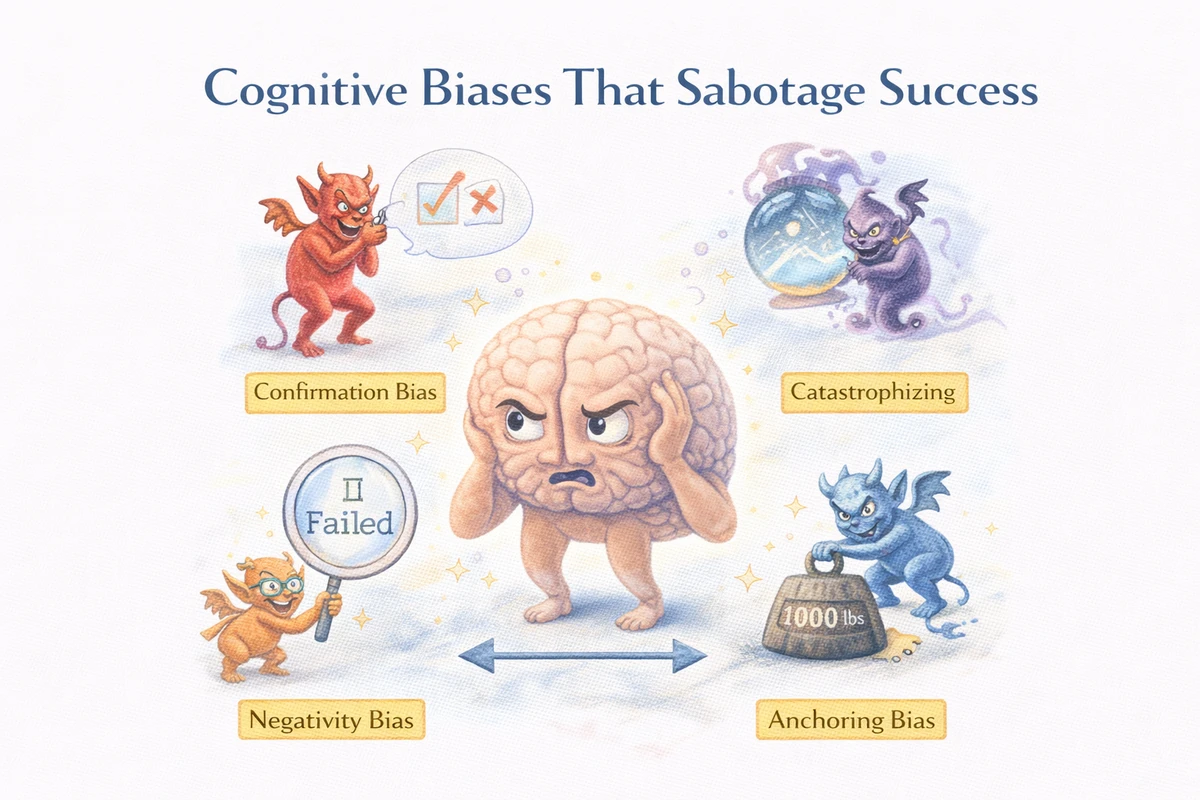
You believe you are thinking clearly. You believe your judgments are based on evidence, your decisions on careful reasoning, your assessments of people and situations on reality as it is. But your brain — the same organ making these confident assessments — is running dozens of automatic shortcuts simultaneously, each one subtly (and sometimes dramatically) distorting what you perceive, what you remember, and what you decide. The people who achieve the most are not those with the fewest biases. They are the ones who have learned to see their biases clearly enough to work around them.
What Cognitive Biases Actually Are
Cognitive biases are systematic patterns of deviation from rational judgment — predictable errors in thinking that arise from the brain's use of mental shortcuts (heuristics) to process information efficiently. They are not signs of stupidity or moral failure. They are the predictable outputs of a brain that evolved to make fast, good-enough decisions under uncertainty, not to perform perfect logical analysis under all conditions.
Daniel Kahneman's work, summarized in Thinking, Fast and Slow, describes two systems underlying human cognition. System 1 is fast, automatic, associative, and largely unconscious — it handles the vast majority of moment-to-moment judgment and decision-making. System 2 is slow, deliberate, effortful, and logical — it is capable of rigorous analysis but is cognitively costly and therefore rarely engaged. Cognitive biases are primarily artifacts of System 1 operating in domains where its shortcuts produce systematically wrong answers.
The problem for success is not the existence of these biases — they are features of all human cognition, including the most brilliant minds in history. The problem is unawareness of them. Research consistently shows that people are far less aware of their own biases than they believe themselves to be, and that simply knowing about a bias in the abstract does surprisingly little to reduce its influence on actual judgment. What works is structural — building decision processes, feedback loops, and checking habits that catch bias-driven errors before they become costly actions.
The Meta-Bias to Know First
The bias blind spot — documented by Emily Pronin and colleagues at Princeton — is the tendency to believe you are less biased than other people. In studies, virtually everyone rates themselves as below average in bias, which is statistically impossible. More troublingly, people who score highest on measures of cognitive sophistication are often better at rationalizing biased conclusions, not worse at being biased. Awareness of your own susceptibility is therefore the prerequisite for everything else in this article.
Confirmation Bias: The Belief Protector
Confirmation bias is the tendency to search for, interpret, favor, and recall information in a way that confirms your preexisting beliefs, while giving disproportionately less attention to information that contradicts them. It is arguably the most consequential cognitive bias for long-term success because it operates across virtually every domain — business decisions, investment judgments, career assessments, relationship evaluations, political views — and because it is self-reinforcing: the longer you hold a belief, the more confirmation you accumulate, making it progressively harder to revise.
The success costs are concrete. Entrepreneurs with confirmation bias build products their market research "confirms" customers want — because they ask questions designed to elicit confirming answers and discount the signals that don't fit. Investors hold losing positions too long because they weight the confirming signals and mentally explain away the disconfirming ones. Managers assess employee performance through the lens of their initial impression, noticing confirming evidence and overlooking data that would update their view.
The Antidote: Active Disconfirmation
The counterintuitive corrective is to actively seek disconfirmation. Before committing to any significant decision, ask: "What would I need to see to conclude I am wrong about this?" Then genuinely look for that evidence. Assign someone on your team the explicit role of devil's advocate — not to be obstructionist, but to ensure that the strongest contrary case is actually articulated and engaged. For individual decisions, practice what Charlie Munger calls "destroying your best-loved ideas" periodically. Learn more about this in our piece on how confirmation bias destroys good decisions.
The Dunning-Kruger Effect: Competence and Confidence
The Dunning-Kruger effect describes a pattern in which people with limited knowledge or skill in a domain tend to overestimate their competence, while people with genuine expertise tend to underestimate theirs relative to their peers. The original 1999 study by David Dunning and Justin Kruger found that participants who scored in the bottom quartile on tests of logical reasoning, grammar, and humor consistently rated their own performance as above average — because they lacked the metacognitive skill to recognize their own errors.
The success implication cuts both ways. Overconfidence in your early knowledge of a domain leads to underprepared action — you stop learning before you've learned enough, take on challenges you're not equipped for, and dismiss expert guidance because you don't yet know enough to know what you don't know. But the less-discussed other side of the Dunning-Kruger pattern — experts underestimating themselves — also has costs: imposter syndrome, reluctance to claim authority, and unnecessary deference to less-qualified voices.
The antidote is calibrated feedback — not self-assessment, which is what the bias distorts, but structured comparison against objective standards and honest input from people more knowledgeable than you. This connects directly to the psychology of impostor syndrome: both overconfidence and underconfidence are products of miscalibrated self-assessment, and both are corrected by the same thing — accurate external feedback processed without defensive distortion.
Overconfidence Costs
Entering domains unprepared and overexposed
Dismissing expert guidance prematurely
Underinvesting in skill development
Making bold commitments before testing assumptions
Underconfidence Costs
Failing to claim deserved authority and opportunity
Excessive deference to less-qualified voices
Chronic impostor syndrome limiting performance
Underselling your work and capability
The Sunk Cost Fallacy: Trapped by the Past
The sunk cost fallacy is the tendency to continue investing in a course of action — time, money, effort, emotional commitment — because of what you have already invested, rather than because of its expected future value. The rational principle is clear: past investments are irretrievable regardless of what you do next, and future decisions should be based entirely on future costs and benefits. In practice, humans systematically violate this principle, staying in failing businesses, bad relationships, and unproductive projects far longer than the evidence warrants because of what they have already put in.
The mechanism is loss aversion — the well-documented finding that losses feel roughly twice as painful as equivalent gains feel good. Abandoning a sunk cost is registered psychologically as a loss, which triggers the disproportionate pain response that makes cutting losses feel worse than it objectively is. The result is the career of someone who spent fifteen years in the wrong field because they had already spent ten, or the business that poured a second million into a failing product because they had already spent the first.
The practical corrective is what Jeff Bezos popularized as "Type 1 vs Type 2 decision" framing, and what Annie Duke calls "resulting" — judging the quality of a decision by the process that produced it, not by the outcome or by what's already been invested. When evaluating whether to continue a course of action, ask: "If I were starting fresh today, with no prior investment, would I choose to begin this?" If the honest answer is no, the sunk cost is the only thing keeping you there — and that is not a valid reason to stay.
The Availability Heuristic: Mistaking Vivid for Likely
The availability heuristic is the tendency to assess the probability or frequency of an event based on how easily an example comes to mind. Events that are recent, emotionally vivid, or frequently reported are judged as more common or likely than events that are statistically more probable but less memorable. The classic demonstration: after reading a list of names with more famous women than men, people judge women as more common on the list — the famous names are more available in memory.
For success, the availability heuristic distorts risk assessment in both directions. It makes rare but vivid failures (startup collapses, investment disasters, high-profile firings) loom larger than their base rates warrant, causing excessive risk aversion in domains where the objective expected value is positive. And it makes common, undramatic failures (chronic underperformance, slow career drift, gradual relationship deterioration) feel less urgent than they are because they generate no vivid, available mental examples.
Media consumption dramatically amplifies availability bias — the news cycle selects for vivid, exceptional events by definition, which systematically distorts your intuitive model of what is common, likely, or dangerous. The corrective is deliberate base-rate thinking: before making a probability judgment, find the actual statistical frequency of the outcome you're assessing rather than relying on how easily you can generate mental examples. This is one of the core moves in mental models for better decision making.
Attribution Errors: How You Explain Success and Failure
Attribution biases concern how you explain the causes of events — especially successes and failures. Two are particularly damaging for long-term growth. The fundamental attribution error is the tendency to over-attribute other people's behavior to their character or disposition ("she's lazy," "he's arrogant") while under-weighting situational factors — and to do the reverse for yourself. The self-serving attribution bias is the tendency to attribute your successes to internal factors (your skill, effort, intelligence) and your failures to external factors (bad luck, unfair circumstances, other people's failures).
The self-serving bias is particularly insidious for growth because accurate self-assessment requires the opposite pattern: crediting external factors for some successes (luck matters, and denying it blinds you to how much of your position is replicable) and taking ownership of failures (the only failures you learn from are the ones you honestly attribute to something you did or failed to do). Leaders with uncorrected self-serving bias build teams of yes-men, because accurate feedback is threatening, and organizations that don't learn from failure.
The corrective practice is what Carol Dweck's growth mindset research points toward: treating outcomes — both good and bad — as primarily informative about your process, not as reflections of your fixed worth. Ask after each significant outcome: "What specifically did I do that contributed to this result?" Apply the question equally to successes and failures, and compare your honest assessment against outside perspectives. The growth mindset framework is partly a systematic corrective to self-serving attribution.
Status Quo Bias: The Hidden Cost of Inaction
Status quo bias is the preference for the current state of affairs — the tendency to perceive any change from the baseline as a loss, even when the expected value of the change is clearly positive. It is driven by loss aversion (changing means risking a loss; staying means avoiding that risk) combined with omission bias (harms caused by inaction feel less morally weighty than equivalent harms caused by action, even when the outcomes are identical).
Status quo bias is one of the primary mechanisms of career stagnation. People stay in roles, organizations, and industries that have stopped growing them because the discomfort of change is vivid and proximate while the cost of not changing is abstract and gradual. They maintain habits, relationships, and beliefs that no longer serve them because changing would require acknowledging that the current state isn't good enough — and the brain registers that acknowledgment as a loss.
The corrective reframe is to make the status quo a conscious choice rather than a default. Ask: "If I were not already doing this, would I choose to start?" If the answer is no, the status quo is being maintained by inertia and loss aversion, not by genuine preference. This is the same logic underlying Bezos's regret minimization framework — projecting to your eighty-year-old self and asking which you would regret more: trying and failing, or not trying. Read more on this in our piece on the regret minimization framework.
The Planning Fallacy: Why Everything Takes Longer
The planning fallacy, identified by Kahneman and Tversky, is the tendency to underestimate the time, costs, and risks of future actions while overestimating the benefits — even when you have clear evidence from past experience that similar projects took longer and cost more than planned. It is why virtually every large construction project runs over budget, why software ships late, why your personal projects take three times as long as you estimated, and why people chronically over-schedule their days.
The mechanism is a failure to use the "outside view" — the statistical base rate of how long similar tasks have historically taken — in favor of the "inside view" — a detailed mental simulation of this specific plan, which focuses on the best-case scenario and fails to adequately account for unexpected complications. When you plan a project by imagining the steps, you imagine each step going right. In reality, some steps will hit obstacles, some dependencies will be delayed, and some problems won't be foreseeable until you encounter them.
The evidence-based corrective is reference class forecasting: before estimating how long something will take, find the base rate for similar projects and anchor your estimate there. Then adjust for specific features of your situation that genuinely differentiate it from the average. This systematic approach — used in large infrastructure planning and increasingly in software development — consistently outperforms intuitive estimation. At the personal level, a simple rule of thumb: multiply your intuitive time estimate by 1.5 to 2 for tasks under a week, and by 2 to 3 for projects over a month.
The Pre-Mortem Technique
One of the most effective tools against both the planning fallacy and overconfidence is the pre-mortem, developed by psychologist Gary Klein. Before launching a project or making a major decision, imagine it is one year in the future and the project has failed catastrophically. Then work backwards: what went wrong? This prospective hindsight technique reliably surfaces risks and failure modes that forward planning misses, because it bypasses the optimism bias that distorts forward-looking analysis. Learn more in our piece on the mental models for better decisions.
Negativity Bias: Why Bad Outweighs Good
Negativity bias is the asymmetric weighting of negative information relative to positive information of equal objective magnitude. Bad events, bad feedback, bad experiences, and bad impressions have greater psychological impact than equivalent good ones — they are processed more thoroughly, remembered longer, and given more weight in judgment. The research finding that losses hurt about twice as much as equivalent gains feel good is a specific instance of this broader negativity asymmetry.
For success, negativity bias distorts performance assessment (one piece of critical feedback outweighs five pieces of positive feedback, even when the positive is more accurate), relationship perception (a single bad interaction can overwhelm months of positive ones), and risk evaluation (potential losses dominate the decision calculus even when expected value strongly favors action). It also drives excessive risk aversion in entrepreneurship and investing — the vivid pain of a potential loss prevents action that the objective expected value would clearly warrant.
The corrective is not to ignore negative information — it often contains more signal per unit than positive feedback, which is why the bias evolved. The corrective is to consciously recalibrate the weighting. When you receive negative feedback, ask: "Is this disproportionately affecting my overall assessment relative to its actual signal value?" When evaluating a risk, ask: "Am I weighting the potential downside at roughly twice the emotional intensity I'm giving the equivalent upside, and is that weighting justified by the actual probabilities?" Building a deliberate gratitude and positive evidence practice — not as mere positivity, but as a systematic recalibration of negativity-biased attention — has genuine evidence behind it for improving both performance and wellbeing.
A System for Overcoming Your Cognitive Biases
Reading about biases does not reliably reduce them. What works is building structural habits that catch bias-driven errors at the moment of decision, before they become costly actions. Here is a practical system:
Action Steps
- Build a decision journal. For every significant decision, record your reasoning, your assumptions, your predicted outcomes, and the key evidence you considered. Review entries after six to twelve months. This practice — used by serious investors and leaders like Ray Dalio — is the most powerful tool for catching systematic patterns in your own biased reasoning, because it creates an honest record that your memory cannot retroactively rewrite. A simple notebook or a dedicated notes app works.
- Institutionalize the outside view. For any plan involving time, cost, or probability estimates, find the base rate before forming your intuitive estimate. How long do similar projects actually take? What percentage of similar ventures succeed? What does historical data say about this type of investment? The outside view is uncomfortable because it replaces flattering intuition with impersonal statistics — but it is consistently more accurate.
- Create a personal bias checklist for major decisions. Identify the four or five biases you know you are most susceptible to — confirmation bias, sunk cost, status quo, planning fallacy, and availability heuristic are the most common starting points — and build a short checklist you run through before any significant commitment. The checklist format, used in aviation, surgery, and investing, converts abstract bias awareness into actionable in-the-moment interruption.
- Cultivate a trusted truth-teller. Identify one or two people in your life who have demonstrated both the willingness to disagree with you and the judgment to do so usefully. Structure your relationship with them to include regular honest input on your major decisions and your self-assessments. External perspectives are the most reliable corrective for the self-serving biases that internal reflection cannot catch.
- Separate the decision from the outcome. Train yourself to evaluate the quality of a decision based on the process and information available at the time, not on how it turned out. This is not a self-exculpation tactic — it is a calibration tool. Outcome-based evaluation reinforces the self-serving bias (good outcomes confirm your genius; bad outcomes were bad luck) and prevents the honest process analysis that actually improves future decision quality. As Annie Duke argues in Thinking in Bets, good decisions sometimes produce bad outcomes, and bad decisions sometimes produce good outcomes — the two are far less correlated than intuition suggests.
- Practice inversion on your major beliefs. Periodically — quarterly or annually — pick your most consequential held beliefs about your career, your strategy, your relationships, and ask: "What is the strongest case that I am wrong about this?" Don't just gesture at the exercise — actually construct the argument as thoroughly as you can. The beliefs that survive genuine inversion are ones you can hold with more confidence; the ones that collapse under it are the ones your confirmation bias has been protecting. Learn more about this approach in our piece on the inversion mental model.
The Compound Return on Debiasing
Each of the practices above produces modest improvement on any single decision. The compounding effect is what makes them worth the investment. A person who systematically catches bias-driven errors in their reasoning makes slightly better decisions every week — better hires, better career moves, better risk assessments, better relationship choices — and over a decade, the accumulation of those marginally better decisions produces dramatically different outcomes from someone of equivalent raw intelligence who never bothered. Bias reduction is not glamorous. But it may be the highest-ROI cognitive investment available to anyone serious about long-term achievement. For a recommended foundation, Think and Grow Rich is a classic starting point, and Annie Duke's Thinking in Bets is the best modern practical guide to debiasing your decisions.
Conclusion: The Most Dangerous Biases Are the Ones You're Confident You Don't Have
The eight biases covered here — confirmation bias, Dunning-Kruger, sunk cost fallacy, availability heuristic, attribution errors, status quo bias, planning fallacy, and negativity bias — are not an exhaustive list. Researchers have catalogued over 180 documented cognitive biases. But these are the ones with the clearest, most consistent, and most consequential effects on the decisions that shape careers, businesses, and lives.
The goal is not to eliminate bias — that is neurologically impossible. The goal is to build sufficient metacognitive awareness and structural safeguards that your biases distort your most important decisions less than they would otherwise. That is a reachable goal, and the research suggests it is one of the highest-leverage investments you can make in your own performance. The people who consistently make better decisions are not smarter — they are more systematically honest about the ways their thinking goes wrong.
Start with the decision journal. The rest builds from there.
Your First Step This Week
Open a notes app or notebook and create your decision journal today. Record one current significant decision you're facing: what you're deciding, what assumptions you're making, what evidence you're weighing, and what your gut is telling you. Then run through the five bias questions: Am I avoiding disconfirming evidence? Am I over- or underestimating my competence here? Am I being held by sunk costs? Am I planning optimistically without a base-rate check? Am I letting a vivid example distort my probability estimate? This single exercise will reveal more about your thinking patterns than a month of reading about cognitive biases.
Further Reading
📚 Recommended Reading


Affiliate links — we may earn a small commission at no extra cost to you.