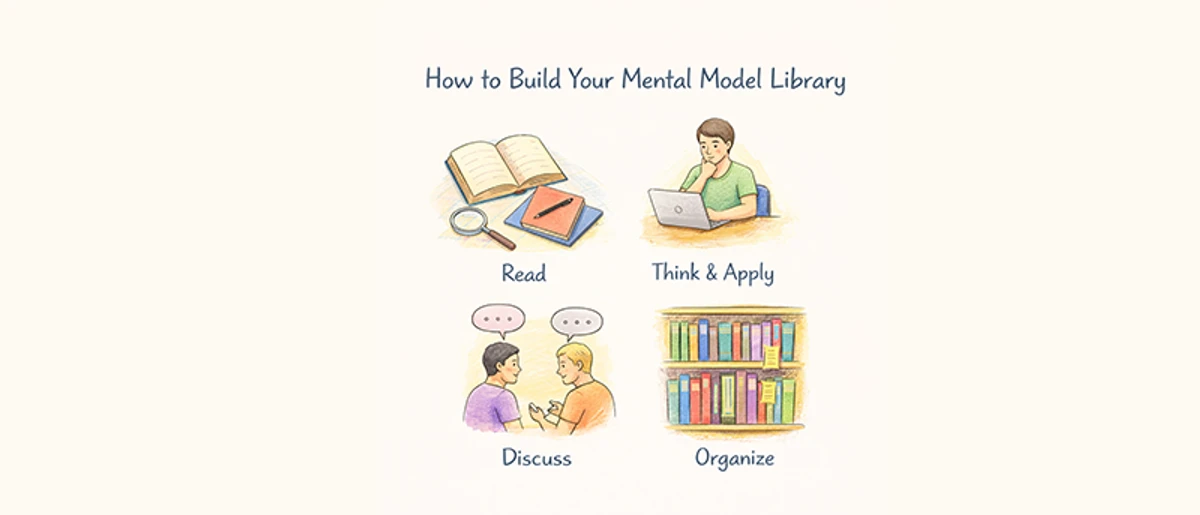
Reading about mental models is not the same as having them. The gap between encountering a framework and actually using it under pressure — when a decision is urgent, stakes are real, and your first instinct is already pulling you in a direction — is where most mental model education fails. This guide is about closing that gap: building a library that actually gets used, that compounds over time, and that changes how you think rather than just what you know.
Why a Library, Not a List
Most treatments of mental models present them as lists — "here are 15 mental models you should know," "the top 10 thinking frameworks of great investors." Lists are useful for discovery. They're poor formats for building usable knowledge, because lists suggest that models are independent items to be collected rather than interconnected tools to be woven into a coherent thinking framework.
A library is different. In a library, books are organized, related to each other, and retrievable when needed. You know what you have, where it is, and when to use it. A mental model library has the same properties: models are organized by domain and application, understood in their relationships to each other, and retrievable when the situation calls for them. The library metaphor also captures something important about ongoing curation: books get added, some get referenced more than others, and occasionally a book gets removed because it's been superseded by better knowledge.
The Difference That Matters
Someone with a list of 50 mental models they've read about has an index. Someone with a library of 15 models they genuinely understand, can explain without reference material, have tested against real decisions, and can retrieve automatically in relevant situations has genuine thinking capital.
Munger's latticework — explored in depth in the Charlie Munger article — is a library, not a list. Each model is understood, connected to others, tested against decades of real decisions, and available without conscious retrieval effort. The library took 70 years to build. The principles of how it was built are available immediately.
Acquiring Mental Models: Where They Come From
Mental models come from three sources: reading, experience, and deliberate synthesis. Each contributes differently and has different strengths and weaknesses as an acquisition mechanism.
Reading: Broad Exposure, Shallow Encoding
Reading is the most efficient mechanism for initial exposure to mental models. A well-written book on a discipline can introduce a dozen important models in the time it takes to have a few real-world experiences in that domain. The limitation is encoding depth: reading about a model is not the same as understanding it, and understanding is not the same as automatic retrieval under pressure.
The reading that produces usable mental models is not passive consumption — it is active engagement. Reading with the explicit intention of identifying the models being presented, writing them down in your own words, generating examples outside the book's context, and connecting them to models you already have is qualitatively different from reading for information. The Feynman Technique is the right reading companion: after encountering a new model, close the book and try to explain the model plainly. Where you can't, you've found the gap.
Experience: Deep Encoding, Slow Accumulation
Direct experience of a model's operation — seeing confirmation bias distort a team's strategic analysis, experiencing the compounding return of a daily habit over years, watching a business fail because the flywheel never started spinning — encodes the model at a depth that reading alone cannot match. The embodied experience creates multiple retrieval routes and emotional anchors that make the model available automatically in similar future situations.
The limitation is speed: direct experience is slow and often expensive. You can read about the sunk cost fallacy in 20 minutes; experiencing it viscerally enough to make the lesson permanent may require years of watching money get thrown after bad decisions before the lesson becomes automatic. Vicarious experience — studying the experiences of others through biography, history, and case studies — partially bridges this gap, particularly when the vicarious experience is studied with enough attention to the details that make it feel real.
Deliberate Synthesis: The Latticework Work
The third acquisition mechanism is the most important and least common: deliberately synthesizing models from different domains by identifying their structural similarities and differences. This is the work Munger did when he recognized that evolution and competitive advantage are structurally analogous, or that critical mass in physics and network effects in business are the same underlying phenomenon in different domains.
Deliberate synthesis creates new nodes in the library that don't exist in any single source — connections between models from different fields that reveal aspects of reality visible only from the intersection. It requires both breadth (knowing enough models from enough domains to notice potential connections) and depth (understanding each model well enough to identify genuine structural similarities rather than superficial analogies).
Depth Before Breadth: The Right Acquisition Order
The most common mistake in building a mental model library is optimizing for breadth — collecting as many models as possible — rather than depth. A large collection of shallowly understood models is worse than a small collection of deeply understood ones, because shallow models are unreliable guides that fail exactly when they're most needed: in novel, high-stakes, time-pressured situations.
The correct acquisition order: master a small set of foundational models deeply before adding more. Foundational models are those that apply across the widest range of domains and produce the highest leverage across different types of decisions. With a solid foundation, each new model connects to existing ones and becomes useful faster; without it, new models accumulate without integration.
What Deep Understanding Looks Like
You deeply understand a mental model when you can:
✓ Explain it clearly to someone with no background using only plain language
✓ Generate multiple examples from different domains without prompting
✓ Identify the model's limits — where it applies and where it doesn't
✓ Connect it to at least three other models in your library
✓ Recall and apply it automatically when you encounter a relevant situation, without having to consciously think "which model applies here?"
Signs of Shallow Understanding
You only shallowly understand a model when you:
✗ Can define it only by repeating the definition you read
✗ Can give examples only from the original source material
✗ Cannot specify what evidence would falsify or limit it
✗ Cannot connect it to other models in your library
✗ Would not spontaneously apply it in a real situation without being prompted to think about mental models
The depth-before-breadth principle applies at the library level too: it's better to have 10 deeply understood models that you genuinely use than 100 shallowly understood ones that you recognize when presented but never deploy. The 10 deep models compound; the 100 shallow ones don't.
Testing Models Against Reality
A model that has never been tested against real decisions is a hypothesis, not knowledge. The testing phase — applying models to actual situations and tracking whether their predictions prove accurate — is what converts reading into usable mental equipment. It is also the most commonly skipped step in mental model education.
The Prediction Journal
The most direct testing mechanism is the prediction journal: before making significant decisions, write down explicitly which models you are applying, what predictions those models make about likely outcomes, and what you would need to observe to conclude the models had been validated or falsified. Review the journal periodically to see where models proved reliable and where they failed.
The prediction journal serves multiple functions simultaneously. It forces explicit model application rather than post-hoc rationalization. It creates a feedback loop that calibrates model reliability over time. It reveals the domains where your library is strongest and weakest. And it creates the conditions for genuine model updating — because you've committed to specific predictions, you cannot as easily explain away disconfirming outcomes. This is the same mechanism that makes Philip Tetlock's superforecasters more accurate: accountability to specific predictions produces calibration that unconstrained judgment never achieves.
The Post-Decision Review
After significant decisions play out — especially bad ones — conduct a structured review focused on which models you applied, which ones you should have applied but didn't, and what about the situation was different from how your models represented it. The bad decisions are where the most learning lives, because the gap between model prediction and actual outcome is widest there.
The most useful question in a post-decision review: "Was there a model I know that would have predicted this outcome, and if so, why didn't I apply it?" The answers typically fall into three categories: you didn't have the model (acquisition failure), you had it but didn't recognize the situation as the model's domain (retrieval failure), or you recognized the situation but didn't act on the model because other factors overrode it (application failure). Each failure mode has different remedies.
The Weekly Model Test
Each week, choose one model from your library and identify two or three situations from the week where it applied — either situations where you used it effectively, situations where you should have used it but didn't, or situations where using it produced a wrong prediction. The weekly review builds the habit of model application and surfaces retrieval failures before they become a pattern.
Organizing Your Library for Retrieval
A model that's in your library but can't be retrieved when needed is no more useful than a model you never learned. Organization is the infrastructure of retrieval — and good organization enables the automatic, contextually-triggered application that characterizes genuine expertise.
Organization by Application Domain
The most practically useful primary organization is by application domain: decision-making models, cognitive bias models, system and complexity models, human behavior models, financial and economic models, strategy models. Within each domain, models are ordered from most to least foundational — the models that underlie the others in the domain come first.
This organization makes library retrieval context-sensitive: when you're facing a decision, you scan the decision-making domain. When you're analyzing a market, you scan the economic and strategy domains. The domain-based organization matches the way situations present themselves, making retrieval faster and more reliable than alphabetical or chronological organization.
The Connection Map
Beyond single-domain organization, a connection map — a visual representation of how models in different domains connect to each other — supports the latticework function of the library. When a new situation requires thinking across domains, the connection map surfaces relevant models from non-obvious places.
Building the connection map is itself a learning activity: drawing the connections forces you to articulate why two models from different domains are related, which deepens understanding of both. The map becomes denser as the library grows, and the denser it is, the more insights emerge from model intersections.
Trigger-Based Organization
A complementary organization approach: for each model, identify the situations that should trigger its application. What phrases, patterns, or circumstances should make this model come to mind? The trigger list is a retrieval mechanism that works at the pre-conscious level: when you recognize a situation as matching a trigger, the relevant model surfaces automatically.
For example, triggers for the survivorship bias model: "I'm drawing conclusions from examples," "This seems like a consensus view based on visible successes," "Everyone is citing the same successful cases." When any of these phrases or patterns arise, the survivorship bias model should automatically surface as a relevant check.
The Application Practice: Using Models Under Pressure
The most important capability a mental model library can develop is automatic application under pressure — the ability to apply relevant models in real-time during actual decisions, when time is limited, emotions are engaged, and the first instinct is already active. This capability requires deliberate practice, not just knowledge accumulation.
The Slow Practice
Deliberate practice for model application begins slowly, with low-stakes situations where there's time for reflection. Taking 15 minutes at the end of each day to review decisions made and identify which models were relevant — even retroactively — builds the recognition patterns that eventually enable real-time application. The slow practice teaches the mind which models apply in which types of situations, creating the associative networks that make automatic retrieval possible.
The Pre-Mortem Protocol
For significant upcoming decisions, run a structured pre-mortem that explicitly cycles through your most important models: what does inversion say about this decision? What does second-order thinking reveal about downstream consequences? Where is confirmation bias most likely to be distorting the analysis? Is there a survivorship bias in the evidence I'm drawing on? What is the opportunity cost of this choice?
The structured pre-mortem builds the habit of multi-model analysis for important decisions and gradually makes the cycle automatic for less important ones. As the structured practice consolidates, the deliberate model-by-model cycling accelerates until it happens in the time available rather than requiring dedicated analytical sessions.
The Two-Minute Model Scan
For decisions that don't warrant a full pre-mortem but are important enough to benefit from structured thinking, a two-minute model scan is practical: identify the most relevant domain (decision-making, human behavior, systems, strategy), recall the two or three most applicable models from that domain, and run each one quickly against the decision. The scan takes two minutes when the models are genuinely internalized and much longer when they're not — which makes the time required for the scan a reliable indicator of how well the library is actually internalized.
Updating and Retiring Models
A library that only adds and never removes or updates becomes cluttered with outdated and superseded knowledge. Part of library maintenance is the honest assessment of which models are proving unreliable, which have been superseded by better models, and which are being systematically misapplied in ways that make them net negative contributions.
When to Update a Model
Update a model when your prediction journal shows consistent divergence between model predictions and actual outcomes in a specific domain, when new research or evidence reveals systematic errors in the model's assumptions, or when you discover a more accurate version of the same model that incorporates additional relevant factors.
Updating a model is not the same as abandoning it. Most updates are refinements — adding nuance about the model's limits, adjusting the confidence level in its predictions in specific domains, or incorporating a new variable that the original formulation didn't account for. The map-territory principle applies: as your experience of the territory improves, the map should be updated to reflect that improved knowledge.
When to Retire a Model
Retire a model when it produces more errors than correct predictions in its intended application domain, when it has been entirely superseded by a more accurate model that covers the same terrain, or when you realize that what you thought was a general model is actually a domain-specific heuristic that doesn't transfer.
Retiring a model requires the intellectual honesty that confirmation bias actively resists. Models become part of identity — you've recommended them to others, you've made decisions based on them, you've built your analytical framework around them. Retiring one feels like admitting a mistake rather than updating a tool. The distinction matters: tools are updated when better tools become available; identity commitments are defended regardless of evidence. Mental models should be tools.
The Essential Starting Library
For anyone building a mental model library from scratch, here is the most important starting set — the foundational models that provide the highest leverage across the broadest range of domains. Master these deeply before expanding.
Thinking & Decision Making
Inversion — think backwards before thinking forwards; what would guarantee failure?
Second-order thinking — what happens after what happens next?
First principles — what is genuinely true, stripped of assumptions?
Circle of competence — where does your genuine understanding end?
Occam's Razor — prefer the simplest sufficient explanation
Map vs. territory — your model is not the reality it represents
Human Behavior & Bias
Confirmation bias — you seek what confirms, discount what challenges
Survivorship bias — the failures aren't in your sample
Hanlon's Razor — incompetence before malice
Regret minimization — what would your 80-year-old self choose?
Systems & Leverage
Compounding — small consistent inputs become large outputs over time
Pareto principle — 80% of results from 20% of inputs
Opportunity cost — every choice eliminates every other choice
Skin in the game — who bears the consequences?
Applied Domains
Investing models — Mr. Market, margin of safety, economic moat
Business models — JTBD, flywheel, unit economics
Relationship models — trust account, Four Horsemen, bids for connection
This starting library of approximately 15-20 core models, understood deeply and applied consistently, will produce more value than a superficial familiarity with 200 models. The depth is the investment that produces compounding returns; the breadth comes naturally as the deep foundation makes each new model easier to connect and integrate.
The Compounding Return of the Library
A mental model library, properly built and maintained, compounds in the same way that financial capital compounds — except faster, because each new model adds value not just linearly but through the connections it creates with existing models. The 20th model in a rich library is worth more than the 20th model in an empty one, because it connects to 19 existing models and creates new insights from each connection. The 50th model in a rich library is worth more than the 20th, because the richer the existing structure, the more valuable each addition.
This compounding is visible in the trajectory of people who build genuine mental model libraries. Early progress is slow and effortful — each new model requires significant work to understand and integrate, and the connections to other models are few. As the library grows, integration accelerates — new models connect to more existing ones more quickly, insights emerge from intersections more readily, and application becomes more automatic. Eventually the library reaches a state of self-reinforcing richness where encountering a new idea immediately surfaces relevant connections across multiple domains.
The 20-Year Library
Munger's latticework took 70 years to build because it started from almost nothing and was built one book, one experience, and one deliberate synthesis at a time. Someone starting today with the explicit intention of building a latticework — reading the right books, applying the Feynman test to each new model, building the connection map, maintaining the prediction journal — could build a qualitatively different library in 10-20 years than someone who reads widely but never builds the structure.
The 20-year library is not a consolation prize for not starting earlier. It is the most valuable intellectual investment available to anyone with 20 years ahead of them — which is most people reading this. The compounding starts on day one. The steeper part of the curve arrives faster than intuition suggests, because the early models are foundational and the connections accumulate faster than the models themselves.
The Practice That Makes It Real
The library is built by practice, not by intention. The specific practices that build it:
Action Steps
- One new model per week, understood deeply. Apply the Feynman test, generate examples, find connections to existing models, add it to the library with triggers and connections noted.
- Daily decision review. At the end of each day, identify one decision you made and ask which models were relevant — whether or not you applied them consciously.
- Weekly model test. Choose one model from your library and find situations from the week where it did or should have applied. Note where the model's prediction was accurate and where it was off.
- Monthly pre-mortem for major commitments. Run the structured model scan — inversion, second-order, confirmation bias check, opportunity cost — before any significant decision or commitment.
- Annual library audit. Review the full library: which models are you actually using? Which predicted well over the year? Which didn't? Which need updating? What's missing that you kept wishing you had?
These practices together constitute the maintenance system that keeps a mental model library alive and compounding rather than becoming an impressive-sounding inventory that gets consulted occasionally and forgotten the rest of the time. The goal is not to have a library. It is to be the library — to think through these frameworks automatically, to see situations through multiple relevant lenses simultaneously, to be the kind of person whose judgment people trust precisely because it is deep, calibrated, and continuously updated.
That is what Munger built over 99 years. The same architecture is available to anyone willing to do the building. The articles in this Mental Models series — from first principles through inversion, compounding, circle of competence, cognitive biases, the domain-specific applications for investing, business, and relationships, and everything in between — are the threads. This article is the instruction for weaving them together. The rest is the work.


